Key takeaways
- The short answer: NAV lending is a loan to a private equity fund secured on the net asset value (NAV) of the companies it already owns. Funds use NAV loans late in their life, mostly to back portfolio companies, refinance debt or return cash to investors.
- Typical terms: most primary NAV loans close at a loan-to-value (LTV) under 25%, pay 4–5% over SOFR and run for five years, by Proskauer's survey of the 2025 market.
- Market size: Oaktree put NAV finance at about $44B in 2023, $70B+ in 2025 and $145B by 2030.
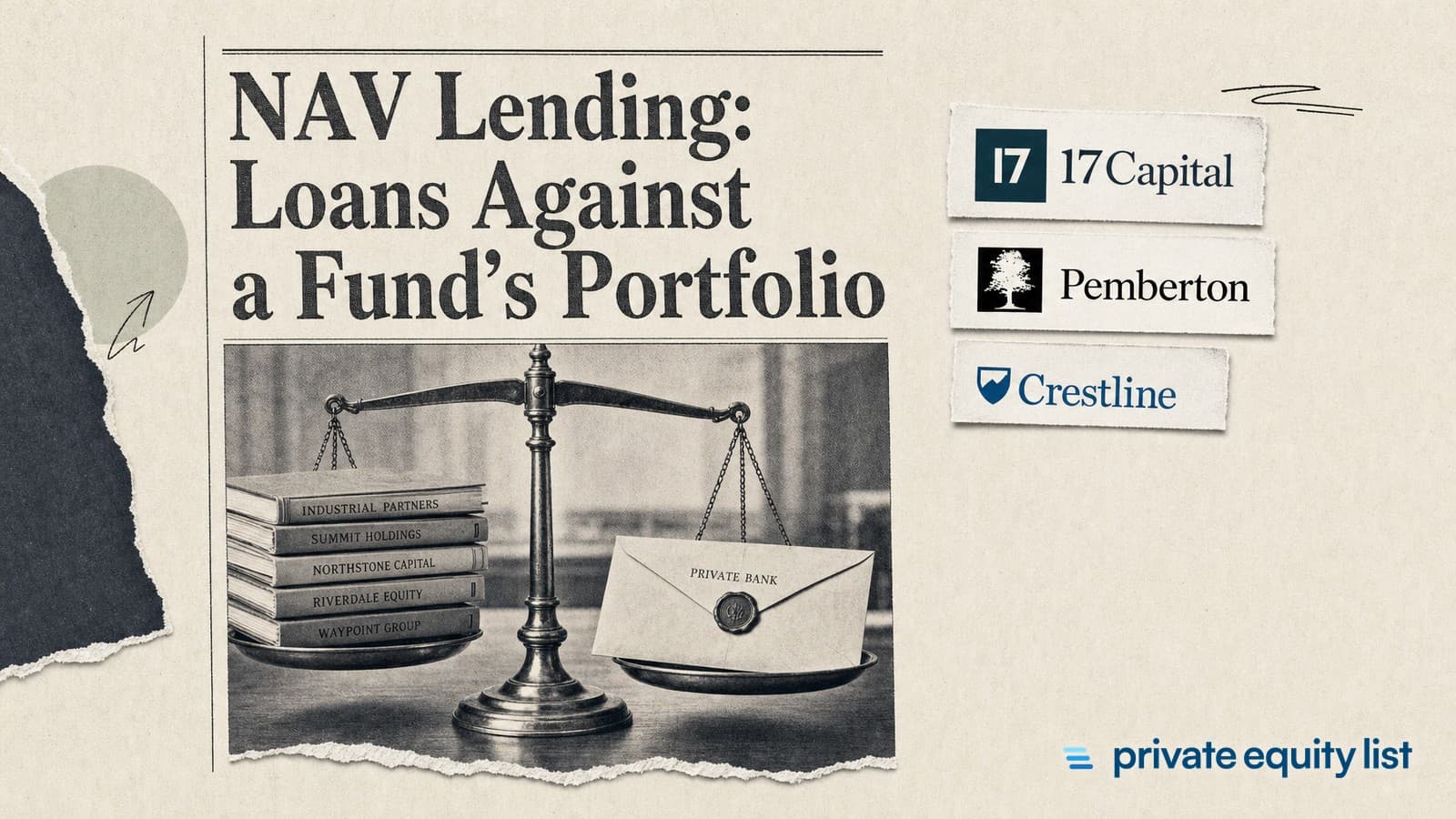
- Who lends: specialist funds (17Capital, Hark Capital, Nodem Capital), private credit managers (Pemberton, Arcmont, Crestline, Carlyle AlpInvest) and banks such as HSBC.
- Biggest fund: 17Capital closed Credit Fund 2 at about $7.5B in March 2026, the largest NAV loan fund raised so far.
- The catch: ILPA asks managers to get LP advisory committee consent before a NAV loan and to count it inside the fund's borrowing limit.
| Under 5% | 23 | 23.0% |
|---|---|---|
| 5–10% | 32 | 32.0% |
| 10–25% | 36 | 36.0% |
| 25%+ | 9 | 9.0% |
Source: Proskauer NAV financing survey, full year 2025
| Follow-on investments | 45 | 45.0% |
|---|---|---|
| Portfolio company debt | 19 | 19.0% |
| Payouts to investors | 7 | 7.0% |
| Mixed uses | 22 | 22.0% |
| Other | 7 | 7.0% |
Source: Proskauer NAV financing survey, full year 2025
What is NAV lending: a loan against a fund's portfolio
Definition: a NAV loan, also called a NAV facility or NAV financing, is debt taken by a private equity fund and secured on the value of its portfolio. The lender looks at the companies the fund owns, not at the investors' unpaid commitments.
Who borrows: buyout funds are the largest group of borrowers, by Proskauer's 2025 survey. Growth, infrastructure, credit and secondaries funds use NAV loans too.
When: once most of the money is invested and the portfolio has a value to borrow against, so in the middle and later years of a fund.
Collateral: a pledge over the fund's cash accounts and distributions, often with a pledge of the shares of the holding company or SPV that owns the portfolio.
Repayment: cash from exits and dividends goes to the lender first through a cash sweep, so most NAV loans are repaid well before their stated maturity.
How NAV loans work: LTV, pricing, cash sweep and maturity
Loan-to-value: 91% of primary NAV loans closed below 25% LTV in 2025, and the largest group sat at 5–10%. Callan puts the typical LTV against a single primary private equity fund at 10–20% (Callan).
Pricing: the most common spread was 4–5% over three-month Term SOFR, with 31% of facilities below 4%. Rede Partners sees most deals at a margin of 4–7% and says pricing may now turn up (Rede Partners, 2026).
Fees: upfront fees or original issue discount ran at 1–2% on most deals; 33% of respondents reported 1–1.5%.
Maturity: five years in 45% of primary facilities; three to five years covers most of the market.
Cash sweep: 63% of primary NAV loans sweep distributions at a rate tied to the LTV, and 21% use a fixed sweep. Only 16% have none.
Minimum return to the lender: about half of deals carry no minimum multiple on invested capital; where there is one, it is usually under 1.15x.
Facility size: $100–250M is the most common primary facility; secondaries funds borrow more, often $250M and above.
| Term | Primary NAV loans | Secondaries NAV loans |
|---|---|---|
| Closing LTV | Mostly under 25%; 5–10% most common | 25–50% for 57%; 50–75% for the rest |
| Spread over SOFR | 4–5% most common; 31% below 4% | Under 3% for 67% |
| Upfront fee or OID | 1–2% on most deals | Under 1.5% |
| Maturity | 5 years for 45% | 5 years for 69% |
| Lenders per deal | 2–3 lenders for 44%; bilateral for 39% | More than 3 lenders for 38% |
| Main use | Follow-on investments (45%) | Buying portfolios (58%) |
All figures in the table are from Proskauer's survey of the 2025 NAV financing market.
NAV lending market size: $44B in 2023, $145B by 2030
| $44B | $70B | +107.1% on 2025$145B |
| 2023 | 2025 | 2030 |
|---|
Source: Oaktree estimates, reported by Preqin
Oaktree's estimate: about $44B in 2023, more than $70B in 2025 and $145B by 2030 (Preqin). Oaktree owns a majority of 17Capital, the largest specialist NAV lender.
Smaller base, other counts: Callan put the market at about $50B, roughly 1% of a $5 trillion private equity market, and expects about $150B by 2030 (Callan).
Why it grows: exits are slower, so funds hold companies longer and need cash for follow-on deals and investor payouts. 80% of lenders and borrowers in Proskauer's survey expect more NAV deals in 2026.
Banks are gaining: Rede Partners finds banks' median NAV deal size has tripled, while deal sizes at alternative lenders have stayed flat.
Largest NAV lending funds: 17Capital, AlpInvest, Pemberton and Crestline
 17Capital Credit Fund 2 (2026) | |
|---|---|
 AlpInvest Strategic Portfolio Finance Fund II (2025) | |
| 17Capital Credit Fund (2022) | |
 Pemberton NAV Financing Core Fund I (2025) | |
 Crestline Portfolio Finance Sentry (2025) | |
 HSBC NAV Financing Partnership, first round (2026) | |
| Crestline Portfolio Financing Fund II (2022) | |
 Hark Capital Fund IV (2024) |
Source: Private Equity List database and fund announcements
- 17Capital closed Credit Fund 2 at about $7.5B in March 2026, more than double the $2.9B of its first credit fund in April 2022 (Alternative Credit Investor). It has lent more than $7.5B across 30 NAV loans and raised about $24B since 2008.
- 17Capital also closed Strategic Lending Fund 6 at about $5.5B in July 2025 (17Capital). That fund lends to the management companies of private equity firms, for larger GP commitments, growth and succession, so it is GP financing, not NAV lending.
- Carlyle AlpInvest closed Strategic Portfolio Finance Fund II at $3.2B in June 2025, more than three times its first fund (press release). It lends to private equity funds, GPs and LPs, and in December 2024 teamed up with Mubadala on NAV financing (Dakota).
- Pemberton reached its $1.7B target for NAV Financing Core Fund I, its first, in September 2025 (Alternative Credit Investor). A subsidiary of ADIA anchored the first close of more than $1B (Alternative Credit Investor).
- Crestline raised $1.7B of investable capital, including expected leverage, for Portfolio Finance Sentry, its third NAV fund, in May 2025 (Alternative Credit Investor). Its earlier Portfolio Financing Fund II closed at $1B in January 2022.
- HSBC Asset Management raised $1B in the first round of its NAV Financing Partnership strategy in June 2026, with insurers and pension funds as anchors (Alternative Credit Investor). Fundraising runs into 2027.
- Hark Capital, a New York NAV lender owned by Ridgepost Capital (formerly P10), closed Fund IV with $645M of commitments in July 2024 (GlobeNewswire). It lends to middle-market private equity sponsors and has deployed more than $2B with over 60 of them; a $50M NAV facility to Pharos Capital Group in 2025 is typical (National Law Review).
NAV lenders to know in 2026
| Lender | HQ | Type | What it provides |
|---|---|---|---|
| 17CapitalLondon NAV finance specialist founded in 2008, majority-owned by Oaktree since 2022. | London | Specialist NAV fund | NAV loans and strategic lending to private equity funds; Credit Fund 2, $7.5B |
| Carlyle AlpInvest | New York | Private markets manager | Portfolio finance for funds, GPs and LPs; Strategic Portfolio Finance Fund II, $3.2B |
| Pemberton | London | Private credit manager | NAV loans secured on pools of portfolio companies; NAV Financing Core Fund I, $1.7B |
| Crestline Investors | Fort Worth | Alternative credit manager | NAV loans to private equity and private asset funds; Portfolio Finance Sentry, $1.7B |
 Arcmont Asset Management | London | Private credit manager | NAV financing next to direct lending and capital solutions; raising its first dedicated NAV fund (PDI) |
| HSBC Asset Management | London | Bank-owned manager | Investment-grade NAV loans to private equity funds in Europe and Asia, with HSBC Bank |
 Nodem CapitalFCA-regulated lender against portfolios of family offices, fund managers, LPs and holding companies. | London | Specialist NAV lender | NAV facilities of $10M to $100M+, with payment-in-kind interest options |
| Hark Capital | New York | Specialist NAV fund | NAV loans to middle-market private equity funds; Fund IV, $645M |
 MidCap Financial | Bethesda | Commercial finance lender | Fund finance alongside asset-based and sponsor lending |
 Oaktree Capital Management | Los Angeles | Credit manager | Majority owner of 17Capital; publishes the most cited NAV market estimates |
Specialist funds: 17Capital, Hark Capital and Nodem Capital lend only against portfolios; Nodem also lends to family offices, LPs and holding companies.
Private credit managers: Pemberton, Arcmont and Crestline run NAV lending as one strategy next to direct lending. Their funds draw on the same pension, insurance and sovereign money; see private credit funds and firms for the wider list.
Banks: HSBC and other banks lend at lower spreads to large, diversified funds with low LTVs. Rede Partners finds bank deal sizes rising fastest.
Who backs the lenders: sovereign funds sit behind several NAV programmes, from ADIA in Pemberton's first close to Mubadala's partnership with AlpInvest. More in largest sovereign wealth funds.
NAV loan vs subscription line, GP financing and secondaries
| Financing | Secured on | When a fund uses it | Typical lender |
|---|---|---|---|
| NAV loan | The fund's portfolio and its cash flows | Mid to late life: follow-ons, refinancing, payouts | 17Capital, Pemberton, Crestline, banks |
| Subscription line | Investors' unpaid commitments | Early life: bridging capital calls | Banks |
| Hybrid facility | Both commitments and portfolio | Across the fund's life | Banks and fund finance lenders |
| GP financing | The manager's own stake and fee income | Funding the GP's commitment, growth or succession | 17Capital Strategic Lending Fund 6 ($5.5B), AlpInvest |
| LP-led secondary | Not a loan: an LP sells its fund stake | An investor wants cash now | Secondaries funds such as Lexington and Coller |
| Continuation vehicle | Not a loan: assets move to a new fund | The GP keeps a company longer | Secondaries buyers |
NAV loan vs subscription line: a subscription line is short-term and secured on what investors still owe, so it is cheap and only works while commitments are undrawn. A NAV loan comes later and is secured on the portfolio, so it costs more.
NAV loan vs secondaries: a NAV loan keeps every company in the fund and adds debt; a secondary sale gives up part of the upside for cash now. LP portfolios sold at 87% of NAV on average in H1 2026, as covered in private equity secondaries.
NAV loan vs continuation vehicle: a continuation vehicle moves companies into a new fund with new investors; a NAV loan leaves ownership as it is.
NAV loan vs direct lending: direct lending funds lend to one company against its cash flow; a NAV lender lends to the fund against many companies at once.
What private equity funds use NAV loans for
Follow-on investments: 45% of primary NAV loans in 2025 funded add-on deals and growth in portfolio companies. Pemberton's NAV loans typically fund bolt-on acquisitions (Pemberton).
Portfolio company debt: 19% helped companies pay down or refinance their own debt.
Payouts to investors: 7% went straight to distributions, and another 15% combined payouts with other uses. This is the use LPs question most, because it returns cash without a sale.
Buying portfolios: in secondaries funds, 58% of NAV loans financed the purchase of fund stakes.
Smaller funds: Hark Capital's $50M facility for Pharos Capital Group and $57.5M for Insignia Capital Group in 2025 are the size of deal smaller funds take (GlobeNewswire).
Is NAV lending risky? What LPs and ILPA say
Leverage on top of leverage: portfolio companies already carry buyout debt, so a NAV loan adds a second layer. Low LTVs and cash sweeps are the lender's protection.
Concentration: a fund with five companies is riskier collateral than one with twenty. Callan lists strategy, GP quality, portfolio concentration and loan structure as the main risk drivers (Callan).
ILPA guidance (2024): where the fund agreement is silent, managers should get LP advisory committee consent before a NAV loan, and disclose its purpose, size, structure, cost and any recallable distributions (ILPA).
Borrowing limits: ILPA's view is that a NAV loan is fund-level debt and should count against the fund's borrowing limit, even when it sits in an SPV.
Payouts funded by debt: a loan-funded distribution lifts DPI (cash returned to investors) before any company is sold, and the fund pays interest on it.
Lender competition: lending competition was the top challenge for primary NAV deals in Proskauer's 2026 outlook, which pushes spreads and minimum returns down.
How to find NAV lenders
Start with the specialists: 17Capital, Hark Capital and Nodem Capital lend only against portfolios; Pemberton, Arcmont, Crestline and AlpInvest run dedicated NAV funds.
Browse credit funds: the debt funds page lists every credit fund in Private Equity List, and private equity firms covers managers that also lend to funds.
Check who just raised: a lender with a new fund has money to place. The new funds tracker lists funds as they are announced.
Filter in search: in search, filter by type and country, then open each profile for the credit team; contacts come with the paid plans.
See the wider market: every private credit strategy and the newest credit funds are in private credit funds and firms; the basics are in what is private credit.
Data and methodology
The lenders: firms from the Private Equity List database whose profile or fund record shows NAV lending or fund finance, as of November 2026, plus Hark Capital, which has no profile yet.
Funds: names, sizes and dates come from Private Equity List fund records and the lenders' announcements, linked in the text; sizes are as announced and may include leverage or affiliated vehicles.
External figures: loan terms come from Proskauer's survey of the 2025 NAV financing market; market size from Oaktree via Preqin and Callan; pricing trends from Rede Partners; LP guidance from ILPA.

 Updated weekly
 Investors