Key takeaways
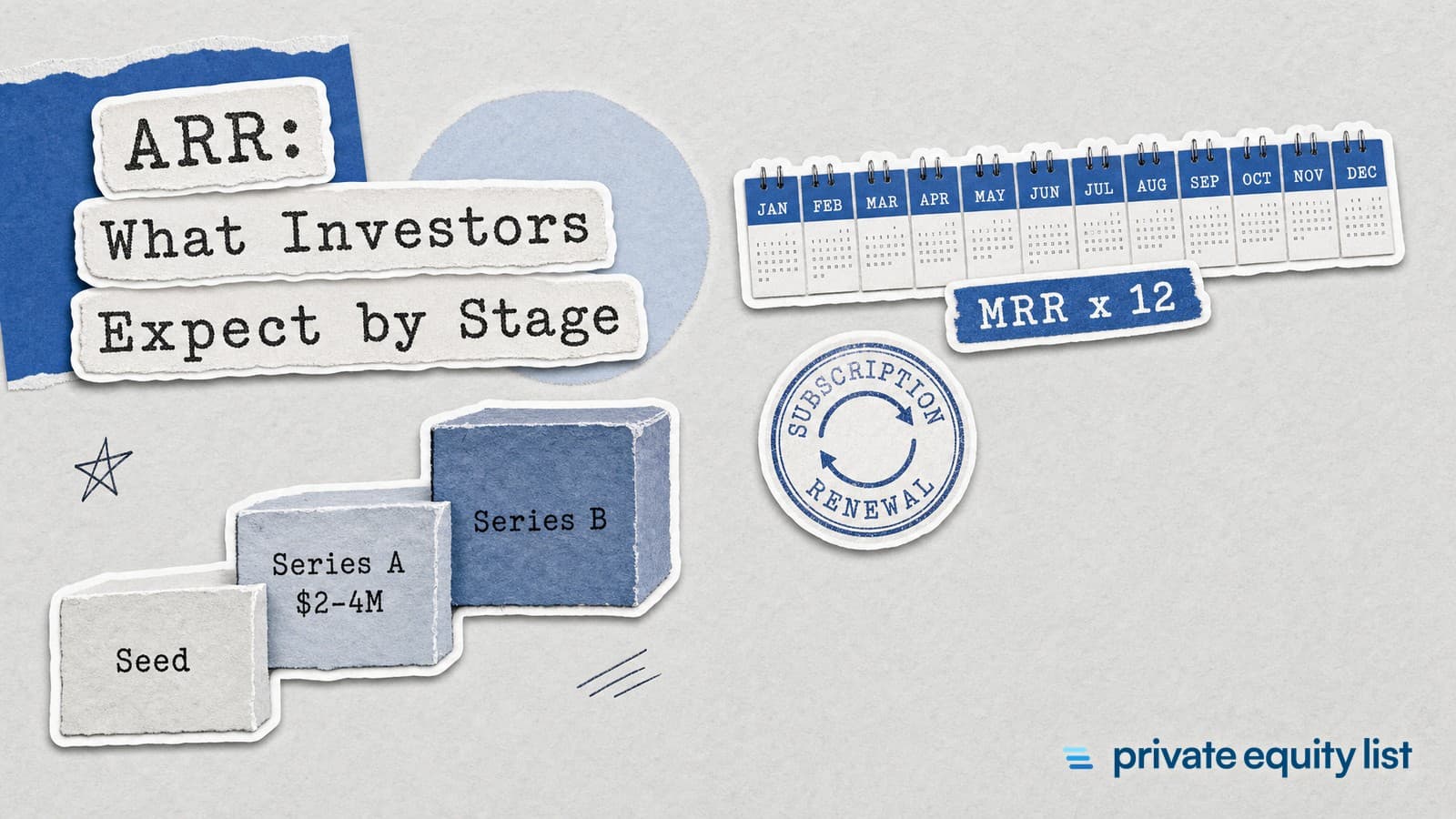
- The short answer: annual recurring revenue (ARR) is the yearly value of the subscription revenue a company has under contract and expects to repeat. The simple formula is monthly recurring revenue (MRR) × 12.
- What counts: subscriptions and other fees that renew. One-off setup fees, consulting work and one-time sales stay out.
- Accounting: ARR is an operating metric. Revenue in the financial statements follows ASC 606 or IFRS 15, so the two rarely match.
- Series A bar: investors now expect $2–4M of ARR at Series A, up from about $1M, according to Uncork Capital's Andy McLoughlin in Crunchbase.
- Growth: the typical private B2B SaaS company grew 22% in 2025, and the typical equity-backed one 25%, in a SaaS Capital survey of over 1,000 companies.
What is annual recurring revenue (ARR)
Annual recurring revenue (ARR): the annual value of all active recurring contracts at a point in time. A customer on a $2,000 monthly plan adds $24,000 to ARR.
Where it is used: subscription businesses, above all B2B software (SaaS). Investors, lenders and buyers use it to value and compare these companies.
Why investors like it: recurring revenue repeats next year without a new sale, so ARR shows how much revenue the company starts each year with.
What it leaves out: one-off implementation and setup fees, professional services, hardware and one-time licences.
Usage-based pricing: companies that bill by usage often count only the committed minimum, or annualise a recent average. Investors ask which method is used.
Other meanings: in accounting, ARR also stands for accounting rate of return, a capital budgeting ratio. In fundraising it always means annual recurring revenue.
How to calculate ARR: the formula
Simple formula: ARR = MRR × 12, where MRR is the recurring revenue billed in one month.
Contract formula: ARR = the sum of the annual value of every active subscription. A three-year, $90,000 contract adds $30,000 a year.
Bridge formula: ending ARR = starting ARR + new + expansion − contraction − churn. Investors ask for this bridge every quarter.
Net revenue retention (NRR): starting ARR plus expansion, minus contraction and churn, divided by starting ARR. It shows what existing customers alone add.
Illustrative example, not data:
| ARR bridge for one year | Amount |
|---|---|
| Starting ARR | $1.20M |
| + New customers | $0.60M |
| + Expansion (upgrades, more seats) | $0.25M |
| − Contraction (downgrades) | $0.05M |
| − Churn (cancelled customers) | $0.15M |
| Ending ARR | $1.85M (growth of 54%) |
| Net revenue retention | 104% |
ARR vs MRR, revenue and run rate
| Metric | What it measures | When to use it |
|---|---|---|
| ARR | Annual value of recurring contracts today | Annual or multi-year B2B contracts; fundraising and valuation |
| MRR | Recurring revenue in one month | Monthly plans; tracking growth month to month |
| Revenue | Income recognised in the period under ASC 606 or IFRS 15 | Financial statements, tax, audits |
| Annual run rate | One recent month or quarter of all revenue, scaled to a year | Usage-based and transactional businesses |
| Bookings | Value of contracts signed in a period | Sales performance |
ARR vs revenue: a company with $1.85M of ARR at year end may have recognised only $1.5M of revenue that year, because new contracts were signed through the year.
ARR vs run rate: run rate includes one-off and usage revenue. Investors give it less weight, since customers have no contract to repeat it.
How much ARR investors expect at each stage
Takeaways
- Series A: $2–4M of ARR, in the AI era, according to Crunchbase. For US startups with a $1M+ seed, the wait for the next round has passed two years since 2023.
- Growth after that: the T2D3 path set out by Battery Ventures' Neeraj Agrawal starts at $2M of ARR, triples twice and doubles three times.
| $2 | $6 | $18 | $36 | $72 | +100.0% on Year 4$144 |
| Start | Year 1 | Year 2 | Year 3 | Year 4 | Year 5 |
|---|
Source: Battery Ventures, Neeraj Agrawal
Seed: no fixed ARR bar. Seed investors back the team, the market and first paying customers.
Series A: $2–4M of ARR. The typical software Series A on Carta raised $14.4M at an $80M valuation in the six months to July 2026. Our Series A funding guide covers the rest of the bar.
Series B and later: investors look at the growth rate as much as the size. On the T2D3 path a company goes from $2M to $6M and then $18M of ARR in two years. See the Series B funding guide for round sizes.
The gap: tripling is 200% growth a year. The typical private B2B SaaS company grew 22% in 2025, so venture-backed companies are judged against a much steeper line.
Quality of ARR: with the same ARR, a company with high net revenue retention, strong gross margin and a low burn raises more easily. The burn rate calculator shows how long your cash lasts at your growth rate.
Series A investors with new funds in 2026
These firms raised funds this year that write cheques at Series A, where the $2–4M ARR bar applies. Sizes and dates come from the linked announcements.
| Investor | New fund | Size | Stages |
|---|---|---|---|
 Bessemer Venture PartnersCheques from $500K to $100M, from seed to growth. | Early and growth funds, September 2026 | $5.75B | Seed to growth |
 Kleiner PerkinsIts largest raise in over a decade; KP22 is the early-stage fund. | KP22 and KP Select IV | $3.5B | Early stage and growth |
 Menlo VenturesRaised for AI, investing from seed to late stage. | Menlo Ventures XVII, June 2026 | $3B | Seed to late stage |
 GreylockOver 80% of its investments are the first cheque, at pre-seed, seed or Series A. | Greylock 18 | $1.5B | Pre-seed to Series A |
 CreandumStockholm generalist. | Creandum VIII, November 2026 | $750M | Pre-seed to Series A |
 White Star CapitalFund IV is built for Series A and B rounds worldwide. | Fund IV | $250M | Series A and B |
The full list of firms that lead at this stage is in the Series A investors directory, and this year's raises are in the new VC funds tracker.
ARR beyond equity rounds
Debt: some lenders size loans to subscription companies as a multiple of ARR instead of profit. Our guide to venture debt lenders lists who offers it.
Valuation: buyers and investors price software companies as a multiple of ARR. The business valuation calculator has a revenue multiple tab for this.
Related terms
MRR, net revenue retention, burn rate, runway and term sheet sit next to annual recurring revenue in our private equity glossary.
Raising on your ARR: the capital raise guide covers the process at every stage, and pre-seed vs seed funding covers the rounds before ARR matters.
Data and methodology
ARR expectations: Crunchbase News (May 2026) for the Series A bar and the seed-to-Series A wait; Carta (July 2026) for the typical Series A round. Both linked in the text.
Growth figures: SaaS Capital's 2026 benchmark of private B2B SaaS growth in 2025; the T2D3 path from Battery Ventures. The ARR bridge is an illustrative example.
Investors: firms with new 2026 funds that invest at Series A, from the Private Equity List fund tracker, checked against the linked announcements, as of November 2026.

 Updated weekly
 Investors