Key takeaways
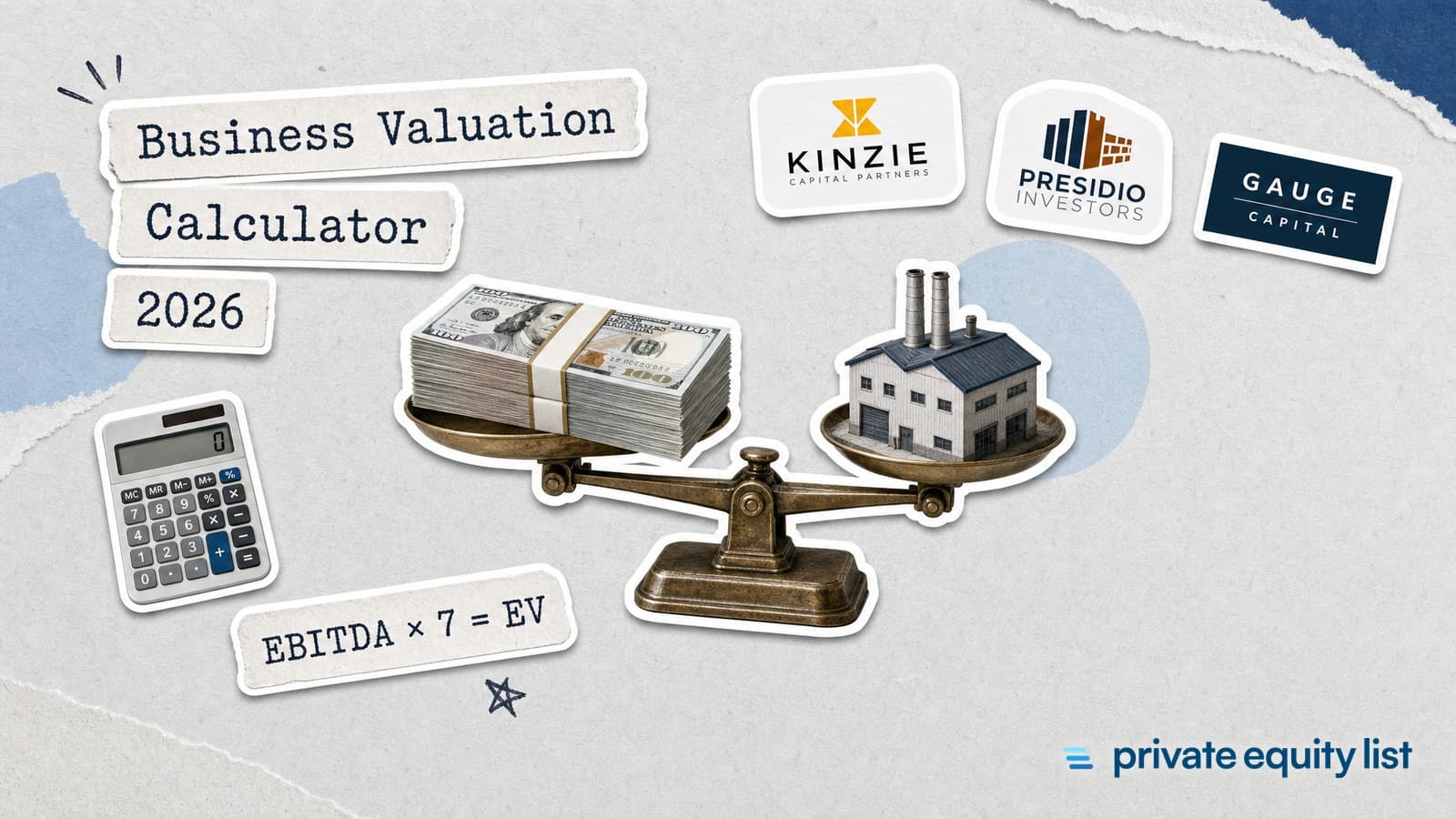
- The short answer: a business is usually worth a multiple of its profit. Private equity firms paid an average 7.0x EBITDA for US companies worth $10–500M in the second quarter of 2026, and small businesses selling for over $1M went for 3.73x the owner's cash flow. The calculator below runs three methods: EBITDA multiple, revenue multiple and DCF.
- Size moves the multiple: deals of $50–250M averaged about 7.6x EBITDA, deals of $10–50M about 6.8x, per GF Data.
- Small businesses: the median small business sold on BizBuySell for $350,000 in Q3 2026. Sales above $1M closed at 3.73x cash flow.
- Listed companies cost more: the average listed US company outside finance traded at 16.95x EBITDA in January 2026, by Damodaran's data. Software was at 24.48x.
- Who buys at your size: 71 private equity firms and family offices in Private Equity List publish the EBITDA they look for. 44 of them take a company with $4M of EBITDA; 12 go below $1M.
- Equity cheques: 1,501 of 3,355 private equity firms in Private Equity List typically invest $10–50M, as of November 2026.
Business valuation calculator
EBITDA multiple: enterprise value = EBITDA × multiple = $4M × 7x = $28M; equity value = $28M − $5M net debt = $23M.
Revenue multiple: $20M × 2x = $40M; equity value $35M.
DCF: $2.5M of free cash flow growing 8.0% a year for 5 years, discounted at 12.0%, with 2.5% growth after year 5: forecast years $10.39M + terminal value $20.82M today = $31.21M; equity value $26.21M.
Equity value = enterprise value − net debt (debt minus cash).
Sources: private equity multiples are GF Data figures reported in Mercer Capital's Middle Market Transaction Update, Fall 2026. Small business prices are from BizBuySell's Q3 2026 Insight Report (published 20 October 2026). Listed company multiples are from Aswath Damodaran's EV/EBITDA and revenue multiple tables.
How to value a business: three methods in the business valuation calculator
| Method | Formula | Best for | Calculator default |
|---|---|---|---|
| EBITDA multiple | EBITDA × multiple = enterprise value | Profitable companies; how private equity buyers price deals | $4M × 7 = $28M |
| Revenue multiple | Revenue × multiple = enterprise value | Fast-growing or loss-making companies, SaaS, startups | $20M × 2 = $40M |
| Discounted cash flow (DCF) | Sum of discounted free cash flow + discounted terminal value | Steady cash flow you can forecast for 5 years | $2.5M growing 8%, 12% discount rate = $31.2M |
Enterprise value: what the whole business is worth to everyone who funds it, before debt is paid off.
Equity value: what the owners get. Take enterprise value and subtract net debt (loans minus cash). In the calculator, $5M of net debt turns $28M into $23M.
Net cash: if the company holds more cash than debt, enter net debt as a negative number and equity value goes up.
Use more than one: buyers check a multiple against a DCF, and a big gap between the two usually means a wrong input.
Business valuation formula, step by step
EBITDA multiple method
| Step | Calculation | Result |
|---|---|---|
| 1. Adjusted EBITDA | Operating profit + depreciation and amortisation + one-off costs + owner pay above market | $4M |
| 2. Multiple | Comparable deals in your sector and size | 7x |
| 3. Enterprise value | $4M × 7 | $28M |
| 4. Net debt | $6M of loans − $1M of cash | $5M |
| 5. Equity value | $28M − $5M | $23M |
Illustrative example, not data.
Adjusted EBITDA: buyers pay for profit the business will keep making. They add back one-off costs, like a lawsuit, and take out income that leaves with the owner.
The multiple: 7x sits at the 7.0x private equity average for Q2 2026. A $10–50M deal averaged about 6.8x.
Working capital: most deals assume a normal level of stock and receivables. Hand over less, and the price drops by the gap.
Revenue multiple method
Formula: enterprise value = annual revenue × revenue multiple. With the default $20M of revenue at 2x, the business is worth $40M.
When it is used: when profit is small, negative or not yet a guide, as with SaaS and venture-backed startups.
Why it is rough: two companies with the same revenue can have 5% and 30% margins. A revenue multiple ignores that, so check it against EBITDA as soon as there is some.
Startups before a round: pre-money valuation is negotiated, not calculated. Our dilution calculator shows what a given pre-money valuation means for founders' ownership.
Discounted cash flow (DCF) method
| Year | Free cash flow | Discount factor at 12% | Present value |
|---|---|---|---|
| 1 | $2.50M | 0.893 | $2.23M |
| 2 | $2.70M | 0.797 | $2.15M |
| 3 | $2.92M | 0.712 | $2.08M |
| 4 | $3.15M | 0.636 | $2.00M |
| 5 | $3.40M | 0.567 | $1.93M |
| Terminal value | $3.40M × 1.025 / (12% − 2.5%) = $36.7M | 0.567 | $20.82M |
| Enterprise value | $31.2M |
Illustrative example, not data.
Free cash flow: cash from operations minus capital spending. The default starts at $2.5M and grows 8% a year.
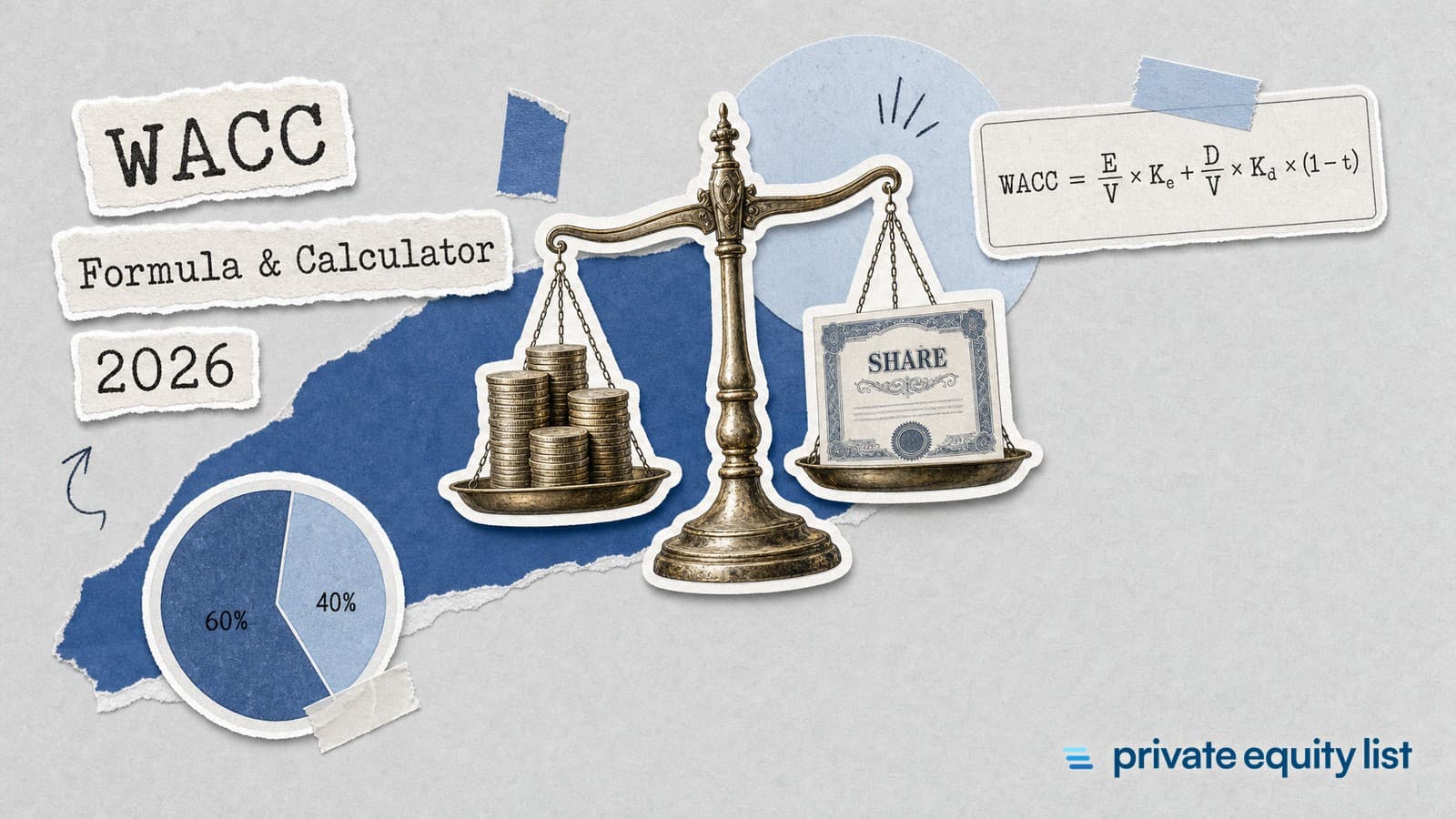
Discount rate: use the company's WACC. Work it out with the WACC calculator; the cost of equity part is in the cost of equity calculator.
Terminal value: the Gordon growth formula values every year after year 5. Here it is two-thirds of the result, so a small change in the 2.5% growth rate moves the price a lot.
Equity value: $31.2M minus $5M of net debt gives $26.2M.
EBITDA multiples in 2026: what private equity pays
Q2 2026: the average private equity deal of $10–500M was priced at 7.0x EBITDA, down from 7.3x in Q1. The first half averaged 7.1x across 170 deals.
Bigger is dearer: deals of $50–250M averaged about 7.6x, deals of $10–50M about 6.8x. Smaller companies carry more risk, so buyers pay less per dollar of profit.
Sector: healthcare services led at 7.7x. Technology fell to 5.7x, from a high of 10.2x in 2023.
Strategic buyers: companies buying a competitor or supplier paid 8.5x in the first half of 2026, against 7.2x for private equity. They can count on cost savings a financial buyer does not have.
Debt: private equity buyers borrowed 2.9x EBITDA on average in Q2. The rest of the price is equity from the fund, often with a loan from private equity lenders.
Valuation multiples by industry: listed US companies
| Industry | EV/EBITDA | EV/revenue | Companies |
|---|---|---|---|
| Software (system and application) | 24.48x | 11.41x | 309 |
| Healthcare products | 19.78x | 4.76x | 204 |
| Restaurants and dining | 17.49x | 4.17x | 64 |
| Engineering and construction | 17.18x | 1.74x | 48 |
| Machinery | 16.22x | 3.43x | 105 |
| Business and consumer services | 14.26x | 2.53x | 155 |
| Computer services | 14.10x | 1.48x | 64 |
| Building materials | 11.61x | 2.05x | 41 |
| Trucking | 10.41x | 1.74x | 26 |
| Food processing | 10.01x | 1.47x | 78 |
| Auto parts | 6.43x | — | 35 |
| All companies outside finance | 16.95x | 3.46x | 4,822 |
Source: Damodaran, EV/EBITDA by sector (companies with positive EBITDA) and revenue multiples by sector, data as of January 2026.
Why listed multiples are higher: shares of a listed company can be sold any day, and the companies are bigger. The average outside finance, 16.95x, is more than double the 7.0x private equity paid.
How to use them: as a ceiling and a sense of which sectors are rated higher. Do not apply 24x to a private software company with $3M of EBITDA.
Small business valuation: what is a small business worth
Median sale: 2,132 small businesses changed hands on BizBuySell in Q3 2026, at a median price of $350,000, up 17% on a year earlier (BizBuySell, 20 October 2026).
Cash flow multiple: sales above $1M closed at 3.73x cash flow and made up 22% of deals. Manufacturing had the highest multiple of the major sectors, 3.02x, at a median price of $807,000 (BizBuySell Insight Report).
Which profit: small business brokers multiply seller's discretionary earnings (SDE). That is profit plus the owner's own salary and perks, so it runs higher than EBITDA.
Is a business worth 3 times profit: close to it. Owner-run businesses selling for over $1M went for 3.73x cash flow in Q3 2026, and smaller ones for less. Once EBITDA reaches $1M or more, private equity buyers come in: they paid about 6.8x for $10–50M deals.
| Business | Profit measure | Multiple | Value |
|---|---|---|---|
| Makes $300,000 a year for the owner | SDE $300K | 2.5–3.5x | $750K–1.05M |
| $1M in sales, 20% owner margin | SDE $200K | 2.5–3.5x | $500–700K |
| $500,000 in sales, 20% owner margin | SDE $100K | 2–3x | $200–300K |
| $2M of EBITDA, family-owned manufacturer | EBITDA $2M | 5–6x | $10–12M |
Illustrative examples, not data. The multiples are set around the BizBuySell and GF Data figures above.
Sales alone do not set the price: a business with $1M in sales and 5% margins is worth far less than one with 30%. Work out the profit first, then apply the multiple.
Who buys businesses at each valuation
Private Equity List holds 3,355 private equity firms and 229 family offices, as of November 2026. 71 of them publish the EBITDA range they buy, so you can see who is in the market for a company your size.
| $10–50M | 1501 | 44.8% |
|---|---|---|
| $1–5M | 557 | 16.6% |
| $50–100M | 491 | 14.7% |
| $100M+ | 375 | 11.2% |
| Under $1M | 242 | 7.2% |
| $5–10M | 183 | 5.5% |
Source: Private Equity List database
The sweet spot: 64 of the 71 buyers take a company with $5M of EBITDA. At $1M only 19 do, and at $500K, 12.
Typical floor: the median buyer wants at least $3M of EBITDA. 26 ask for $5M or more.
From valuation to cheque: a company with $4M of EBITDA at 7x is worth $28M. With debt of 2.9x EBITDA, about $11.6M, the buyer's equity is about $16M. That sits in the $10–50M band, where 1,501 private equity firms in Private Equity List typically invest.
Money to spend: 64 private equity firms announced new buyout or growth funds in 2026, about $151B, as listed in our guide to private equity buyers.
Buyers in the United States and Canada
57 of the 71 buyers are in North America: 52 in the US and 5 in Canada. Most target $2–20M of EBITDA; Breakaway Capital and ScaleCo Capital go below $5M.
| Firm | HQ | EBITDA it looks for | Cheque size | Sectors |
|---|---|---|---|---|
 Breakaway CapitalBreakaway Capital distinctively targets companies with up to $5 million of EBITDA, offering a comprehensive suite of financing options to address diverse capital needs. |  Los Angeles | Up to $5M | $5–10M | Technology, Telecommunications |
 ScaleCo CapitalThey typically target companies with less than $5 million in EBITDA and offer equity holds up to $25 million, with the ability to co-invest. | Cleveland | Up to $5M | $5–10M | RegTech / Compliance, Logistics |
 Cimarron Healthcare CapitalThe firm targets equity investments up to $30 million and looks for businesses generating revenue up to $100 million, with up to $10 million in EBITDA. | Salt Lake City | Up to $10M | $10–50M | Business Services (B2B), Healthcare Services |
 Tritium PartnersThe firm typically invests $20-100 million in companies with revenues of $5-75 million and EBITDA of less than $15 million. | Austin | Up to $15M | $50–100M | Business Services (B2B), E-commerce/Marketplace |
 Kinzie Capital PartnersKinzie typically targets companies with revenues up to $250 million and EBITDA up to $15 million. | Chicago | Up to $15M | $10–50M | Technology, Consumer Services (B2C) |
 O2 Investment PartnersThe firm targets investments in companies with up to $15 million in EBITDA, focusing on businesses with a history of growth, profitability, and strong management teams. | Bloomfield Hills | Up to $15M | $10–50M | Technology, Real Estate |
 Sole Source CapitalSole Source Capital typically invests in companies with EBITDA under $20 million and seeks to leverage its operational capabilities to drive growth. | Dallas | Up to $20M | $10–50M | Construction, Manufacturing |
 Centre Lane PartnersIt targets companies with revenues between $25 million and $500 million and EBITDA of negative to $75 million. | New York | Up to $75M | $10–50M | CleanTech, Energy |
 WP GlobalThey target companies with enterprise values under $500 million and EBITDA under $75 million. | Chicago | Up to $75M | $10–50M | HealthTech, Business Services (B2B) |
 Ridgeline VenturesRidgeline Ventures invests in sectors such as consumer products, CPG/D2C, and food & agriculture, with a particular interest in companies that generate between $1M and $8M of EBITDA. | Boulder | $1–8M | $1–5M | Consumer Products, E-commerce/Marketplace |
 True North EquityThe firm primarily targets middle-market companies with an EBITDA range of $1M-$10M, with flexibility to consider larger or smaller opportunities case-by-case. | Birmingham | $1–10M | $10–50M | Oil and Gas, Industrial |
 SageLink CapitalThe firm invests primarily in SaaS, technology-enabled services, and business services sectors, targeting companies with $5-50 million in revenue and $1-10 million in EBITDA. | Lehi | $1–10M | $10–50M | Cybersecurity, Technology |
 Fulcrum Equity PartnersThe firm targets companies with significant growth potential, including those with $2-15 million ARR in B2B software and $1-15 million EBITDA in healthcare services. | Atlanta | $1–15M | $10–50M | HealthTech, Software |
 Pelican Energy PartnersThey typically engage with businesses having EBITDA ranging from $1 million to $15 million, and have managed to complete transactions with EBITDA up to $30+ million. | Houston | $1–15M | $10–50M | Business Services (B2B), Manufacturing |
 Rockwood Equity PartnersRockwood targets companies with $2-$7 million EBITDA and offers a flexible investment approach, including buyouts, management buyouts, and growth capital. | Beachwood | $2–7M | $10–50M | Defense, Medical Devices |
 Entrepreneur CapitalEntrepreneur Capital focuses on well-run companies generating EBITDA of $2–8 million. | Montreal | $2–8M | $5–10M | Healthcare Services, Retail |
 Corridor CapitalCorridor Capital typically targets companies with an EBITDA of $2-8 million, offering structured equity solutions to support growth and operational transformation. | Los Angeles | $2–8M | $10–50M | Business Services (B2B), Education |
 North Branch CapitalNorth Branch Capital looks for companies with revenue of $10–75 million and EBITDA of $2–8 million. | Oak Brook | $2–8M | $10–50M | Business Services (B2B), Industrial |
 HealthEdge Investment PartnersHealthEdge typically targets businesses with revenues between $10 million and $75 million and EBITDA of $2 million to $10 million. | Tampa | $2–10M | $10–50M | Medical Devices, IT Services |
 Trinity InvestorsTrinity Investors targets companies with $20-100 million in revenue and $2-10 million in EBITDA. | Southlake | $2–10M | $10–50M | HoReCa/Hospitality, HealthTech |
 Heritage HoldingsThey typically invest in companies generating between $2 million and $10 million in EBITDA. | Boston | $2–10M | $10–50M | Business Services (B2B), Healthcare Services |
 Regal Healthcare Capital PartnersThey focus on the lower middle market segment, prioritizing revenue metrics between $20 to $100 million and EBITDA from $2 to $10 million. | New York | $2–10M | $50–100M | Healthcare Services, Medical Devices |
 Bedford Capital ManagementBedford invests equity in established businesses that typically have $2–15 million of EBITDA. | Toronto | $2–15M | $5–10M | Industrial, Real Estate |
 154 PartnersThe firm targets companies generating $2M to $20M in EBITDA and makes both control and shared-control investments. | New York | $2–20M | $50–100M | Infrastructure, Sports/SportsTech |
 Rising Point Capital ManagementRising Point typically makes majority transactions in businesses with revenue of $10M+ and EBITDA/cash flow of $2M+. | Chicago | $2M+ | $50–100M | Industrial, Construction |
 Independent Bankers Capital FundsThe firm invests in companies with at least $10 million in revenue and $2 million in EBITDA, offering investment sizes ranging from $3 million to $18 million, with the possibility of co-investments for larger amounts. | Dallas | $2M+ | $10–50M | Aerospace, LegalTech |
 Prospect PartnersThe firm invests in lower-middle-market companies with EBITDA between $3 million and $10 million, typically in sectors such as specialty services, niche manufacturing, value-added distribution, food, and consumer products. | Chicago | $3–10M | $10–50M | HealthTech, Energy |
 Riverside PartnersTheir investment focus is exclusively on technology and healthcare sectors, targeting North American companies with $3-15 million EBITDA. | Boston | $3–15M | $10–50M | HealthTech, Life Sciences |
 Tamarix CapitalBusinesses generating $10 million to $100 million in revenue and $3 million to $15 million in EBITDA. | New York | $3–15M | $10–50M | Business Services (B2B), Food and Beverage |
 Tenex Capital ManagementThe firm typically targets equity investments ranging from $25 million to $125 million in companies with EBITDA between $3 million and $40 million. | New York | $3–40M | $50–100M | Industrial, HealthTech |
 CAI Capital PartnersCAI invests in founder-led businesses, predominantly within North America, providing capital to companies with over $3 million in EBITDA. | Vancouver | $3M+ | $5–10M | Industrial, Consumer Products |
 Forge52 Capital PartnersForge52 focuses on North American-based manufacturing companies that are family, management, or founder-owned, with a minimum EBITDA of $3 million. | New York | $3M+ | — | Manufacturing |
| Southfield CapitalSouthfield Capital targets companies with $4-20 million in EBITDA and makes equity investments ranging from $20-125 million. | Greenwich | $4–20M | $50–100M | Logistics, Real Estate |
 Pike Street CapitalPike Street Capital typically invests in companies with EBITDA between $4 million and $20 million and revenue ranging from $20 million to $200 million. | Seattle | $4–20M | $5–10M | Manufacturing, Logistics |
 Silver Oak Services PartnersThe firm invests in sectors such as business services, healthcare services, and consumer services, targeting companies with revenues between $15-150 million and EBITDA of $4-25 million. | Evanston | $4–25M | $10–50M | Business Services (B2B), Consumer Services (B2C) |
 Founders Group of Food CompaniesFounders primarily invests in mature food processors and distributors, with a focus on businesses generating $5 to $10 million of EBITDA, although they may extend this range for exceptional opportunities. | Vancouver | $5–10M | $50–100M | Logistics, Retail |
 SunTx Capital PartnersSunTx targets companies with annual revenues of $30-250 million and EBITDA of $5-20 million, with enterprise values ranging from $20-200 million. | Dallas | $5–20M | $10–50M | Business Services (B2B), Financial Services |
 Presidio InvestorsThe firm focuses on control investments in companies with EBITDA between $5-20 million and enterprise values ranging from $20-100 million. | Austin | $5–20M | $10–50M | Business Services (B2B), Education |
 Crossplane CapitalThe firm targets family or founder-owned businesses and complex transactions, focusing on companies with $40 to $200 million in revenue and $5 to $20 million of EBITDA. | Dallas | $5–20M | $10–50M | Business Services (B2B), Industrial |
 Satori CapitalSatori Capital typically targets companies with $5 million to $25 million in EBITDA and operates across the United States. | Dallas | $5–25M | $10–50M | HealthTech, Financial Services |
 Broadwing Capital ManagementBroadwing Capital invests in manufacturing and services companies in North America, specifically targeting businesses with EBITDA ranging from $5 million to $25 million. | Dallas | $5–25M | $50–100M | Manufacturing, RegTech / Compliance |
 Parallel49 EquityParallel49 Equity invests in businesses with EBITDA between $5 million and $30 million in two industry sectors: specialty manufacturing and business services. | Lake Forest | $5–30M | $50–100M | Chemicals, Consumer Services (B2C) |
 Aphias CapitalThe firm invests primarily in healthcare services and essential B2B services sectors, targeting businesses with EBITDA between $5 million and $30 million. | San Francisco | $5–30M | $50–100M | Healthcare Services, Business Services (B2B) |
 Avesi PartnersAvesi Partners invests in companies with $5-30 million in EBITDA, providing capital structures that align incentives and support growth through M&A and revenue diversification. | Stamford | $5–30M | $10–50M | HealthTech, Technology |
 Peloton Capital ManagementThe firm invests in sectors such as financial services, healthcare, consumer products, and business services, targeting North American companies with EBITDA between $5M and $40M. | Toronto | $5–40M | $10–50M | Fintech, Financial Services |
| Moelis Capital PartnersMoelis Capital Partners looks for an enterprise value of $50–400 million and EBITDA of $5–40 million, in healthcare, financial services, telecom, industrials, consumer and business services. | New York | $5–40M | $10–50M | Financial Services, Fintech |
 Continuim Equity PartnersIt targets businesses with EBITDA ranging from $5m to $40m. | Pittsburgh | $5–40M | $50–100M | Business Services (B2B), Industrial |
 Tail End Capital PartnersTail End Capital invests primarily in North American companies with an EBITDA of $5–50 million and focuses on high-quality, growing businesses across various sectors. | Pittsburgh | $5–50M | $10–50M | Technology, Industrial |
 Gauge CapitalGauge Capital targets middle-market companies in the United States and Canada, typically investing in businesses with $5-50 million in EBITDA. | Dallas | $5–50M | $10–50M | HealthTech, Energy |
 Gainline Capital PartnersGainline targets North America-based middle-market platforms, typically making control-oriented investments in companies with $5-50 million in EBITDA. | Stamford | $5–50M | $10–50M | Business Services (B2B), Consumer Products |
| Audax Private EquityThe firm typically targets companies with EBITDA ranging from $5 million to $80 million. | Boston | $5–80M | $10–50M | Consumer Services (B2C), Consumer Products |
 AUA Private Equity PartnersThe firm makes equity investments ranging from $20 to $75 million in companies generating over $5 million in EBITDA. | New York | $5M+ | $10–50M | Consumer Products, Education |
 Clarion Capital PartnersClarion Capital primarily invests in lower middle-market companies with an EBITDA between $7.5 to $30 million. | New York | $7.5–30M | $50–100M | Healthcare Services, Education |
 New State Capital PartnersIt targets companies with EBITDA ranging from $8 million to $300 million, making equity investments between $10 million and $45 million. | New York | $8–300M | $10–50M | Energy, Business Services (B2B) |
 Dominus CapitalThe firm's investments typically revolve around companies with an EBITDA of at least $10 million. | New York | $10M+ | $50–100M | Logistics, Industrial |
 Monomoy Capital PartnersThey target North American companies with annual EBITDA ranging from $15 million to $250+ million. | New York | $15–250M | $50–100M | Consumer Services (B2C), Industrial |
 GHK Capital PartnersIt targets businesses with $20-50+ million of EBITDA and emphasizes sectors such as manufacturing, distribution and logistics, building products, industrial services, testing, inspection and controls, automotive, and packaging. | Greenwich | $20–50M | $100M+ | Logistics, Industrial |
14 buyers are in Europe, and all state their range in euros. Atlantic Capital in Breda and BE Beteiligungen Fonds in Cologne take companies with EBITDA below €5M.
| Firm | HQ | EBITDA it looks for | Cheque size | Sectors |
|---|---|---|---|---|
 Atlantic CapitalIt targets companies with an EBITDA range of €0–3 million, pursuing both minority and majority equity stakes through buy-out, buy-in, or pre-exit transactions. |  Breda | Up to €3M | $10–50M | Software, Retail |
 BE Beteiligungen FondsThe firm targets companies with revenues between €10-100 million and EBITDA up to €5 million, emphasizing strong market positions and sustainable cash flows. |  Cologne | Up to €5M | $10–50M | Construction, Consumer Products |
 MorphosisMorphosis Capital invests between 5 to 10 million euro in high growth Romanian companies from sectors such as FMCG, niche healthcare, technology, and B2B services, which have a strong potential for international expansion and an EBITDA of a minimum half a million euro. |  Bucharest | €500K+ | $5–10M | Financial Services, Fintech |
 Fin CoIts investment strategy includes equity tickets ranging from €2 million to €10 million, typically targeting companies with EBITDA between €1 million and €8 million. |  Antwerp | €1–8M | $10–50M | Business Services (B2B), Consumer Products |
 Going InvestmentThe firm invests in companies with a minimum turnover of €10 million and an EBITDA over €1 million. |  Alagón | €1M+ | $5–10M | MedTech, Real Estate |
 Sun European PartnersTheir typical investment size ranges from $50-100 million, aiming at companies with €2–15 million EBITDA at entry. |  London | €2–15M | $50–100M | Logistics, Financial Services |
 MML Capital PartnersMML typically targets businesses with more than €2 million of EBITDA, deploying investments through funds like Partnership Capital, Enterprise Capital, and Ireland Growth Capital. | London | €2M+ | $10–50M | Aerospace, Business Services (B2B) |
 Crest Capital PartnersCrest Capital Partners primarily focuses on buy-outs of solid, competitive Portuguese businesses with an EBITDA greater than €2 million. | Lisbon | €2M+ | $50–100M | Utilities, Real Estate |
 H2 Equity PartnersThey typically target mid-sized companies with a target EBITDA between €3–20 million, primarily in the Benelux and Germany. | Amsterdam | €3–20M | $10–50M | Business Services (B2B), Consumer Products |
 Quarza InversionesQuarza Inversiones is focused on investing in companies with an EBITDA of more than € 3m, in different geographical areas, although mainly in the Spanish market, and with wide flexibility in terms of activity sectors, terms or capital instruments. | Madrid | €3M+ | $5–10M | Business Services (B2B), Construction |
 Wagram Equity PartnersWagram focuses its investments on medium-sized companies in Northwest Europe, particularly those with EBITDA ranging from €5 to €25 million. | Laren | €5–25M | $50–100M | Networking, Industrial |
 M80 PartnersM80 Partners targets midsize companies with sales ranging from €25 million to €300 million, and EBITDA between €5 million and €30 million, preferring to invest between 10 and 60 million euros in equity. | Brussels | €5–30M | $10–50M | Manufacturing, Healthcare Services |
 Paragon PartnersThey typically invest in companies with an EBITDA ranging from €5 million to €75 million. | Munich | €5–75M | $10–50M | Consumer Products, Business Services (B2B) |
 Alto Partners SGRAlto Partners invests in companies with sales of €30–100 million and EBITDA of €7–15 million. |  Milan | €7–15M | $50–100M | Consumer Services (B2C), Electronics |
Business valuation vs sale price: what changes the number
Rollover: sellers to private equity often keep 10–30% of the equity, so part of the price is paid at the next sale.
Earn-out: part of the price depends on hitting targets after the sale. It closes the gap when buyer and seller disagree on growth.
Customer concentration: if one customer is a third of revenue, expect a lower multiple or an earn-out.
Owner dependence: a business that runs without the founder sells for more. Buyers pay less when the owner holds the client relationships.
Clean numbers: a quality of earnings review checks adjusted EBITDA before signing. Every dollar it removes costs the multiple again in price.
How to get a business valuation
Start with the calculator: run all three tabs with your numbers. A wide gap tells you which input to check.
Use a range: take the low and high multiple for your sector and size, from the GF Data and Damodaran figures above.
Hire an adviser for a sale: M&A advisors run the process and know recent prices in your sector. Their first output is often a CIM.
Test the market: an offer from a buyer is the most reliable valuation. Our capital raise guide covers how to approach investors, and the IRR calculator shows the return a buyer needs at your price.
More on equity value: our older post on private company valuation walks through equity value for private companies. New funds raised in 2026 are on the new VC funds tracker; contacts and exports are on the pricing page.
Data and methodology
Buyers: 71 private equity firms and family offices with a published profile in Private Equity List whose description states an EBITDA range in US dollars or euros, as of 17 November 2026. Lenders, firms without a range and three firms stating ranges in pounds were left out.
Cheque sizes and counts: typical equity cheque, headquarters and sectors come from Private Equity List profiles; 3,355 private equity firms and 229 family offices, November 2026.
External figures: private equity multiples are GF Data (via Mercer Capital), small business prices are BizBuySell, listed company multiples are Damodaran (January 2026), all linked in the text.
Calculator: the business valuation calculator runs in your browser and keeps nothing. Worked examples are illustrative, not data.

 Updated weekly
 Investors