Key takeaways
- Equity dilution in one line: new investors own the amount raised divided by the post-money valuation. Raise $2M at an $8M pre-money valuation and they own 20%, so founders go from 100% to 80%.
- Typical dilution: in Carta's data for January 2021 to May 2025, the typical seed round sold 19% of the company in 2025, Series A 18%, Series B 15% and Series C 9.6%.
- Option pool: a pool topped up before the round comes out of the existing holders only. In our Series A example founders end at 50.6% that way, against 51.7% with the top-up after the round.
- SAFEs: a SAFE converts at the lower of its cap price and the discounted round price. A $1M SAFE with a $10M cap takes 7.6% of the company at a $15M pre-money seed.
- Dilution is not a loss by itself: founders own a smaller share of a company that is worth more. It costs them only when the price is too low or the round bigger than needed.
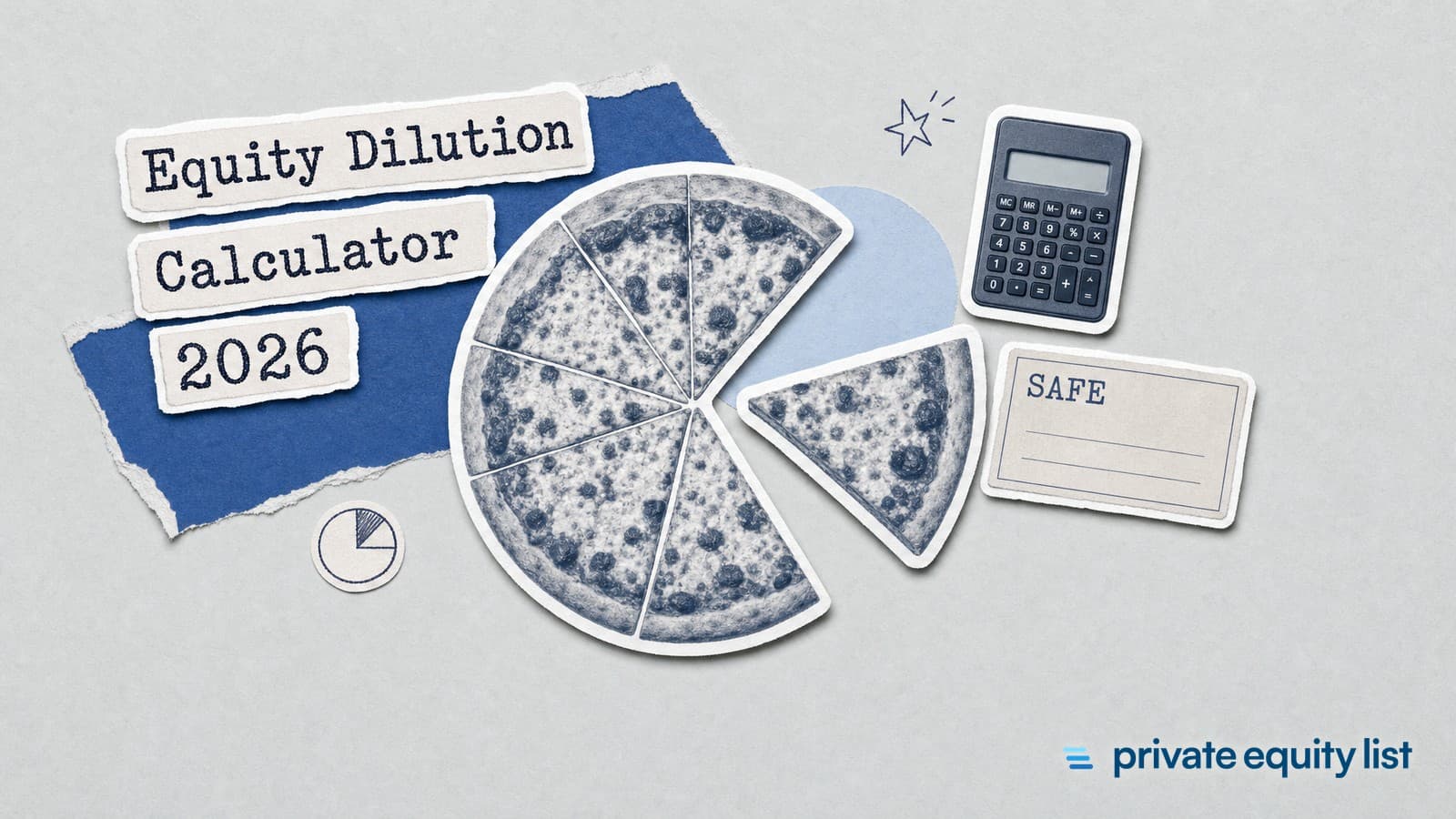
Equity dilution calculator
Post-money valuation: pre-money + new money = $40M + $10M = $50M. Price per share: $40M ÷ 11,076,923 shares = $3.61.
New investors: 2,769,231 new shares, 20.0% of the company after the round.
Founders: with the option pool topped up to 15.0% before the round, they go from 70.0% to 50.6%, a dilution of 27.8%.
SAFEs and notes: they convert at the lower of the cap price (cap ÷ shares before the round) and the round price less the discount.
Source: Carta data on 12,435 venture rounds from January 2021 to May 2025, in SaaStr's analysis. Carta's own 2025 year-end review puts the typical round from seed to Series C at about 16% for the full year.
What is equity dilution
Equity dilution: the drop in an owner's percentage when a company issues new shares. Founders keep the same number of shares, but there are more shares in total.
What causes it: a new funding round, a SAFE or convertible note turning into shares, and new options added to the employee pool.
Fully diluted: counts every share and option, including the unissued pool. Investors negotiate on this basis, so the calculator uses it too.
Value can still grow: owning 80% of a $10M company is worth more than 100% of an $8M one, as long as the new money is put to work.
Dilution formula
| What | Formula | Seed example |
|---|---|---|
| Post-money valuation | Pre-money valuation + amount raised | $8M + $2M = $10M |
| New investors' stake | Amount raised ÷ post-money valuation | $2M ÷ $10M = 20% |
| Stake after the round | Stake before × (1 − new investors' stake) | 100% × 0.8 = 80% |
| Dilution | 1 − stake after ÷ stake before | 1 − 80% ÷ 100% = 20% |
| Price per share | Pre-money valuation ÷ shares before the round | $8M ÷ 10,000,000 = $0.80 |
| New shares | Amount raised ÷ price per share | $2M ÷ $0.80 = 2,500,000 |
When the simple formula breaks: an option pool top-up or a converting SAFE adds shares before the new money comes in, so founders lose more than the investors' stake. The examples below show by how much.
Example 1: seed round, no option pool
The setup: two founders own 100% of 10,000,000 shares. They raise $2M at an $8M pre-money valuation.
The price: $8M ÷ 10,000,000 shares = $0.80 a share. The investors buy 2,500,000 new shares for $2M.
The result: 12,500,000 shares in total. Investors own 20%, founders 80%, a dilution of 20%.
Example 2: Series A with an option pool top-up
The setup: founders own 70%, seed investors 20% and the option pool 10%. The company raises $10M at a $40M pre-money valuation, and the lead investor asks for a 15% pool after the round.
The option pool shuffle: when the extra pool is counted in the pre-money valuation, only the existing holders pay for it. The price falls to $3.61 a share.
| Holder | Before | After, pool topped up before the round | After, pool topped up after the round |
|---|---|---|---|
| Founders | 70.0% | 50.6% | 51.7% |
| Seed investors | 20.0% | 14.4% | 14.8% |
| Option pool | 10.0% | 15.0% | 15.0% |
| Series A investors | 0% | 20.0% | 18.5% |
| Price per share | – | $3.61 | $4.00 |
What it costs founders: a little over 1 point of the company (51.7% against 50.6%). On a $50M post-money valuation that is roughly $590,000 of value.
What to negotiate: the pool size, based on a hiring plan for the next 18–24 months, and whether the top-up sits before or after the round.
Example 3: a SAFE converting at a priced seed
The setup: founders own 90% and the pool 10% of 10,000,000 shares. An earlier $1M SAFE has a $10M valuation cap and a 20% discount. Now the company raises $3M at a $15M pre-money valuation.
Two prices for the SAFE: the cap price is $10M ÷ 10,000,000 = $1.00. The round price is $15M ÷ 11,000,000 shares = $1.36, so the discounted price is $1.09.
The lower price wins: the SAFE converts at $1.00 into 1,000,000 shares. The pre-money valuation includes those shares, so the founders and the pool pay for them.
| Holder | Shares | Before | After |
|---|---|---|---|
| Founders | 9,000,000 | 90.0% | 68.2% |
| Option pool | 1,000,000 | 10.0% | 7.6% |
| SAFE holder | 1,000,000 | – | 7.6% |
| Seed investors | 2,200,000 | – | 16.7% |
| Total | 13,200,000 | 100% | 100% |
The result: founders give up 24.2% of their stake in one round, though the new investors hold only 16.7%. Several SAFEs on top of each other add up quickly.
Post-money SAFEs: Y Combinator's standard SAFE converts a little differently: before the new money, the holder owns the amount divided by the cap, 10% here instead of 9.1%. Check your own documents for the exact terms.
Typical dilution by round
Stable for years: seed and Series A rounds have sold about a fifth of the company since 2021. Only Series C moved much, mostly because rounds got smaller.
The 2025 picture: Carta's year-end review shows the typical round from seed to Series C falling from about 18% to 16% over 2025.
What it adds up to: at 19% and 18%, two rounds leave founders with about 66% of the stake they started with, before any pool top-ups or SAFEs.
How to limit dilution
Raise what the plan needs: every extra million at the same price is more of the company sold.
Size the pool from the hiring plan: ask the investor to agree on the hires the pool must cover, and keep it no bigger than that.
Ask for a post-money top-up: in Example 2 it saved founders over 1 point of the company.
Count your SAFEs: model every SAFE and note in the calculator before the priced round, not after.
Mix in debt: a loan next to the round can extend runway with little dilution. Lenders are in our guide to venture debt lenders and funds.
Raise after a milestone: a higher pre-money valuation sells less of the company for the same money.
Find seed and Series A investors
Seed investors: Private Equity List's seed investor list can be filtered by sector, country and cheque size.
Series A investors: the same for the Series A investor list.
Funds with fresh money: the new funds tracker lists venture funds as they close, and those are the ones writing cheques now.
Other calculators: the cost of equity calculator works out the return investors require from a company's shares.
Data and methodology
Shares: everything is counted on a fully diluted basis, including the whole option pool. The share count before the round only changes the price per share, not the percentages.
Option pool: a top-up before the round counts in the pre-money share count, so it dilutes only the existing holders. A top-up after the round dilutes the new investors too.
SAFEs and notes: they convert at the lowest of three prices: the cap divided by the shares before the round, the round price less the discount, and the round price. The converted shares count in the pre-money share count.
Solving the round: the pool and the SAFE depend on the round price, and the price depends on them, so the calculator repeats the calculation until the numbers stop changing.
Typical dilution: Carta's figures cover 12,435 rounds from January 2021 to May 2025, as summarised by SaaStr, plus Carta's 2025 year-end review. Figures are rounded to one decimal.

 Updated weekly
 Investors