Key takeaways
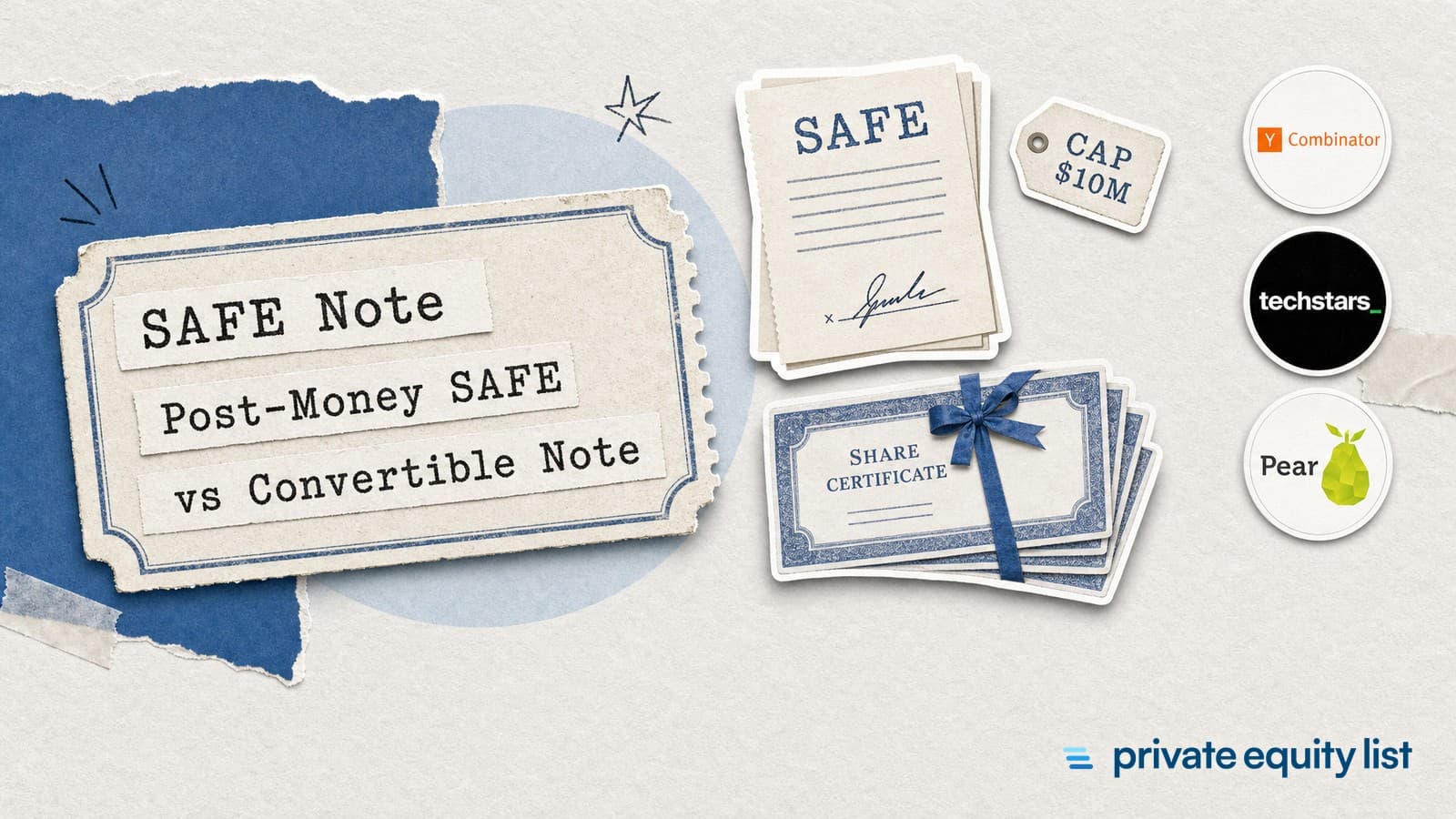
- The short answer: a SAFE note (simple agreement for future equity) is cash an investor gives a startup now for shares it receives at the next priced round. It is not debt: no interest, no maturity date and no repayment. A valuation cap or discount sets the price at which it converts.
- The default: 93% of US pre-seed rounds on Carta were SAFEs in Q2 2026, and 91% of those SAFEs were post-money (Carta).
- Caps: 73% of post-money SAFEs carry only a valuation cap and 21% a cap and a discount. The typical cap on a $250K–1M SAFE was about $10M in 2025.
- SAFE vs convertible note: a note is a loan with interest, 7% at the median in Q1 2025, and a maturity date. A SAFE has neither, and notes are down to about 7% of pre-seed rounds.
- Who signs them: Private Equity List tracks 2,153 active pre-seed investors, and 398 venture funds announced in 2026 back pre-seed or seed, with a typical size of $88M.
 United States | |
|---|---|
 United Kingdom | |
 Germany | |
 India | |
 Canada | |
 Spain | |
 Australia | |
 Netherlands |
Source: Private Equity List database
What is a SAFE note?
Definition: a SAFE, or simple agreement for future equity, is a contract in which an investor pays a startup now and gets shares later, when the company raises a priced round. People often call it a SAFE note, though it is not a note.
Origin: Carolynn Levy at Y Combinator wrote it in 2013; the post-money version has been Y Combinator's standard since 2018. YC says companies have raised over $15B on it.
Not debt: Y Combinator describes the SAFE as neither a debt nor a loan, with no interest and no maturity date. Nothing is owed if the company never raises again.
What the investor gets: no shares, votes or board seat until conversion. At the priced round, the SAFE turns into the same preferred shares the new investors buy, at a lower price.
Why founders use it: one short standard document, no valuation negotiation up front, and money that can close investor by investor. A SAFE round can stay open for weeks while cheques come in.
How a SAFE note works: cap, discount, MFN and pro rata
Most SAFEs have one price term. The table shows each term, what it does and how often Carta sees it on post-money SAFEs in the first half of 2026.
| Term | What it does | Example | How common |
|---|---|---|---|
| Valuation cap | Sets the highest valuation at which the SAFE converts, so it fixes a minimum stake | $1M at a $10M post-money cap buys at least 10% | 94% of post-money SAFEs have one; 73% have only a cap |
| Discount | Converts at a lower price than the priced-round investors pay | 20% off a $1.35 round price = $1.08 a share | 21% have a cap and a discount |
| Uncapped MFN | No cap and no discount; takes the best terms of any later SAFE issued before the round | Y Combinator's $375K and Techstars' $200K SAFEs | Standard at accelerators |
| Pro rata side letter | Lets the investor buy into the next round to keep its stake | A 10% holder may buy 10% of the Series A | Optional; a separate letter in the YC set |
The trigger: the SAFE converts at the next priced equity round of any size, unlike most convertible notes, which name a minimum round (Carta).
Cap and discount together: the holder gets whichever gives the lower price. With a cap only, the price is the lower of the cap price and the round price.
Exit before a round: if the company is sold first, the holder gets either its money back or what its shares at the cap would be worth, whichever is more. If the company shuts down, SAFE holders are paid before common shareholders, from whatever is left (Y Combinator).
Valuation caps rise with the round: the cap is usually set a little above what both sides think the company is worth today. Lower caps favour the investor; higher caps favour the founder (Carta).
Post-money SAFE vs pre-money SAFE
The two versions measure the cap against different share counts, and that decides who pays for the next SAFE: the founders or the earlier SAFE holders.
| Post-money SAFE | Pre-money SAFE | |
|---|---|---|
| Cap measured on | All shares, including every SAFE converting in the round | Shares before any SAFE converts |
| Holder's stake | Known on signing: amount ÷ cap | Unknown until the round; shrinks with each later SAFE |
| Who absorbs later SAFEs | Founders and the option pool | Everyone, earlier SAFE holders included |
| Standard since | 2018 (Y Combinator) | 2013–2018 |
| Share of SAFEs on Carta | 91% in Q2 2026 | About 9% |
Post-money SAFE formula: ownership before the priced round = purchase amount ÷ post-money valuation cap. $500K at a $10M cap is 5%, whatever else is signed later.
The catch for founders: each extra post-money SAFE comes out of the founders' share. Two $1M SAFEs at a $10M cap take 20% of the company before the seed investors arrive.
Pre-money SAFE: the cap divides by the shares outstanding before conversion, so stacked SAFEs dilute each other. About 9% of SAFEs on Carta were still pre-money in Q2 2026.
SAFE note example: how a SAFE converts at a priced round
Illustrative example, not data. Two founders hold 9,000,000 shares and the option pool 1,000,000. An angel invests $1M on a post-money SAFE with a $10M cap and no discount. A year later a seed fund invests $3M at a $15M pre-money valuation.
| Holder | Shares | Post-money SAFE | Pre-money SAFE, same terms |
|---|---|---|---|
| Founders | 9,000,000 | 67.5% | 68.2% |
| Option pool | 1,000,000 | 7.5% | 7.6% |
| SAFE holder ($1M) | 1,111,111 post / 1,000,000 pre | 8.3% | 7.6% |
| Seed fund ($3M) | 2,222,222 post / 2,200,000 pre | 16.7% | 16.7% |
Step 1, the SAFE's stake: $1M ÷ $10M = 10% just before the seed money. That needs 1,111,111 new shares on top of the 10,000,000.
Step 2, the prices: the round price is $15M ÷ 11,111,111 shares = $1.35. The SAFE's cap price is $10M ÷ 11,111,111 = $0.90, so the SAFE buys at $0.90.
Step 3, the new money: $3M ÷ $1.35 = 2,222,222 seed shares, for 16.7% of 13,333,333 shares.
Pre-money version: the cap divides by 10,000,000 shares, so the price is $1.00 and the holder gets 1,000,000 shares, or 7.6%.
Two SAFEs instead of one: with a second $1M SAFE on the same post-money terms, founders end at 60.0%; on pre-money terms, at 62.5%.
SAFE calculator: model your own round
The calculator below starts with the same seed round and a $1M SAFE with a $10M cap and a 20% discount. It converts the SAFE on the share count before the round, the pre-money method, so it shows the SAFE at 7.6%. For a post-money SAFE, the holder's stake is the amount divided by the cap, as above. Our equity dilution calculator guide walks through option pool top-ups and Series A rounds with the same tool.
SAFE conversion calculator
Post-money valuation: pre-money + new money = $15M + $3M = $18M. Price per share: $15M ÷ 11,363,636 shares = $1.32.
New investors: 2,272,727 new shares, 16.7% of the company after the round.
Founders: they go from 90.0% to 66.0%, a dilution of 26.7%.
SAFEs and notes: they convert at the lower of the cap price (cap ÷ shares before the round) and the round price less the discount.
SAFE vs convertible note: key differences
Both turn into shares at the next priced round. Until then, a convertible note is a loan with interest and a deadline.
| SAFE | Convertible note | |
|---|---|---|
| Legal form | Contract for future equity, not debt | Debt, carried as a liability |
| Interest | None | Accrues and converts into shares; median 7% in Q1 2025, down from 8% in Q2 2024 |
| Maturity date | None; open until a round, sale or shutdown | Yes; at maturity, extend, convert or repay with interest |
| Conversion trigger | Any priced equity round | Usually a qualifying round above a set size |
| Price terms | Cap, discount or MFN | Cap, discount or both |
| Share of US pre-seed rounds | 93% (Q2 2026) | About 7% |
| Paperwork | Standard Y Combinator forms | Negotiated note, often with a purchase agreement |
Interest adds shares: a $1M note at 7% that converts after 18 months carries $105K of interest, which converts too (illustrative example, not data). Rates come from Carta's Q1 2025 pre-seed data.
Maturity is leverage: if no round has happened by the maturity date, noteholders can in theory ask for their money back. In practice, the sides usually extend the note or convert it at the cap (Carta).
When a note still fits: when an investor wants interest and a repayment date. Biotech and medical device startups used to lean on notes; by 2025 even they preferred SAFEs (Carta).
When a SAFE does not fit: outside the US, local company law can make a US-style SAFE awkward. UK founders often use an advance subscription agreement instead, which works with the SEIS and EIS tax schemes.
SAFE valuation caps in 2026
Median caps rose for SAFEs of every size in the 12 months to Q2 2026, according to Carta.
| SAFE size | Median post-money cap | Period | Source |
|---|---|---|---|
| Under $250K | $7.5M | Q2 2025 | Carta |
| $250K–1M | About $10M | 2025 | Carta |
| $1–2.5M | About $15M | 2025 | Carta |
| Over $2.5M | $35M, up 40% in a year | Q2 2026 | Carta |
Top of the market: the 75th percentile cap on SAFEs over $2.5M was close to $60M in Q2 2026. Over six quarters, 90th-percentile caps ran 2.5–3.5 times the median.
Volume: US startups on Carta raised $10.4B across 50,316 SAFEs and notes in 2025. Most rounds under $4M were done on SAFEs or notes rather than priced equity.
What it means for you: $1M on a $10M cap sells 10%; the same $1M on a $15M cap sells 6.7%. The cap table template shows how to carry each SAFE at its cap until it converts.
Accelerator SAFEs: Y Combinator, Techstars and others
Accelerators publish their SAFE terms, which makes them a useful benchmark for any first cheque.
| Investor | Total | On a SAFE | Fixed stake |
|---|---|---|---|
 Y Combinator | $500K | $125K on a post-money SAFE + $375K uncapped MFN SAFE | 7% for the $125K |
 Techstars | $220K ($120K in Asia-Pacific) | $200K uncapped MFN SAFE ($100K in Asia-Pacific) | 5% for $20K, on a convertible equity agreement |
| Agentic Builders | $30–100K | Standard post-money SAFE | — |
 1984 Ventures | $500K–2M | SAFE or equity | — |
 Indie.vc | $250K–2M | SAFE or equity | — |
Y Combinator: "We invest $125,000 on a post-money SAFE in return for 7% of your company," plus $375,000 on an uncapped MFN SAFE (Y Combinator).
Techstars: $200,000 on an uncapped MFN SAFE and $20,000 for 5% of common stock, which converts at a priced round of $1M or more (Techstars).
Other firms: cheque sizes and instruments for Agentic Builders, 1984 Ventures and Indie.vc come from their Private Equity List profiles. Our top seed and pre-seed investors list adds more first-cheque firms by region.
Who invests on SAFEs: firms with new pre-seed funds in 2026
Firms that closed a fund this year have money for first cheques now. Private Equity List recorded 398 new venture funds in 2026 that back pre-seed or seed, 223 of them pre-seed; 56% list AI. The typical pre-seed fund is $70M.
 Creandum | |
|---|---|
| Crane Venture Partners | |
 Inspired Capital | |
 AlleyCorp | |
 Pear VC | |
 Gradient | |
 Entrepreneurs First | |
 Antler (US) |
Source: Private Equity List database
| Firm | HQ | New fund (2026) | Stages | Focus |
|---|---|---|---|---|
| CreandumStockholm generalist founded in 2003, with a growing San Francisco team. | Stockholm | $750M Fund VIII, closed | Pre-seed to Series B | Software, fintech, health |
| Crane Venture PartnersLondon investor in foundational technology from inception to seed. | London | $484M across four funds | Pre-seed to Series A | AI, software, cybersecurity |
| Inspired CapitalNew York firm founded in 2019 by Alexa von Tobel and Penny Pritzker. | New York | $450M Fund IV, closed | Pre-seed to Series B | AI, fintech, health, robotics |
| AlleyCorpKevin Ryan's New York company factory, founded in 2007. | New York | $335M Fund II, closed | Pre-seed to Series A | Healthcare, deep tech |
| Pear VCSan Francisco seed firm founded in 2013 by Pejman Nozad and Mar Hershenson. | San Francisco | $333M Fund V, closed | Pre-seed to Series A | AI, fintech, biotech, B2B |
| GradientStarted in 2017 as Google's AI seed fund, now independent. | San Francisco | $220M Fund V, closed | Pre-seed to Series B | AI software, fintech, health |
| Entrepreneurs FirstLondon talent investor founded in 2011; backs people before they have a company. | London | $200M raised | Pre-seed to Series A | Software, robotics, fintech |
| AntlerSingapore-based global investor from inception, with teams in 30 locations. | Singapore | $160M US Fund II | Pre-seed to Series A | AI, SaaS, fintech, climate |
 Genesia VenturesTokyo seed investor founded in 2016; about 80 startups across Asia. | Tokyo | $113M Fund IV, closed | Pre-seed to Series A | Fintech, education, health |
 Credo VenturesPrague and Krakow firm founded in 2010; an early backer of UiPath. | Prague | $88M Stage 5 | Pre-seed to Series A | AI, deep tech |
 2048 VenturesNew York and Boston pre-seed firm founded in 2018 by Alex Iskold. | New York | $82M Fund III, closed | Pre-seed, seed | AI, biotech, deep tech |
 Osney CapitalLondon seed fund that invests only in UK cybersecurity. | London | £60M ($76M) Fund I, closed | Pre-seed, seed | Cybersecurity |
 Norrsken EvolveStockholm pre-seed fund with an in-person acceleration programme; cheques of €250–500K. | Stockholm | €62M pre-seed fund, closed | Pre-seed, seed | Robotics, energy, quantum, health |
 PitchdriveAntwerp pre-seed investor founded in 2020 by European tech operators. | Antwerp | €60M Fund IV, capped | Pre-seed, seed | AI-native software, robotics |
 Connect VenturesLondon product-led seed firm founded in 2012; partners only, no associates. | London | $55M Fund V | Pre-seed to Series A | AI, infrastructure, robotics |
 Passion CapitalLondon first-cheque firm founded in 2011 by Eileen Burbidge, Robert Dighero and Stefan Glaenzer. | London | €46M ($55M) Passion IV, closed | Pre-seed, seed | AI, fintech, software |
| Dorm Room FundStudent-run pre-seed fund started in 2012 out of First Round Capital. | Cambridge, MA | $50M fund, closed | Pre-seed to Series A | Student founders, AI |
| Angel InvestBerlin pre-seed and seed investor founded by Jens Lapinski, formerly of Techstars. | Berlin | €40M Fund III, closed | Pre-seed to Series A | Software, energy, climate |
 Cleo VenturesParis AI-only fund founded in 2025 by alumni of Breega and Balderton. | Paris | €30M Fund II, closed | Pre-seed, seed | AI, infrastructure, cybersecurity |
| Redbud VCColumbia, Missouri firm founded in 2023 that backs founders outside the usual hubs. | Columbia, MO | $25M Fund II, closed | Pre-seed, seed | AI, SaaS, health, legal tech |
 Octopus VenturesLondon firm founded in 2007, part of Octopus Group. | London | First Cheque II, first close above £20M | Pre-seed to Series B | AI, robotics, energy, health |
Cheque sizes from the announcements: Norrsken Evolve writes €250–500K, Redbud VC $250–500K, Cleo Ventures €300K–1M and Osney Capital £250K–2.5M.
Where they are: 1,222 of the 2,153 pre-seed investors in Private Equity List are in the United States, 112 in the UK and 104 in Germany. Filter them by country and sector in the pre-seed investors and seed investors lists.
Fresh funds weekly: the new VC funds tracker adds funds as they are announced.
Pros and cons of a SAFE for founders and investors
Speed (founder pro): one standard form and no valuation fight, so legal work is lighter than in a priced round.
Rolling close (founder pro): each cheque can sign and fund on its own day; a priced round closes everyone together.
Hidden dilution (founder con): SAFEs stack quietly. Three $1M post-money SAFEs at a $10M cap hand over 30% before the seed round starts.
No interest, no deadline (founder pro): nothing compounds and nobody can call the money back.
Price protection (investor pro): the cap guarantees a minimum stake if the company does well.
No rights until conversion (investor con): no vote, no board seat and, without a side letter, no information rights. If the company never raises a priced round, the SAFE may never convert.
How to raise on a SAFE
- Pick the form: use the Y Combinator post-money SAFE with a valuation cap and no discount; 73% of post-money SAFEs on Carta carry a cap only. Add a discount only if an investor asks for one.
- Set the cap: work back from the stake you will sell. Selling 10% for $1M means a $10M cap; check it against the Carta medians above.
- Model the stack: put every SAFE into a cap table before you sign the next one. The equity dilution calculator shows founders' stake after the seed or Series A.
- Build the list: filter pre-seed investors by country, sector and cheque size, and start with firms that closed a 2026 fund. Our guide on how to find investors covers outreach.
- Plan the next round: the SAFE converts at your first priced round, often the seed or Series A. Our capital raise guide sets out how much to raise at each stage and from whom.
Data and methodology
Investors: pre-seed and seed investors are active Private Equity List profiles tagged with those stages, as of 19 November 2026; headquarters and types come from the profiles. Types overlap, so the type chart adds up to more than 2,153.
Funds: the 398 venture funds are announcements from 1 January to 19 November 2026 that passed our checks and are tagged pre-seed or seed; duplicates are counted once, and sizes are as announced, converted to dollars.
External figures: SAFE shares, caps and note interest rates come from Carta; standard terms come from Y Combinator and Techstars. Each is linked where it appears. Conversion examples are illustrative.

 Updated weekly
 Investors