Key takeaways
- VC definition: VC stands for venture capital, money that funds invest in young, fast-growing private companies for a minority stake.
- Private equity: funds that buy mature companies, usually taking control and often using debt.
- Themes: investors and funds, fund economics, startup fundraising, deal terms, valuation, deals and exits, and debt.
- Typical numbers: a 2% management fee and 20% carry (Carta), an 8% hurdle at more than half of funds (Goodwin), four-year vesting with a one-year cliff (Carta).
- How to use it: each theme is one table with its own filter; the A–Z index at the end links to every term.
Jump to a letter: A · B · C · D · E · F · G · H · I · J · L · M · N · O · P · Q · R · S · T · U · V · W
VC definition: what venture capital means
VC stands for: venture capital. "A VC" can also mean a venture capitalist, the person, or the venture firm itself.
How it works: LPs such as pension funds and family offices commit money to a fund; the GP invests it in startups and returns it, with a profit, years later.
The deal: a minority stake in a young company, in exchange for cash to grow fast. Most of the return comes from a few big winners.
The fund: 72% of venture funds have a 10-year term (Goodwin), and the median fee is 2% with 20% carry (Carta).
| Venture capital | Private equity | Private credit | |
|---|---|---|---|
| What it buys | Minority stakes in startups | Usually control of mature companies | Loans, not shares |
| Typical company | Pre-seed to late stage, often loss-making | Profitable, with steady cash flow | Mid-sized, often owned by private equity |
| Where returns come from | A few companies that grow very large | Profit growth, paying down debt, a higher exit multiple | Interest and fees |
| Read more | Series A funding | Private equity vs venture capital | What is private credit |
Investors and funds: private equity and venture capital terms
| Term | What it means | Our guide |
|---|---|---|
| Angel investor | A person who invests their own money in startups, usually at pre-seed or seed. | How to find investors |
| Continuation fund | A new vehicle a GP sets up to buy one or more companies from its older fund; LPs can sell or roll over. | — |
| Corporate venture capital (CVC) | The venture arm of a company, investing its balance sheet in startups close to its business. | — |
| Debt fund | A fund that lends to companies instead of buying shares and earns interest. | What is private credit |
| Direct lending | Loans made straight from a fund to a mid-sized company, without a bank syndicate. US middle-market direct loans returned 9.3% in 2025 (Cliffwater). | Direct lending |
| Emerging manager | A fund manager raising its first, second or third fund, with a short track record. Many LPs run separate programmes to back them. | LP database |
| Evergreen fund | A fund with no end date: investors come in and redeem periodically, and proceeds are reinvested. Traditional funds last about 10 years (Hamilton Lane). | — |
| Family office | A private company that manages one wealthy family's money; many invest directly in private companies and funds. | Family office list |
| Fund of funds | A fund that invests in other funds rather than in companies. | LP database |
| General partner (GP) | The firm that manages a fund: it picks the investments, calls capital from LPs and earns the management fee and carry. | — |
| Growth equity | Minority stakes in fast-growing companies that are past the startup stage and often profitable. It sits between venture capital and buyouts. | — |
| Independent sponsor | A dealmaker without a committed fund who finds a company first, then raises equity for that one deal. | Independent sponsors |
| Leveraged buyout (LBO) | The purchase of a company paid for mostly with borrowed money, secured on the company's own cash flow. It is the core private equity deal. | — |
| Limited partner (LP) | An investor in a fund: a pension fund, endowment, insurer, family office or fund of funds. LPs commit the money and the GP invests it. | LP database |
| Mezzanine financing | Junior debt, often with warrants, that sits between senior loans and equity in a buyout. It costs more than senior debt and less than equity. | Mezzanine lenders |
| Micro VC | A small venture capital fund that writes small cheques at pre-seed and seed. | Top seed and pre-seed investors |
| Placement agent | A firm a fund manager hires to find LPs, paid a success fee of 1.5–2.5% of the capital raised (Pipeline Road). | Placement agents in 2026 |
| Private credit | Lending by investment funds instead of banks, mostly to mid-sized companies, many of them owned by private equity. | What is private credit |
| Private equity (PE) | Funds that buy stakes in mature private companies, usually control, improve them and sell them years later. | Private equity vs venture capital |
| Search fund | A vehicle in which one or two searchers raise money to find, buy and then run a single small company. | Independent sponsors and search funds |
| Secondaries | Buying existing stakes in funds or companies from investors who want to sell early. | LP database |
| Sovereign wealth fund | A state-owned investment fund that invests a country's surplus, such as oil revenue. Many are large LPs in private equity funds. | LP database |
| Syndicate | A group of investors backing one deal together, often led by one angel or fund. In lending, a group of banks sharing one loan. | — |
| Venture capital (VC) | Funds that buy minority stakes in young, fast-growing private companies, from pre-seed to late stage. | Private equity vs venture capital |
| Venture debt | Loans to venture-backed startups, usually with warrants, that extend runway between equity rounds. All-in rates commonly run 10–13.5% a year (Ramp). | Venture debt lenders |
Fund economics and performance terms
| Term | What it means | Our guide |
|---|---|---|
| Assets under management (AUM) | The total value of the money a firm manages for its investors. Private fund managers often count uncalled commitments too. | — |
| Capital call | A GP's request for LPs to send part of the money they committed, usually when the fund makes an investment. Also called a drawdown. | — |
| Carried interest (carry) | The GP's share of a fund's profits, paid after LPs get their money back and the hurdle. The median is 20% (Carta). | — |
| Catch-up clause | Once LPs have received the hurdle, the GP takes most or all of the next profits until it has its full 20% share (KKR). | — |
| Clawback | A clause that makes the GP return carry it received early if later losses mean it was overpaid across the whole fund. | — |
| Co-investment | A direct stake in a deal offered to an LP next to the fund, usually with low or no fees. | LP database |
| Committed capital | The total amount LPs promise to a fund. The GP draws it down over the investment period through capital calls. | — |
| Distribution waterfall | The order in which fund profits are paid: LPs' capital back, the hurdle, the GP catch-up, then an 80/20 split (KKR). | — |
| DPI (distributions to paid-in) | Cash returned to LPs divided by the capital they paid in. A DPI of 1.0x means LPs have their money back. | — |
| Dry powder | Committed capital that funds have not yet invested. | — |
| Final close | The last date a fund accepts new commitments; its size is then fixed. | — |
| First close | The point at which a fund has enough commitments to start investing; it keeps raising until the final close. | — |
| GP commitment | The GP's own money in its fund, which ties its interests to the LPs'. For funds of $1–10M on Carta, the median is 2% of fund size (Carta). | — |
| Hard cap | The most a fund will accept, set in the LPA. | — |
| Hurdle rate | The minimum return LPs must receive before the GP earns carry. More than half of funds set it at 8% (Goodwin). | — |
| IRR (internal rate of return) | The yearly return of a fund or deal that takes the timing of each cash flow into account. Faster exits push IRR up. | — |
| J-curve | The shape of a fund's returns over time: negative in the early years, when fees and costs come first, then rising as investments are sold. | — |
| Limited partnership agreement (LPA) | The contract between the GP and the LPs that sets the fund's term, fees, carry, hurdle and investor rights. | — |
| Management fee | The yearly fee a GP charges to run the fund, with a median of 2% during the investment period (Carta). With 20% carry, it makes "2 and 20". | — |
| MOIC (multiple on invested capital) | Money returned plus the value still held, divided by the money invested. A 3.0x MOIC turns $10M into $30M, however long it takes. | — |
| NAV lending | Loans to a fund secured on the value of its portfolio, used to return cash to LPs or to support portfolio companies. | — |
| Net asset value (NAV) | The value of a fund's investments minus its debts. In private funds, the GP values the portfolio every quarter. | — |
| Preferred return | The return LPs receive before the GP shares in the profits, usually 8% a year in private equity (KKR). Often used for the hurdle rate. | — |
| TVPI (total value to paid-in) | Distributions plus the value of remaining holdings, divided by the capital paid in. It equals DPI plus the unrealised part. | — |
| Vintage year | The year a fund starts investing, used to compare funds that began at the same time. Funds launched this year are the 2026 vintage. | LP database |
Startup fundraising: venture capital terms
| Term | What it means | Our guide |
|---|---|---|
| Bridge round | A small round, often a SAFE or note from existing investors, that keeps a startup going until its next priced round. | — |
| Burn rate | How much cash a startup spends each month. Net burn is spending minus revenue. | — |
| Cap table | A table of who owns what in a company: founders, employees, investors, the option pool and any SAFEs or notes. | Cap table template |
| Convertible note | A short-term loan that converts into shares at the next priced round, usually at a discount or under a cap. Unlike a SAFE, it carries interest and a maturity date. | SAFE vs convertible note |
| Data room | A secure online folder of company documents that investors or buyers review during due diligence. | Capital raise guide |
| Dilution | The fall in an owner's percentage when a company issues new shares to investors or employees. | Equity dilution calculator |
| Down round | A round priced below the previous round. Existing holders lose more of their stake, and anti-dilution clauses may apply. | — |
| Equity crowdfunding | Raising money online from many small investors in exchange for shares, through regulated platforms. | — |
| Lead investor | The investor who sets the terms of a round, usually writes the largest cheque and often takes a board seat. | Capital raise guide |
| Non-dilutive funding | Money that costs the founders no shares: grants, tax credits, revenue-based financing and venture debt. | — |
| Option pool | Shares set aside for future employees' stock options, often topped up before a round so that only existing owners are diluted. | Equity dilution calculator |
| Pitch deck | A short slide presentation founders use to pitch investors: problem, product, market, traction, team and the round. | Pitch deck template |
| Post-money valuation | The company's value right after a round: the pre-money valuation plus the amount raised. | Equity dilution calculator |
| Pre-money valuation | The company's value just before new money comes in. $8M pre-money plus a $2M round gives $10M post-money, so investors own 20%. | Equity dilution calculator |
| Pre-seed | The earliest round, from founders, angels and pre-seed funds, often before a finished product. | Top seed and pre-seed investors |
| Pro rata rights | An investor's right to buy enough shares in later rounds to keep its percentage of the company. | — |
| Runway | How many months a startup can run before its cash is gone: cash in the bank divided by monthly net burn. | — |
| SAFE note | A Simple Agreement for Future Equity: money now for shares at the next priced round, with no interest or maturity date. 93% of US pre-seed rounds on Carta were SAFEs in Q2 2026 (Carta). | SAFE note guide |
| Seed round | The first institutional round, used to reach product-market fit. | Top seed and pre-seed investors |
| Series A | The first large priced round from venture capital, to scale what works. | Series A funding guide |
| Series B | The round that funds growth after Series A, usually led by larger venture or growth funds. | — |
| Series C | A later round for companies entering new markets or preparing for an exit. | — |
| Valuation cap | The highest valuation at which a SAFE or note converts into shares. A $1M SAFE with a $10M post-money cap buys 10%. | SAFE note guide |
Deal terms from term sheets and LOIs
| Term | What it means | Our guide |
|---|---|---|
| Anti-dilution | A clause that protects investors in a down round by lowering their conversion price. Weighted average is the common form; full ratchet is the harsh one. | — |
| Cliff vesting | A waiting period before any equity vests, typically one year at startups. A quarter of a four-year grant then vests at once (Carta). | — |
| Drag-along rights | Let a majority of shareholders force the others to join a sale of the company on the same terms. | — |
| Due diligence | The buyer's or investor's check of a company before closing: finances, legal, tax, customers and technology. | — |
| Earn-out | Part of a sale price paid later, only if the business hits agreed targets such as revenue or EBITDA. Buyers offer it when they and the seller disagree on price. | — |
| Full ratchet | The harshest anti-dilution clause: the investor's conversion price drops to the new, lower price, whatever the size of the new round. | — |
| Letter of intent (LOI) | A short, mostly non-binding letter in which a buyer sets out the price and main terms before due diligence, often with exclusivity. | — |
| Liquidation preference | Investors' right to get their money back, for example 1x what they invested, before common shareholders in a sale or wind-down. | — |
| No-shop clause | Bars the seller from talking to other buyers or investors for a set period after signing a term sheet or LOI. | — |
| Participating preferred | Preferred shares that get their money back first and then also share in what is left alongside common shareholders. | — |
| Protective provisions | Investor vetoes over major decisions, such as selling the company, issuing new senior shares or changing the charter. | — |
| Right of first refusal (ROFR) | The company's or investors' right to buy shares a holder wants to sell, on the same terms as the outside offer. | — |
| Rollover equity | Part of the sale proceeds that the seller reinvests next to the new private equity owner, keeping a stake for the next exit. | Private equity buyers |
| Tag-along rights | Let minority shareholders join a sale by the majority on the same terms, so they are not left behind. | — |
| Term sheet | A short, mostly non-binding summary of a round's terms: valuation, amount, board seats, liquidation preference and investor rights. | Capital raise guide |
| Vesting schedule | The timetable over which founders and employees earn their shares. Four years with a one-year cliff is the norm at VC-backed companies (Carta). | — |
Valuation and metrics terms
| Term | What it means | Our guide |
|---|---|---|
| Annual recurring revenue (ARR) | The yearly value of subscription revenue a company expects to repeat. It is the headline metric in SaaS fundraising. | Series A funding guide |
| Cost of equity | The return shareholders require for the risk of owning a company's shares, often worked out with CAPM. | Cost of equity calculator |
| Discounted cash flow (DCF) | A valuation that adds up a company's future free cash flows, discounted to today at its cost of capital. | Business valuation calculator |
| EBITDA | Earnings before interest, taxes, depreciation and amortisation: a stand-in for operating cash profit and the base of most buyout prices. | EBITDA multiples by industry |
| EBITDA multiple | Enterprise value divided by EBITDA. US middle-market private equity deals averaged 7.0x in Q2 2026, by GF Data (Mercer Capital). | EBITDA multiples by industry |
| Enterprise value (EV) | The value of the whole business to all its funders: equity value plus net debt. | Business valuation calculator |
| Equity value | What all the shares are worth: enterprise value minus net debt. | Business valuation calculator |
| Quality of earnings (QoE) | An accountant's report that tests whether a company's EBITDA is real and repeatable, adjusting for one-offs, before a deal. | — |
| Revenue multiple | Enterprise value divided by revenue, used for companies with little or no profit, such as fast-growing software firms. | Business valuation calculator |
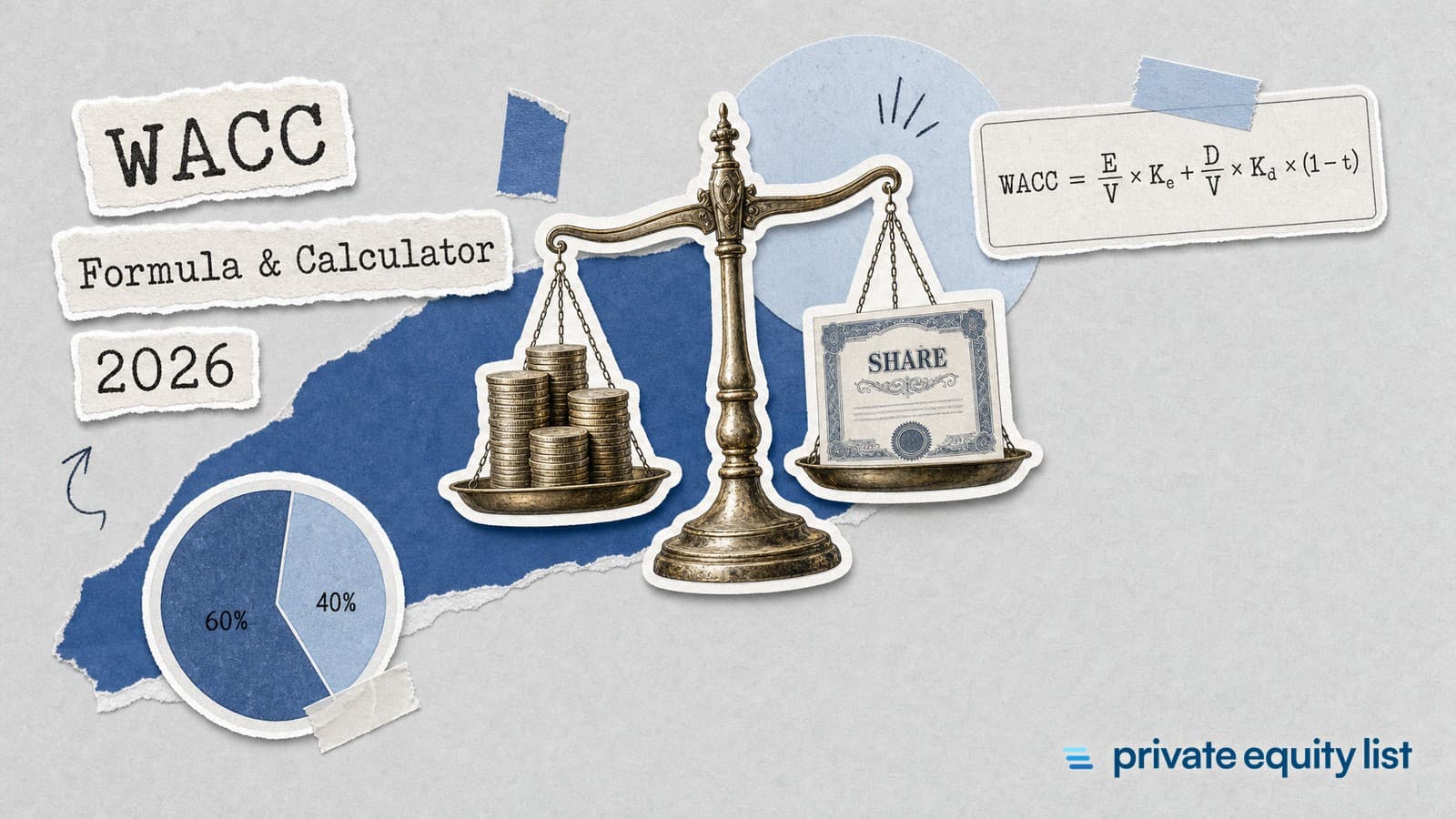
| WACC | Weighted average cost of capital: the blended return a company's lenders and shareholders require, used as the DCF discount rate. | WACC calculator |
Deals and exits: private equity terms
| Term | What it means | Our guide |
|---|---|---|
| Add-on acquisition | A smaller company that a platform company owned by private equity buys to grow. Also called a bolt-on. | Private equity buyers |
| Buy and build | Buying a platform company and adding smaller rivals to it, so the group sells at a higher multiple than its parts. | — |
| Carve-out | The sale of a division of a larger company, which becomes a standalone business, often bought by private equity. | — |
| Dividend recapitalisation (dividend recap) | A company takes on new debt to pay a dividend to its private equity owner, returning cash without a sale. | — |
| Exit strategy | How and when an investor plans to sell: a trade sale, a sale to another fund, an IPO or a dividend recap. | — |
| IPO (initial public offering) | A company's first sale of shares on a stock exchange, one of the exit routes for private equity and venture investors. | — |
| Management buyout (MBO) | The company's managers buy the business, usually with a private equity firm and borrowed money behind them. | — |
| Platform company | The first, larger company a private equity firm buys in a sector, which then makes add-on acquisitions. | — |
| Secondary sale | The sale of existing shares to another investor, with no new money going to the company. It also means one fund selling a company to another. | — |
| Take-private | A deal in which a private equity firm buys a listed company and takes it off the stock exchange. | — |
Debt and private credit terms
| Term | What it means | Our guide |
|---|---|---|
| Debt covenants | Conditions in a loan agreement, such as a maximum leverage ratio, that the borrower must keep. A breach lets the lender step in. | — |
| Distressed debt | Loans or bonds of companies in or near default, bought below face value in the hope of a recovery or control. | Distressed debt |
| Leveraged loan | A floating-rate loan to a company that already carries a lot of debt, often to fund a buyout. | Private equity lenders |
| Senior debt | The loan repaid first if a company fails, usually secured on its assets, which makes it the cheapest debt. | Private equity lenders |
| Unitranche | One loan that replaces separate senior and junior debt, with one price. It costs SOFR + 450–525 bps for companies with $20–100M of EBITDA (Houlihan Lokey). | Private equity lenders |
A–Z index of private equity and venture capital terms
A: Add-on acquisition · Angel investor · Annual recurring revenue (ARR) · Anti-dilution · Assets under management (AUM)
B: Bridge round · Burn rate · Buy and build
C: Cap table · Capital call · Carried interest (carry) · Carve-out · Catch-up clause · Clawback · Cliff vesting · Co-investment · Committed capital · Continuation fund · Convertible note · Corporate venture capital (CVC) · Cost of equity
D: Data room · Debt covenants · Debt fund · Dilution · Direct lending · Discounted cash flow (DCF) · Distressed debt · Distribution waterfall · Dividend recapitalisation (dividend recap) · Down round · DPI (distributions to paid-in) · Drag-along rights · Dry powder · Due diligence
E: Earn-out · EBITDA · EBITDA multiple · Emerging manager · Enterprise value (EV) · Equity crowdfunding · Equity value · Evergreen fund · Exit strategy
F: Family office · Final close · First close · Full ratchet · Fund of funds
G: General partner (GP) · GP commitment · Growth equity
H: Hard cap · Hurdle rate
I: Independent sponsor · IPO (initial public offering) · IRR (internal rate of return)
J: J-curve
L: Lead investor · Letter of intent (LOI) · Leveraged buyout (LBO) · Leveraged loan · Limited partner (LP) · Limited partnership agreement (LPA) · Liquidation preference
M: Management buyout (MBO) · Management fee · Mezzanine financing · Micro VC · MOIC (multiple on invested capital)
N: NAV lending · Net asset value (NAV) · No-shop clause · Non-dilutive funding
O: Option pool
P: Participating preferred · Pitch deck · Placement agent · Platform company · Post-money valuation · Pre-money valuation · Pre-seed · Preferred return · Private credit · Private equity (PE) · Pro rata rights · Protective provisions
R: Revenue multiple · Right of first refusal (ROFR) · Rollover equity · Runway
S: SAFE note · Search fund · Secondaries · Secondary sale · Seed round · Senior debt · Series A · Series B · Series C · Sovereign wealth fund · Syndicate
T: Tag-along rights · Take-private · Term sheet · TVPI (total value to paid-in)
U: Unitranche
V: Valuation cap · Venture capital (VC) · Venture debt · Vesting schedule · Vintage year
W: WACC

 Updated weekly
 Investors