Key takeaways
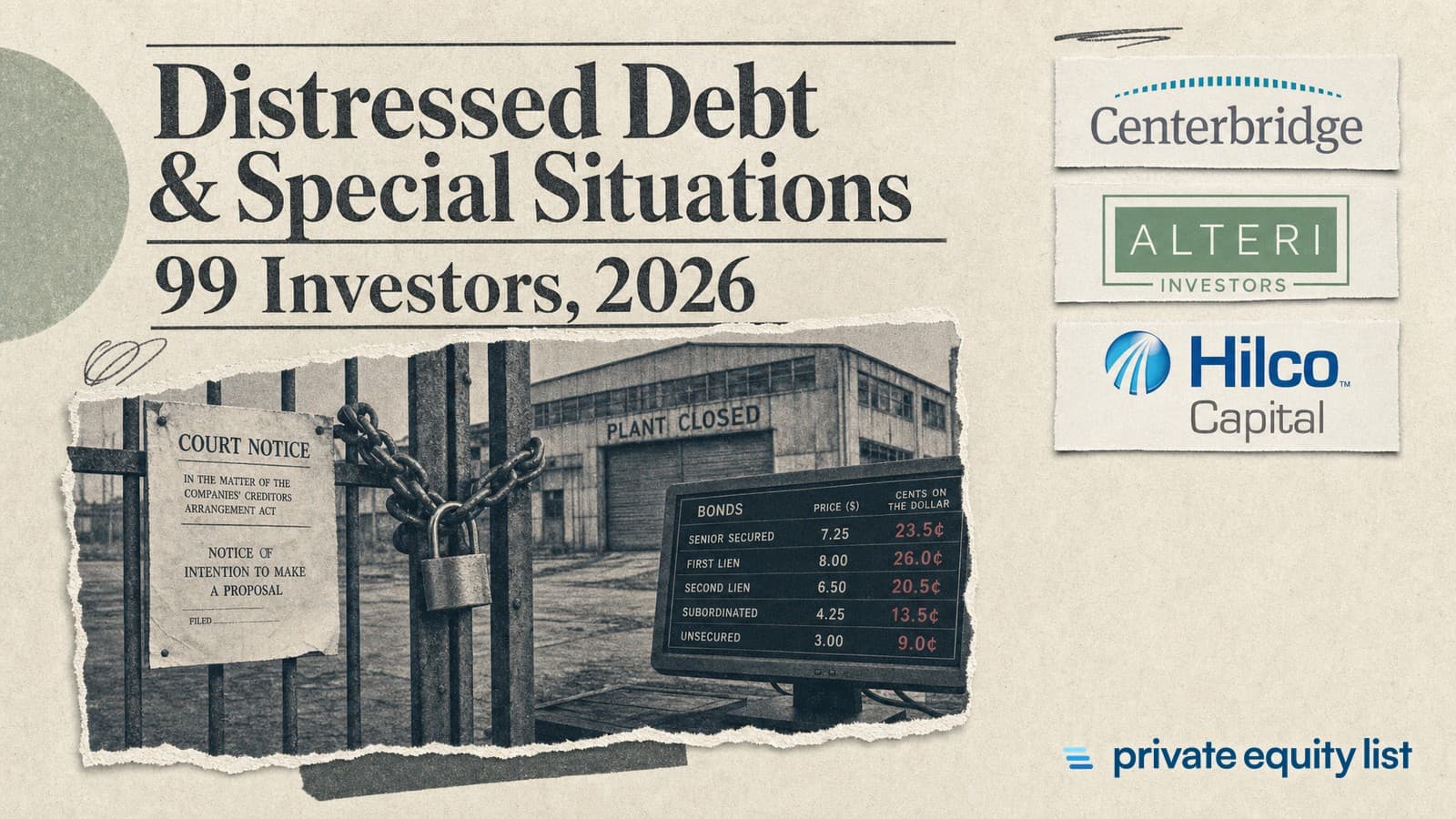
- The short answer: distressed debt is the loans and bonds of a company that is in default, in bankruptcy or close to it. They trade far below face value, often at a yield 1,000 bps or more over Treasuries. Oaktree, Davidson Kempner, Centerbridge, Marathon and Diameter are among the best-known distressed debt investors.
- Who invests: Private Equity List counts 99 distressed debt and special situations investors as of November 2026: 44 in the US, 17 in the UK, 18 in continental Europe and 20 in Asia and the rest of the world.
- Two camps: 33 buy distressed and opportunistic credit, 43 are special situations private equity firms, 14 buy and fix companies in turnaround, 6 offer rescue-style capital solutions and 3 buy non-performing loans.
- Biggest funds: Bain Capital Global Special Situations Fund II ($5.7B) and Diameter Dislocation Fund III ($4.5B) lead the funds recorded since 2023.
- New money in 2026: four special situations and capital solutions funds, at least $2.9B between them, led by Arcmont Capital Solutions Fund II ($1.65B).
- Why now: 372 large US companies filed for bankruptcy in the first half of 2026, the most for a first half since 2010.
 United States | |
|---|---|
 United Kingdom | |
 Germany | |
 Hong Kong | |
 India | |
 Portugal | |
 France | |
 Austria | |
 Brazil | |
 South Korea | |
 Australia |
Source: Private Equity List database
| Special situations | 43 | 43.4% |
|---|---|---|
| Distressed credit | 33 | 33.3% |
| Turnaround | 14 | 14.1% |
| Capital solutions | 6 | 6.1% |
| NPLs and recoveries | 3 | 3.0% |
Source: Private Equity List database
What is distressed debt: debt of a company that may not pay it back
Definition: distressed debt is the bonds, loans or trade claims of a company that is in default, in bankruptcy or likely to get there. The market doubts the company has the cash to pay its debts on time.
The usual test: a bond counts as distressed when it trades 1,000 bps or more over Treasuries of the same maturity. Loans count when they trade 1,000 bps over the base rate or below 75 cents on the dollar (Babson Capital white paper).
Stressed vs distressed: stressed debt still pays but trades at a wide spread, often because of high leverage or a likely covenant breach. Distressed debt is closer to a missed payment or a restructuring.
Who sells it: banks, CLOs and loan funds that cannot or will not hold a defaulted loan. Buyers step in at a discount and take on the work of the restructuring.
What it can be: senior or junior, secured or unsecured, private loans or public bonds. Non-performing loans (NPLs) are the bank version: whole portfolios of loans that stopped paying, bought by firms such as Cadence in Brazil and Alsis in Mexico.
Distressed debt investing: three ways to make money
Discount value (trading): buy the debt below face value and sell it when the price recovers, without taking part in the restructuring. The three-way split by how involved the investor gets is the standard one (Babson Capital white paper). Managers such as King Street and Canyon Partners work across liquid and private credit this way.
Activist: buy enough of a class of debt to have a say in the restructuring plan, then push for better terms. Anchorage Capital describes its focus as defaulted and leveraged issuers.
Control (loan-to-own): buy the debt that will turn into equity in a restructuring and end up owning the company. Centerbridge pairs buyouts with distressed securities; Alchemy Partners in London buys distressed debt and restructures companies across Europe.
Rescue financing: some funds lend new money to a company in trouble instead of buying old debt. In a US bankruptcy this is a debtor-in-possession (DIP) loan, which is repaid ahead of most other claims.
Special situations funds: equity and debt for companies in transition
Definition: a special situations fund invests in a company going through an event that most investors avoid: a restructuring, a carve-out, a liquidity squeeze, a lawsuit or a change of control. It can buy debt, equity or something in between.
How it differs from distressed debt: the company does not have to be close to default. MBK Partners runs a special situations strategy for companies short of capital at a hard stage of their development, next to its buyout funds.
Inside big platforms: Bain Capital (Global Special Situations Fund II, $5.7B), Goldman Sachs SSG, Silver Point and Avenue Capital run special situations as one strategy among several.
Specialists: Alteri Investors buys stressed and distressed European retailers; Hilco Capital lends against assets to retailers in trouble; Mutares buys and restructures mid-sized companies and carve-outs.
Turnaround buyouts: some firms buy the equity of an underperforming company and fix it themselves. Atlas Holdings owns about 30 companies with around 75,000 staff, bought when they faced financial or operational trouble.
Distressed debt market in 2026: bankruptcies at a 16-year high
Bankruptcies: 372 large US companies filed in the first half of 2026, the most for a first half since 2010 and more than in all of 2022 (317), on S&P Global Market Intelligence data (Benzinga).
Which sectors: industrial companies filed 50 times, consumer discretionary 35 and healthcare 26 in the same six months.
Chapter 11: commercial chapter 11 filings rose 28% to 4,589 in the first half, on Epiq AACER and American Bankruptcy Institute data (same source).
Private credit: Fitch's private credit default rate reached a record 6.3% in the 12 months to September 2026, mostly deferrals and extensions (Investment Executive). Proskauer's narrower index of senior and unitranche loans showed 2.41% in the third quarter (Alternative Credit Investor).
What it means for buyers: more defaulted loans held by funds that would rather sell, and more companies that need rescue capital. Managers raising for it this year include Arcmont, Crestline and Neo Alternative.
Distressed debt vs special situations, direct lending and turnaround private equity
| Strategy | What the fund buys | State of the company | How it makes money | Examples |
|---|---|---|---|---|
| Distressed debt | Bonds and loans below face value | In default, in bankruptcy or close to it | Price recovery, or equity after a restructuring | Oaktree, Davidson Kempner, Marathon, Diameter |
| Special situations | Debt, equity or hybrids | Facing an event: restructuring, carve-out, liquidity squeeze | Structured returns with downside protection | Bain Capital, MBK Partners, Arena, Tikehau |
| Capital solutions | New loans, preferred equity | Healthy or stressed, short of capital | Interest plus fees and upside features | Arcmont, Crestline, Gramercy, Neo Alternative |
| Turnaround private equity | Control of the equity | Underperforming or loss-making | Operational fix, then sale | Atlas Holdings, Mutares, Wynnchurch, Volvere |
| Direct lending | New senior loans at par | Healthy, usually private equity-owned | Interest, held to maturity | See direct lending |
Is distressed debt part of private credit? Yes. It is one of the riskier strategies next to direct lending, mezzanine and NAV loans; the full map is in private credit funds and firms.
Versus mezzanine: mezzanine is new junior debt for healthy buyouts; distressed debt is old debt bought after things went wrong. See mezzanine lenders and funds.
Versus hedge funds: many distressed debt hedge funds trade liquid bonds and loans. Closed-end distressed funds lock money up for years and can take control of companies.
Biggest distressed debt and special situations funds since 2023
 Bain Capital Global Special Situations Fund II | |
|---|---|
| Diameter Dislocation Fund III | |
 Oaktree Special Situations Fund III | |
 Davidson Kempner Opportunities Fund VI | |
 Marathon Distressed Credit Fund II | |
 Arcmont Capital Solutions Fund II | |
 BC Partners Special Opportunities Fund III | |
 Tikehau Special Opportunities III | |
 Arena Special Opportunities Partners III | |
 Paceline Opportunity Fund II |
Source: Private Equity List database
The leader: Bain Capital Global Special Situations Fund II was recorded at $5.7B in November 2024.
Dislocation funds: Diameter Capital Partners more than doubled from Dislocation Fund II ($2.2B, 2023) to Dislocation Fund III ($4.5B, November 2025). Värde Partners raised The Värde Dislocation Fund ($1.6B) in 2020.
Distressed specialists: Oaktree Special Situations Fund III ($3B, December 2023), Davidson Kempner Opportunities Fund VI ($3B, July 2023) and Marathon Distressed Credit Fund II ($2.7B, March 2025).
Europe: BC Partners Special Opportunities Fund III ($1.4B) and Tikehau Capital Special Opportunities III ($1.2B), both 2025. Avenue Capital recorded Avenue Europe Special Situations Fund V in May 2024.
Below $1B: Paceline Opportunity Fund II ($780M), Gramercy Capital Solutions Fund III ($760M) and Tor Investment Management Asia Credit Opportunity Fund III ($310M).
New special situations funds of 2026: 4 funds, at least $2.9B
- Arcmont Asset Management recorded Capital Solutions Fund II at $1.65B in February. The London firm runs it next to its direct lending and NAV financing funds across Europe.
- Neo Alternative Asset Managers closed Neo Special Credit Opportunities Fund II at $654M in November, above its Rs 5,000 crore target (announcement). The fund covers acquisition finance, refinancing and special situations where Indian banks cannot lend.
 Crestline Investors closed Crestline European Capital Solutions Fund II at $625M in August (announcement). It gives transitional capital, from senior debt to structured equity, to asset-heavy, often family-owned firms in Northern and Western Europe.
- Canonicus Capital held a first close of nearly $21M for its Special Situations Fund in November, aiming for Rs 500 crore (announcement). It backs projects around Delhi facing capital shortfalls, governance gaps or stalled execution.
More on the way: new funds from these firms show up in the new funds tracker as they are announced.
Distressed debt investors to know
| Firm | HQ | Cheque size | What it does |
|---|---|---|---|
| Oaktree Capital Management | Los Angeles | $50–100M | Liquid and illiquid credit, private equity and real estate; Special Situations Fund III ($3B) |
| Davidson Kempner Capital Management | New York | $50–100M | Credit and event-driven investing with a global, opportunistic approach |
 Centerbridge Partners | New York | $100M+ | Leveraged buyouts and distressed securities; $47B under management |
| Marathon Asset Management | New York | $100M+ | Opportunistic credit and asset-based lending; Distressed Credit Fund II ($2.7B) |
| Diameter Capital Partners | New York | $50–100M | Hedged and dislocation credit strategies; Dislocation Fund III ($4.5B) |
| Bain Capital | Boston | $100M+ | Special situations alongside private equity and credit; Global Special Situations Fund II ($5.7B) |
 Cerberus Capital Management | New York | $50–100M | Corporate credit, direct lending and operational private equity; about $70B under management |
 Värde Partners | Minneapolis | $10–50M | Credit across the quality spectrum, including The Värde Dislocation Fund ($1.6B) |
 King Street Capital Management | New York | $50–100M | Multi-strategy and opportunistic credit, restructurings and event-driven situations |
 Anchorage Capital Group | New York | $100M+ | Credit and special situations, focused on defaulted and leveraged issuers |
 Avenue Capital Group | New York | $100M+ | Opportunistic credit and special situations in the US, Europe and Asia |
 CarVal Investors | Minneapolis | — | Distressed and credit-intensive assets; $121B invested in 5,450 deals since 1987 |
 Silver Point Capital | Greenwich | $100M+ | Special situations, capital solutions and direct lending; over $51B of assets |
 Goldman Sachs SSG | New York | $100M+ | Goldman Sachs' Special Situations Group; large investments in North America, Europe and Asia |
 Atlas Holdings | Stamford | $100M+ | Control buyouts of manufacturers and distributors facing financial or operational trouble |
 Mutares | Munich | $10–50M | Buys and restructures mid-sized companies and carve-outs in complex turnarounds |
 Alteri Investors | London | $100M+ | Stressed and distressed European retail businesses, in partnership with Apollo |
 SC Lowy | Hong Kong | $100M+ | Opportunistic, senior secured lending and special situations in Asia-Pacific and the Middle East |
All 99 distressed debt and special situations investors by region
Strategy comes from each firm's profile. The fund column shows a distressed, special situations or capital solutions fund where one is on record.
Distressed debt investors in the United States
The US: 44 firms, more than half of them distressed credit managers in New York and Greenwich. The rest are special situations and turnaround buyers of lower middle-market companies.
| Firm | City | Cheque size | Strategy | Fund in Private Equity List |
|---|---|---|---|---|
 Alpina Equity | Los Angeles | $5–10M | Special situations | — |
| Anchorage Capital Group | New York | $100M+ | Distressed credit | Capital Partners Credit Fund, $7.4B (2021) |
| Arena Investors | Cleveland | $10–50M | Capital solutions | Special Opportunities Partners III, $1.1B (2025) |
 Ascend Global Investments | New York | $10–50M | Special situations | — |
| Atlas Holdings | Stamford | $100M+ | Turnaround | — |
| Avenue Capital Group | New York | $100M+ | Distressed credit | Avenue Europe Special Situations Fund V (2024) |
| Bain Capital | Boston | $100M+ | Special situations | Global Special Situations Fund II, $5.7B (2024) |
 Bain Capital Credit | Boston | $10–50M | Distressed credit | — |
| Bayside Capital | Miami | $10–50M | Distressed credit | Bayside Loan Opportunity Fund VI, $1.4B (2021) |
 Benefit Street Partners | New York | $100M+ | Distressed credit | — |
 Canyon Partners | Dallas | $100M+ | Distressed credit | — |
| CarVal Investors | Minneapolis | — | Distressed credit | — |
| Centerbridge Partners | New York | $100M+ | Distressed credit | — |
| Cerberus Capital Management | New York | $50–100M | Distressed credit | Levered Loan Opportunities Fund IV, $2.4B (2021) |
 Compass Partners International | New York | $100M+ | Special situations | — |
 Comvest Partners | West Palm Beach | $10–50M | Distressed credit | — |
| Crestline Investors | Fort Worth | $10–50M | Capital solutions | European Capital Solutions Fund II, $625M (2026) |
| Davidson Kempner Capital Management | New York | $50–100M | Distressed credit | Opportunities Fund VI, $3B (2023) |
 Deer Creek Group | Wheat Ridge | $10–50M | Distressed credit | — |
| Diameter Capital Partners | New York | $50–100M | Distressed credit | Dislocation Fund III, $4.5B (2025) |
 Drum Capital Management | Stamford | $10–50M | Special situations | Drum Special Situation Partners II, $176M (2012) |
 EOS Private Equity | New York | $10–50M | Special situations | — |
 FGA Partners | New York | $10–50M | Turnaround | — |
| Goldman Sachs SSG | New York | $100M+ | Special situations | — |
 Gramercy Funds Management | Greenwich | $10–50M | Distressed credit | Capital Solutions Fund III, $760M (2024) |
 H.I.G. Capital | Miami | $10–50M | Turnaround | — |
 Kennedy Lewis Investment Management | New York | $10–50M | Distressed credit | Capital Partners Master Fund III, $4.1B (2023) |
| King Street Capital Management | New York | $50–100M | Distressed credit | Global Drawdown Fund II, $2.3B (2023) |
| Kismet Capital | Washington | $10–50M | Special situations | — |
| Marathon Asset Management | New York | $100M+ | Distressed credit | Distressed Credit Fund II, $2.7B (2025) |
 New Water Capital | Boca Raton | $10–50M | Special situations | — |
| Newport Global Advisors | The Woodlands | $10–50M | Distressed credit | Newport Global Opportunities Fund I, $186M (2024) |
| Oaktree Capital Management | Los Angeles | $50–100M | Distressed credit | Special Situations Fund III, $3B (2023) |
| Paceline Equity Partners | Dallas | $10–50M | Special situations | Opportunity Fund II, $780M (2024) |
 Rialto Capital | Miami Beach | $10–50M | Distressed credit | — |
 Saratoga Investment Corp | New York | $50–100M | Special situations | — |
 Searchlight Capital Partners | New York | $100M+ | Distressed credit | — |
| Silver Point Capital | Greenwich | $100M+ | Distressed credit | Specialty Credit Fund III (2024) |
 Skyview Capital | Los Angeles | $5–10M | Special situations | — |
| Sound Point Capital Management | New York | $100M+ | Distressed credit | Strategic Capital Fund III, $1.5B (2026) |
 Turnspire Capital Partners | New York | $10–50M | Special situations | Turnspire Value Fund II, $275M (2023) |
| Värde Partners | Minneapolis | $10–50M | Distressed credit | The Värde Dislocation Fund, $1.6B (2020) |
 Wynnchurch Capital | Chicago | $50–100M | Turnaround | — |
| The Yucaipa Companies | Los Angeles | $50–100M | Turnaround | — |
Distressed debt and special situations investors in the United Kingdom
The UK: 17 firms, all but one in London. Eight are special situations investors in UK and European mid-market companies; five, including Hayfin, Cheyne and Arini, buy distressed and opportunistic credit.
| Firm | City | Cheque size | Strategy | Fund in Private Equity List |
|---|---|---|---|---|
 Acasta Partners | London | $10–50M | Special situations | — |
 Alchemy Partners | London | $50–100M | Special situations | — |
| Alteri Investors | London | $100M+ | Special situations | — |
 AnaCap Financial Partners | London | $1–5M | Special situations | — |
| Arcmont Asset Management | London | $100M+ | Capital solutions | Capital Solutions Fund II, $1.65B (2026) |
 Arini | London | $5–10M | Distressed credit | — |
 AS Equity Partners | London | $1–5M | Special situations | — |
| BC Partners | London | — | Distressed credit | Special Opportunities Fund III, $1.4B (2025) |
 Cabot Square Capital | London | $1–5M | Turnaround | — |
 Cheyne Capital Management | London | $10–50M | Distressed credit | — |
 Gatemore Capital Management | London | $100M+ | Special situations | — |
 Hayfin Capital Management | London | $100M+ | Distressed credit | — |
 Hilco Capital | London | $100M+ | Capital solutions | — |
 Paxtibi | London | Under $1M | Distressed credit | — |
 Rcapital Partners | London | $50–100M | Special situations | — |
 Tennor | London | $100M+ | Special situations | — |
 Volvere | Leamington Spa | $50–100M | Turnaround | — |
Special situations investors in continental Europe
Continental Europe: 18 firms. Germany has 6, led by Mutares and Hannover Finanz, and Portugal 3. Austria's EMSA and VMS specialise in turnarounds.
| Firm | City | Cheque size | Strategy | Fund in Private Equity List |
|---|---|---|---|---|
 ActiveCap | Lisbon, Portugal | $50–100M | Special situations | — |
 ALFIN | Luxembourg, Luxembourg | $10–50M | Special situations | — |
 Blackpearl Capital Partners | Madrid, Spain | $10–50M | Special situations | — |
 Butler Capital Partners | Paris, France | $10–50M | Turnaround | — |
 Callista Private Equity | Munich, Germany | $10–50M | Turnaround | — |
| Capmont | Munich, Germany | $10–50M | Special situations | — |
 Deutsche Invest Capital Partners | Munich, Germany | $1–5M | Special situations | — |
 ECM Partners | Ljubljana, Slovenia | $1–5M | Special situations | — |
| ECS Capital | Lisbon, Portugal | $100M+ | Special situations | — |
 EMSA Capital | Vienna, Austria | $50–100M | Turnaround | — |
 Hannover Finanz | Hannover, Germany | $10–50M | Special situations | — |
 I2 Capital Partners | Milan, Italy | $1–5M | Special situations | — |
 Lafayette Mittelstand Capital | Frankfurt am Main, Germany | $10–50M | Special situations | — |
| Mutares | Munich, Germany | $10–50M | Turnaround | — |
 Oxy Capital | Lisbon, Portugal | $10–50M | Special situations | — |
| Tikehau Capital | Paris, France | $10–50M | Distressed credit | Special Opportunities III, $1.2B (2025) |
 VE Partners | Amsterdam, Netherlands | $10–50M | Turnaround | — |
 VMS Value Management Services | Vienna, Austria | $1–5M | Turnaround | — |
Distressed debt and special situations investors in Asia and the rest of the world
Asia and beyond: 20 firms. Hong Kong hosts credit managers Tor and SC Lowy; India has the newest funds, from Neo Alternative and Canonicus.
| Firm | City | Cheque size | Strategy | Fund in Private Equity List |
|---|---|---|---|---|
 AIF Capital | Hong Kong, Hong Kong | $10–50M | Special situations | — |
 AIP Private Capital | Toronto, Canada | $10–50M | Capital solutions | — |
| Allegro Funds | Sydney, Australia | $10–50M | Special situations | — |
 Alsis Funds | Mexico City, Mexico | $1–5M | NPLs and recoveries | — |
 ASOCapital | Sandton, South Africa | $10–50M | Special situations | — |
 Cadence Gestora de Recursos | São Paulo, Brazil | $50–100M | NPLs and recoveries | — |
| Canonicus Capital | Gurugram, India | $10–50M | Special situations | Special Situations Fund, first close (2026) |
 CDIB Capital International | Hong Kong, Hong Kong | $1–5M | Special situations | — |
 CITIC Capital Partners | Hong Kong, Hong Kong | $10–50M | Special situations | — |
 Finansa Asset Management | Bangkok, Thailand | $1–5M | Distressed credit | — |
 Fortissimo Capital | Tel Aviv, Israel | $10–50M | Turnaround | — |
 Helmsman Capital | Sydney, Australia | $50–100M | Special situations | — |
 JM Financial | Mumbai, India | $10–50M | NPLs and recoveries | Credit Opportunities Fund 1, $73M (2023) |
 Kotak Private Equity Group | Mumbai, India | $100M+ | Special situations | — |
 MBK Partners | Seoul, South Korea | $100M+ | Special situations | — |
| Neo Alternative Asset Managers | Mumbai, India | $50–100M | Capital solutions | Special Credit Opportunities Fund II, $654M (2026) |
 Polo Capital | Rio de Janeiro, Brazil | $1–5M | Special situations | — |
| SC Lowy | Hong Kong, Hong Kong | $100M+ | Distressed credit | Strategic Investments IV, $417M (2025) |
 STIC Investments | Seoul, South Korea | $1–5M | Special situations | — |
 Tor Investment Management | Hong Kong, Hong Kong | $50–100M | Distressed credit | Asia Credit Opportunity Fund III, $310M (2024) |
How to find a distressed debt investor
Start with the list: the tables above hold every distressed debt and special situations investor in Private Equity List. The wider pool is on the debt funds and private equity firms pages.
Match the situation: selling a defaulted loan or a claim goes to distressed credit managers; a company that needs new money goes to capital solutions and special situations funds; selling the whole business goes to turnaround buyers such as Atlas, Mutares or H.I.G.
Check who just raised: a fund that closed this year has money to deploy. The new funds tracker lists each fund as it is announced.
Filter in search: in search, filter by type, country and cheque size, then open each profile for the team; contacts come with the paid plans.
See the wider credit market: senior lenders are in direct lending and private equity lenders; the basics are in what is private credit.
Data and methodology
The firms: 99 distressed debt and special situations investors from the Private Equity List database, picked by reading each profile for distressed, stressed, special situations, turnaround, opportunistic credit or NPL investing, or a distressed, dislocation or special situations fund on record. Firms that only mention turnarounds in passing were left out. Data as of 20 November 2026.
Strategy, headquarters and cheque sizes: strategy is our label from the profile; headquarters and cheque sizes are as recorded. Two firms without a credible cheque size show a dash and are left out of the size counts.
Funds: names, dates and sizes come from funds recorded in Private Equity List; the 2026 closings with a news link come from our fund tracker and count only verified announcements.
External figures: the distressed debt definition, bankruptcy counts and default rates come from Babson Capital, S&P Global Market Intelligence via Benzinga, Epiq AACER, Fitch and Proskauer, linked in the text.

 Updated weekly
 Investors