Key takeaways
- Meaning: a capital call, also called a drawdown, is a fund manager's request for investors to send part of the money they committed to the fund. Investors keep the rest until the next call.
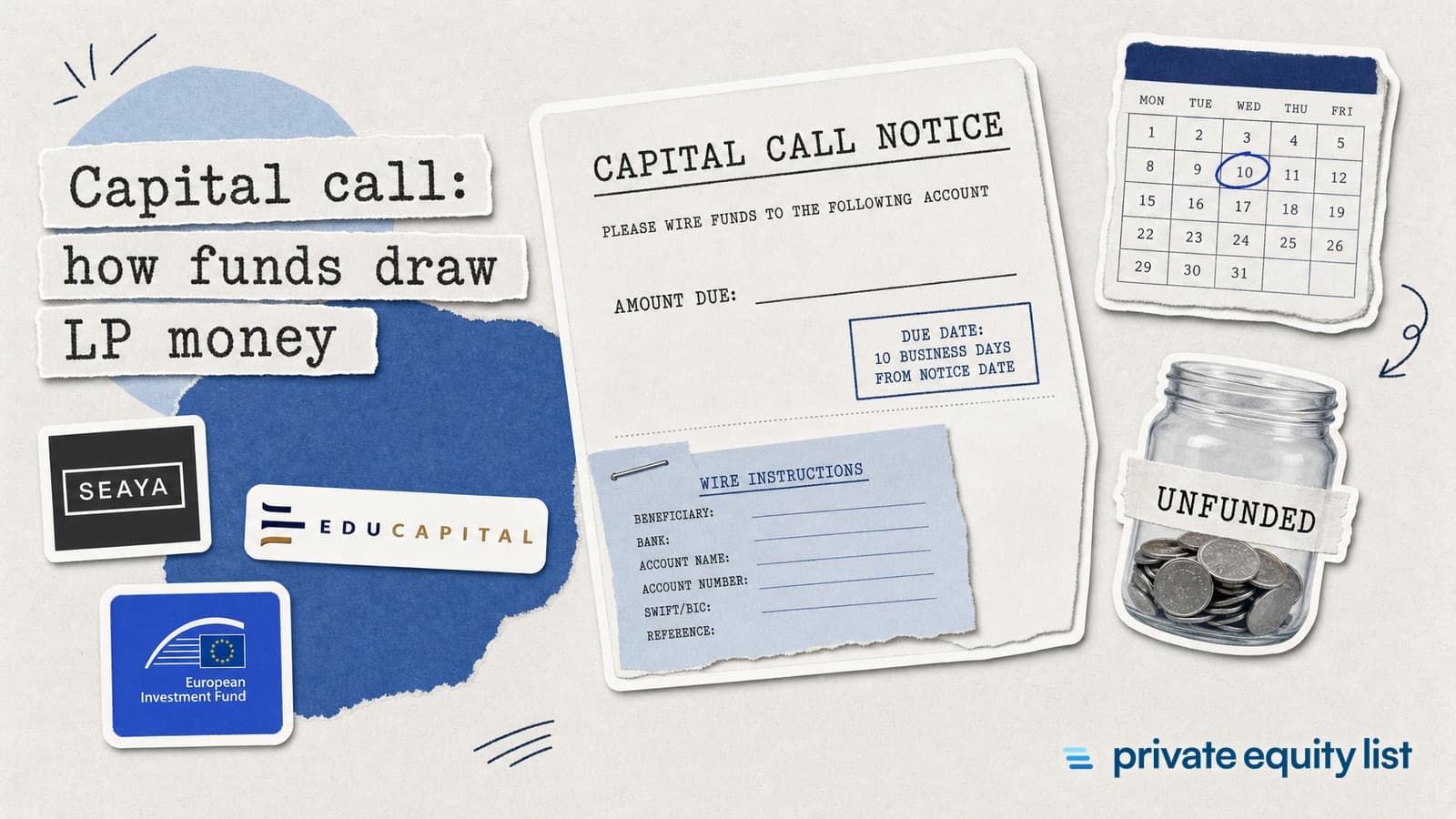
- Notice: the limited partnership agreement sets the deadline. For many venture and private equity funds it is 10 business days.
- Pace: US venture funds from the 2022 vintage had put only 43% of their capital to work after two years, against 60% for 2020 funds.
- Legally binding: a commitment is a contract. An investor who misses a call can be charged interest, lose distributions or have its stake sold at a discount, for example 50%.
- Capital call lines: funds borrow against unfunded commitments to close deals fast. KBRA puts these facilities at about $850 billion worldwide.
What is a capital call
Capital call: a written notice from the general partner (GP) asking limited partners (LPs) to wire part of their commitment by a set date.
Drawdown: the same thing. Fund documents often call the notice a "drawdown notice".
Committed vs called: an LP signs up for a total amount, the commitment. The part already sent is paid-in capital; the rest is the unfunded commitment, or dry powder at fund level.
Why funds work this way: hardly any fund asks for the full amount on day one. Many hold a "dry closing" with nothing paid in, then call money as each deal or fee comes due. Cash that sits idle in the fund drags down returns.
How a capital call works
1. The fund needs money: a new investment, a follow-on round, the management fee or fund expenses.
2. The GP sends the notice: the amount, the share of each LP's unfunded commitment, the due date and wire details.
3. Every LP pays its share: calls are pro rata, so each investor sends the same percentage of its commitment.
4. The money arrives: within the notice period, often 10 business days. AngelList cites 10 to 20 days as common.
5. The cycle repeats: most calls come in the investment period, the fund's first years. Later calls cover follow-ons and fees.
Illustrative example, not data: an LP commits $1 million to a $100 million fund.
| Call | Purpose | Fund calls | This LP pays | LP's unfunded commitment after |
|---|---|---|---|---|
| Year 1 | First two investments and fees | $20M (20%) | $200,000 | $800,000 |
| Year 2 | Three new deals | $30M (30%) | $300,000 | $500,000 |
| Year 3 | New deals and a follow-on | $25M (25%) | $250,000 | $250,000 |
| Years 4–6 | Follow-ons and fees | $15M (15%) | $150,000 | $100,000 |
The last $100,000 may never be called. Funds often keep a reserve and end their life with part of the commitments unused.
How fast funds call capital
The pace depends on the market. Venture funds on Carta called money much faster in 2020 and 2021 than in the slower deal market that followed.
Year one: 2018 and 2019 funds deployed 23% of their capital in their first year, per Carta.
Year two: 2022 funds deployed just 15% in their second year, which left them at 43%.
Year three: 2021 funds went from 51% after 24 months to 63% after 36 months.
For an LP: slower calls mean keeping cash ready for longer.
What a capital call notice includes
Basic notice: the amount called, the percentage of the LP's unfunded commitment, the due date and the wire instructions. Smaller venture funds often send just this.
Institutional notice: larger private equity funds also state the purpose (the company, sector and country of the deal), the fee and expense breakdown, total fund commitments, and the LP's unfunded commitment before and after the call. Morgan Lewis publishes both versions.
Recallable distributions: some notices also show money already paid out to the LP that the fund can call back.
Is a capital call legally binding?
Yes. A commitment is a contract under the limited partnership agreement, and missing a call puts the LP in default. Many agreements give a short cure period first. After that, the GP can use one or more remedies.
| Remedy | What happens to the defaulting LP |
|---|---|
| Default interest | Pays interest at a penalty rate on the unpaid amount until it pays |
| Withheld distributions | The fund keeps its payouts and uses them against what it owes |
| Forced sale | Its stake is sold to other investors at a discount, for example 50% |
| Capital account cut | Its capital account is reduced, for example by 50–100% |
| Forfeiture | Loses its capital account and future profits, shared among the other LPs |
| Loss of rights | No vote and no seat on the advisory committee; side letter rights can lapse |
| Overcall | The GP calls the shortfall from the other LPs, within limits |
Remedies as listed by Mayer Brown and Dillon Eustace; the exact terms are in each fund's agreement. An LP that can no longer meet calls often sells its stake on the private equity secondaries market instead, and the buyer takes over the unfunded commitment.
Capital call lines (subscription lines)
What they are: short-term bank loans to the fund, secured by the LPs' unfunded commitments. Also called subscription facilities or sub lines.
Why funds use them: the GP can close a deal the same day, then call LPs and repay the loan. Calls come less often and in bigger, rounder amounts.
The effect on returns: the LPs' money goes in later, which can lift the fund's IRR; the interest is a fund cost.
Market size: about $850 billion worldwide, per KBRA. Banks have offered them since the 1990s.
Commitments announced in 2026
Each of these commitments will reach the fund as a series of capital calls over the coming years.
| Fund | Investor (LP) | Commitment | Source |
|---|---|---|---|
 Seaya Nova, growth fund, €600M first close |  European Investment Fund | €300M anchor | October 2026 |
 Monolith Management RMB AI fund, $745M | Zhihu | $223.5M | September 2026 |
 Nordic Foodtech VC Fund II, €80M target | European Investment Fund | Up to €30M | September 2026 |
 Educapital III, edtech venture fund | European Investment Fund | €20M | September 2026 |
For more funds that closed this year, see new venture capital funds and our LP database guide on who commits to funds.
Related terms
Committed capital, dry powder and carried interest sit next to capital call in our VC definition and private equity glossary.
How private equity and venture funds differ in fees, fund life and call pace: private equity vs venture capital.
Data and methodology
Deployment pace: Carta's analysis of US venture funds on its platform, published for Q2 2024; the two-year figures for 2018–2020 add up Carta's year-one and year-two rates.
Notice periods, notice contents and default remedies: Morgan Lewis, AngelList, Mayer Brown and Dillon Eustace, linked in the text. Terms differ fund by fund.
Commitments: fund announcements from 2026 in the Private Equity List fund tracker, checked against the linked articles, as of November 2026; fund managers link to their Private Equity List profiles.

 Updated weekly
 Investors