Key takeaways
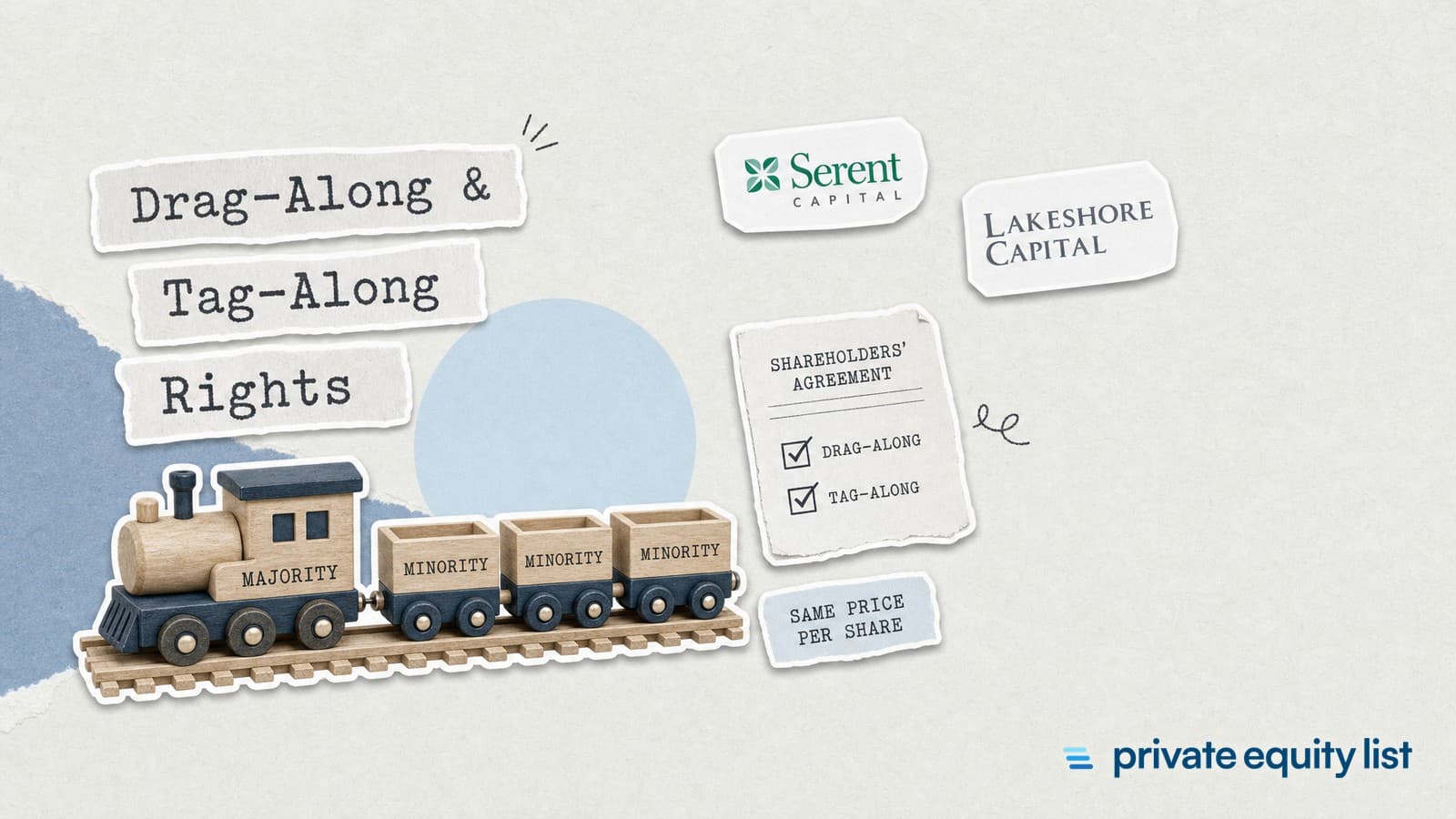
- Drag-along: lets the holders of an agreed majority force every other shareholder to sell on the same terms when they accept an offer for the company. The buyer gets 100% and no small holder can block the deal.
- Tag-along: works the other way. When a majority holder sells, minority holders may join the sale and sell their shares at the same price and terms.
- Where they sit: in a shareholders' agreement or the articles; in US venture deals, drag-along goes in the NVCA Voting Agreement and tag-along in the Right of First Refusal and Co-Sale Agreement.
- Trigger: in 2025, 22.9% of venture rounds in Osler's deal study needed more than one group of preferred holders to trigger the drag, up from 9.5% in 2024.
- Without a contract: UK law lets a bidder with 90% of the shares buy out the rest (Companies Act 2006, s.979), and lets the remaining 10% demand to be bought (s.983).
What are drag-along rights
Drag-along rights: a clause that lets shareholders above an agreed threshold (often a majority of the preferred, plus the board) make every other holder sell when they approve a sale of the company.
Also called: drag rights, a drag-along clause or drag-along provision.
What the dragged holders must do: vote for the deal, sell their shares on the same price and terms, sign the closing papers and not seek appraisal.
Why buyers want it: most acquirers want 100% of a company. One founder or angel with 2% can otherwise hold up a sale.
Why investors want it: a lead investor can deliver a clean exit without chasing dozens of small holders.
What are tag-along rights
Tag-along rights: a clause that lets minority holders join a sale when a majority holder (or a founder) sells shares to a third party.
Also called: co-sale rights or piggyback rights.
How much they can sell: usually a pro-rata share. If the founder sells 30% of their stake, a tagging investor may sell 30% of theirs.
Why minority holders want it: when control changes hands, they can sell at the buyer's price instead of staying on under a new owner they did not choose.
In venture deals: the co-sale right covers founder sales. If a founder sells in a secondary, investors may sell alongside on the same terms.
Drag-along vs tag-along
| Drag-along | Tag-along | |
|---|---|---|
| Who uses it | Majority holders, lead investors, the buyer | Minority holders, smaller investors, sometimes founders |
| What it does | Forces others to sell | Lets others join a sale |
| Trigger | An approved sale of the company | A sale of shares by the majority or a founder |
| Who it protects | The seller and the buyer | The minority |
| Main risk | Minority dragged into a price it does not like | Buyer may walk if it must buy more shares |
Both in one deal: a shareholders' agreement usually carries both clauses, and each one ties the price to what the majority gets per share.
Drag-along and tag-along clauses in a term sheet
Illustrative example, not data. Wording close to the one used in US venture term sheets:
| Clause | Sample wording |
|---|---|
| Drag-along | Holders of a majority of the Series A Preferred, the Board and holders of a majority of the Common Stock may require all stockholders to vote for, and sell their shares in, an approved Sale of the Company, on the same terms per share. |
| Tag-along (co-sale) | Before a Founder transfers shares to a third party, each Major Investor may sell a pro-rata portion of its shares in the transfer, on the same price and terms. |
| Carve-outs | Dragged holders give only representations about their own shares, are liable severally and not jointly, and are liable for no more than the proceeds they receive. |
The full list of terms around these clauses is in our term sheet template, items 19 and 20.
Drag-along thresholds and minority protections
Who triggers it: a set share of the preferred, a set share of the common and the board, in some mix. In Osler's 2025 study, 77.1% of rounds used one preferred threshold.
Why it is changing: new investors in 2025, many in AI rounds priced well above earlier ones, asked for their own series to approve the drag. Multiple thresholds rose from 9.5% to 22.9% of rounds.
Founders' ask: require common stock (the founders) to approve as well, so investors alone cannot force a low sale.
| 9.5% | +141.1% on 202422.9% |
| 2024 | 2025 |
|---|
Source: Osler, 2025 Deal Points Report: Venture Capital Financings
Same price and form: each holder of a class gets the same price per share and the same type of consideration, cash or stock.
Liquidation order: the sale proceeds still follow the liquidation preferences in the charter.
Capped liability: indemnity limited to each holder's share and capped at the proceeds it receives.
No new burdens: no non-compete or non-solicit for dragged holders who do not work at the company.
Appraisal waiver: in Manti Holdings v. Authentix (2021), the Delaware Supreme Court held, 4–1, that sophisticated holders who signed a drag-along with a 50% trigger had validly waived their right to appraisal.
Drag-along and tag-along under UK law
Squeeze-out (statutory drag): after a takeover offer, a bidder with at least 90% in value and voting rights of the shares in the offer may buy out the rest on the same terms, under s.979 of the Companies Act 2006.
Sell-out (statutory tag): once the bidder holds 90%, the remaining holders may require it to buy their shares, under s.983.
Why contracts still matter: a contractual drag usually kicks in far below 90%, often at 50% to 75%, so private companies put their own clause in the articles.
Who negotiates tag-along rights: minority investors with new funds in 2026
Tag-along rights matter most to investors who take minority stakes. These firms closed or launched funds in 2026 that make minority investments, according to the announcements linked:
| Investor | HQ | New fund | Size | Announced |
|---|---|---|---|---|
 Ampersand Capital PartnersMajority and minority investments in healthcare and life sciences companies with $10–200 million in revenue. | Boston | AMP-26 | $1.5B | 1 June 2026 |
 Serent CapitalMajority and minority investments in founder-led software and tech-enabled services companies. | San Francisco | Serent Capital VI | $1.3B | 9 July 2026 |
 Lakeshore CapitalControlling and minority investments in companies set for regional expansion or consolidation. | Bangkok | Lakeshore Capital Partners Fund III | $305M | 24 September 2026 |
 LionLight Capital$25–200 million of equity per platform, through minority or majority investments. | Chapel Hill | LionLight Capital Fund I | $215M | 16 July 2026 |
 SEVA GrowthMinority growth equity stakes in profitable or near-breakeven, founder-led software and tech-enabled services companies. | Brooklyn | SEVA II | $160M | 8 October 2026 |
 BlackPeak CapitalMinority and majority stakes in growing businesses in Southeast Europe. | Sofia | Southeast Europe Growth Equity Fund II (first close) | €125M | 9 November 2026 |
SEVA II: closed at $160 million against a $125 million target.
BlackPeak: the €125 million is a first close, not the final size.
For more firms that take minority stakes, see the private equity firms directory and new venture capital funds.
Related terms
Right of first refusal, liquidation preference, pro rata rights and term sheet sit next to drag-along rights in our private equity glossary.
When a buyer takes control: management buyout, earn-out and the LOI template.
Data and methodology
Drag-along thresholds: Osler's 2025 Deal Points Report on venture capital financings, linked in the text.
Law and cases: UK Companies Act 2006 ss.979 and 983 on legislation.gov.uk; Manti Holdings v. Authentix via Mintz. Sample clauses are illustrative, not legal advice.
Investors: firms with new minority-investing funds from the Private Equity List fund tracker, checked against the linked announcements, as of November 2026; firms link to their Private Equity List profiles.

 Updated weekly
 Investors