Key takeaways
- Meaning: an earn-out is the part of a company's sale price that the buyer pays after closing, and only if the business hits agreed targets such as revenue or EBITDA. It bridges a gap between what the seller asks and what the buyer will pay today.
- How common: 24% of private-target deals closed in 2025 had an earn-out, outside life sciences. In biotech and pharma it was more than 75%.
- How big: the typical earn-out was worth 34% of the closing payment in 2025.
- How much gets paid: across all deals, sellers collect about 21 cents per potential earn-out dollar.
- Disputes: Delaware's courts awarded Auris Health's former shareholders over $1 billion after Johnson & Johnson missed its earn-out milestones.
What is an earn-out
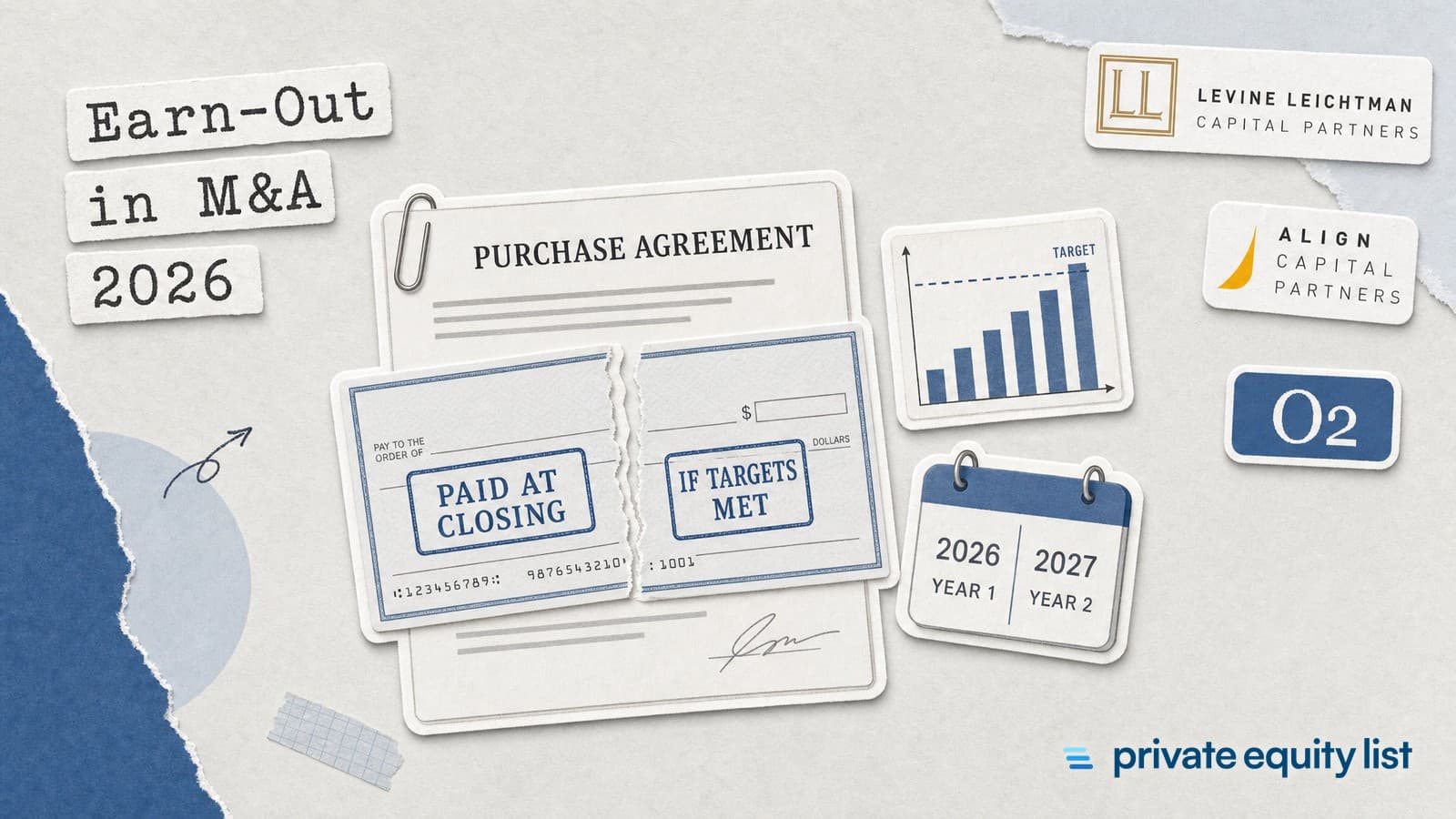
Earn-out: a clause in the purchase agreement that defers part of the price. The seller gets it later, and only if the business reaches set goals after the sale.
Also called: earnout, contingent consideration. In life sciences the payments are "milestones", tied to trial results or drug approvals.
Why buyers offer it: the seller prices in growth the buyer does not trust yet. The earn-out pays for that growth only if it shows up.
Why sellers accept it: a higher headline price, with the risk that the extra money never arrives.
How an earn-out works
1. The deal splits the price: cash at closing, plus an earn-out that pays if targets are met.
2. The parties pick a metric: revenue, gross profit, EBITDA, customer numbers or a product milestone such as FDA approval.
3. They set the period: one to three years for most deals. In 2025, 38% of earn-outs ran 1–2 years, 23% a year or less and 20% for 2–3 years, per Fasken's summary of SRS Acquiom data.
4. The buyer runs the business and reports: at the end of each period it sends a statement of the result.
5. The seller is paid or disputes: payment follows the formula; a disagreement usually goes to an accountant or to court.
Illustrative example, not data: a buyer pays $20 million for a software firm with $10 million in revenue, plus up to $6 million more.
| Revenue in year 2 | Target hit | Earn-out paid | Total price |
|---|---|---|---|
| Under $12M | No | $0 | $20M |
| $12M–14M | Partly | $3M | $23M |
| $14M or more | Yes | $6M | $26M |
The earn-out here is 30% of the closing payment, close to the 2025 median of 34%. A tiered structure like this pays something for partial success; an all-or-nothing target pays zero one dollar short of the line.
How often earn-outs are used and how much they pay
Earn-outs rise when buyers and sellers disagree on value. They jumped in 2023, after the 2022 repricing, and stayed above the long-run norm since.
| 19% | 33% | 22% | +9.1% on 202424% |
| 2014 | 2023 | 2024 | 2025 |
|---|
Source: SRS Acquiom, 2026 M&A Deal Terms Study and earn-out trends summary
Prevalence: SRS Acquiom counts an earn-out in 24% of 2025 deals, up from 19% in 2014.
Payout when it pays: sellers who get anything typically collect about 50 cents on the dollar, per DealLawyers' summary.
By deal size: deals with $50 million or less paid upfront saw a median of 43 cents; larger deals, 67 cents.
Overall: counting earn-outs that pay nothing, the rate is about one dollar in five.
Earn-out vs holdback, escrow and seller note
All four defer part of the price, but only the earn-out depends on how the business performs.
| Structure | What it does | Paid if | Seller's main risk |
|---|---|---|---|
| Earn-out | Pays extra price for future results | Targets are met | Targets missed, or the buyer runs the business differently |
| Escrow | Third party holds part of the price for indemnity claims | No valid claims by the end date | Claims for breached representations |
| Holdback | Buyer keeps part of the price for claims or adjustments | No claims; buyer releases it | Buyer credit and set-off |
| Seller note | Seller lends part of the price to the buyer | On a fixed schedule with interest | Buyer default, subordination to bank debt |
Escrow size: the median escrow in 2025 deals was 10% of deal value; how it sits next to the earn-out in an offer is in our LOI template.
Earn-out disputes and how to avoid them
Fortis v. Johnson & Johnson: J&J bought Auris Health for $3.4 billion in 2019, plus up to $2.35 billion in milestones. None was met. The Court of Chancery found breach of the "commercially reasonable efforts" clause and fraud, and awarded over $1 billion. The Delaware Supreme Court largely affirmed in January 2026.
Define the metric: say which accounting rules apply and what costs the buyer can load on the business.
Set the buyer's duties: "commercially reasonable efforts", a business plan, or covenants to keep the unit separate.
Use tiers: partial payouts for partial results cut the incentive to fight over one number.
Add acceleration: the full earn-out becomes due if the buyer sells the business or breaches its duties.
Name a referee: an independent accountant for calculation disputes, before anyone files suit.
Who uses earn-outs
Lower middle-market deals: deals with $50 million or less paid upfront are more likely to carry an earn-out, and a larger one relative to price, per SRS Acquiom.
Private equity and tech buyers: historically less likely to use earn-outs, though both rose in 2025.
Life sciences: milestones in more than three in four biotech and pharma deals.
These lower middle-market buyout funds closed in 2026. They buy companies in the deal size where earn-outs are most common:
| Buyer | HQ | New fund | Size | Announced |
|---|---|---|---|---|
 Levine Leichtman Capital Partners | Los Angeles | LLCP Lower Middle Market IV | $2B | 26 July 2026 |
 Align Capital Partners | Dallas | Align Capital Partners Fund IV | $770M | 18 June 2026 |
 O2 Investment Partners | Bloomfield Hills | Fund V | $670M | 4 March 2026 |
 Iron Path Capital | Nashville | Iron Path Capital Fund II | $450M | 6 October 2026 |
 Rising Point Capital Management | Chicago | Fund I | $325M | 30 September 2026 |
For more buyers, see private equity buyers and the advisers who negotiate these terms in M&A advisors and boutique investment banks.
Related terms
Escrow, letter of intent, due diligence and EBITDA multiple sit next to earn-out in our private equity glossary.
Before the earn-out is agreed: the LOI template, the due diligence checklist and EBITDA multiples by industry for the price.
Data and methodology
Earn-out prevalence, size, length and payout: SRS Acquiom's 2026 M&A Deal Terms Study, M&A Earnouts & Claims Study and earn-out trends summary, based on private-target deals where it acted, via the summaries linked in the text.
Fortis v. Johnson & Johnson: Harvard Law School Forum on Corporate Governance and Arnold & Porter.
Buyers: buyout funds from the Private Equity List fund tracker, checked against the linked announcements, as of November 2026; firms link to their Private Equity List profiles.

 Updated weekly
 Investors