Key takeaways
- The short answer: dry powder in private equity is money that investors have committed to funds but that the funds have not yet invested. Bain puts global dry powder at $1.3 trillion in its 2026 report.
- Still high, slowly falling: S&P Global, using Preqin data, counted $2.18 trillion of private equity dry powder at 31 March 2025, down 5.2% from the record at the end of 2023.
- Spent faster than raised: buyout funds invested $904B in 2025 while buyout fundraising fell 16% to $395B, per Bain.
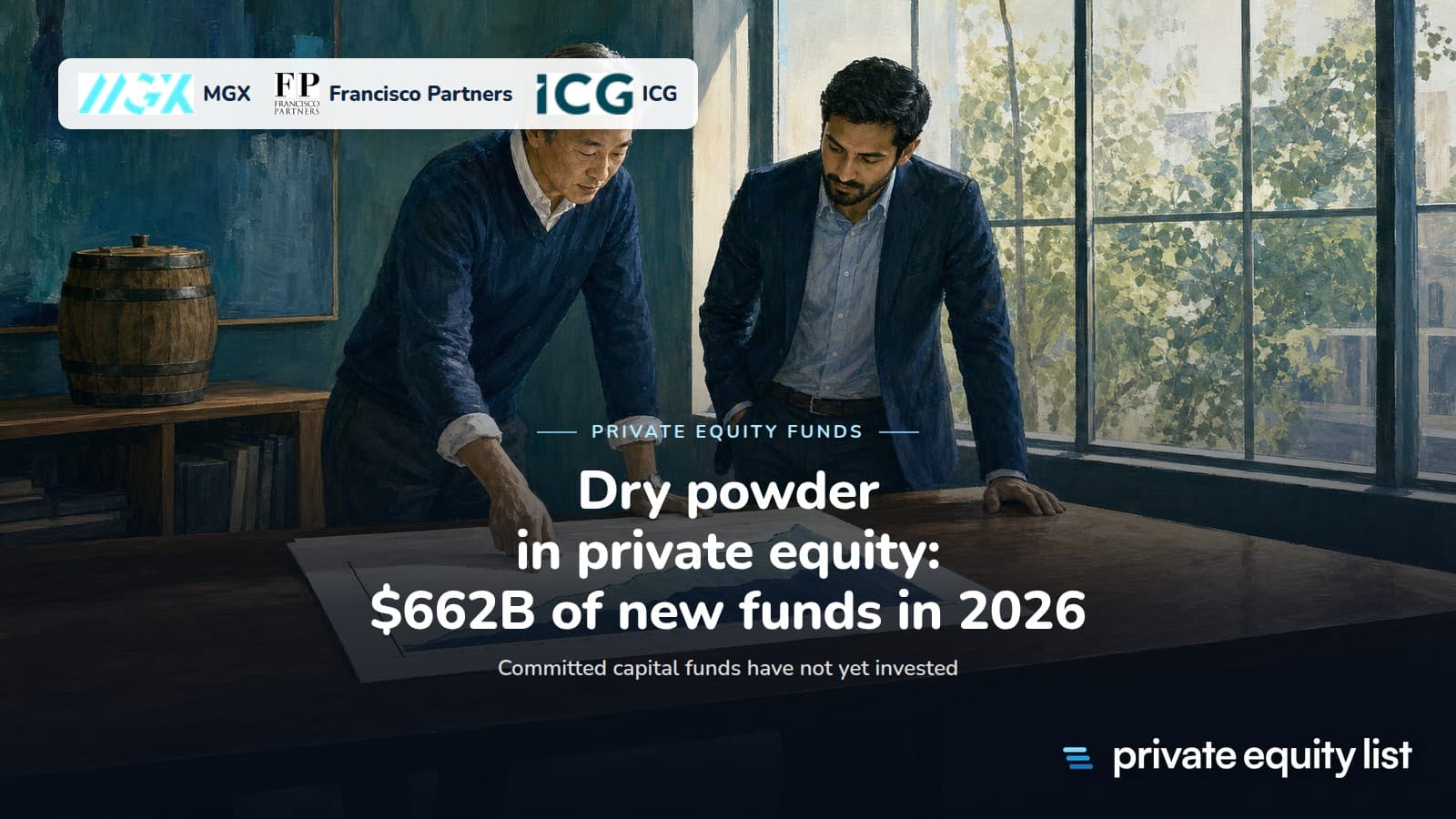
- New money in 2026: Private Equity List tracked 744 new PE, VC and debt funds from January to 27 November 2026; the 688 with a size announced add up to about $662B.
- Concentrated: 31 funds of $5B or more hold 53% of that money. MGX's $49B Fund I alone is 7%.
- Where it sits: managers based in the United States announced $398B, 60% of the total, as of November 2026.
What is dry powder in private equity?
Definition: dry powder is committed capital that a fund has not yet called from its investors or put into deals.
Where the name comes from: soldiers kept gunpowder dry so it would fire when needed. In finance, dry powder means cash held back for the right moment.
How it is counted: committed capital minus capital already called for investments and fees. A fund with $1B committed and $350M called has $650M of dry powder.
Who holds it: the limited partners (pension funds, endowments, family offices, sovereign funds) keep the cash until the general partner sends a capital call. Until then it sits on their balance sheets.
How long it lasts: a closed-end fund can make new investments only during the investment period set in its limited partnership agreement. Uncalled money after that is mostly kept for follow-ons and fees.
Other meanings: in the stock market and in corporate finance, dry powder means cash and liquid assets an investor or company keeps to buy when prices fall.
Worked example (illustrative example, not data):
- Fund size: a buyout fund closes at $500M of commitments.
- Year 2: it has called $150M for two deals and $20M for fees. Dry powder is $330M.
- Year 4: after four more deals it has called $380M in total. Dry powder is $120M, kept for add-ons.
- Fees: at 2% of committed capital, the fund charges $10M a year whether the money is invested or not.
How much dry powder is there in 2026?
Estimates differ because providers count different strategies and dates. Bain's $1.3 trillion and S&P Global's $2.18 trillion both describe money committed to private equity and not yet invested.
Bain, 2026 report: global dry powder "sits at a towering $1.3 trillion", most of it from 2022–23 fund vintages (Bain).
S&P Global and Preqin: $2.184 trillion of private equity dry powder at 31 March 2025, against a record $2.305 trillion at the end of 2023 (S&P Global).
Why it is falling: deals and exits came back in 2025 while fundraising stayed weak, so funds spent more than they raised.
Why it is still large: the total is above $1 trillion on every measure, and much of it was raised in the record years of 2021–2023.
Deals: buyout investment rose 44% to $904B in 2025, with an average disclosed deal size of a record $1.2B (Bain).
Exits: buyout-backed exit value rose 47% to $717B.
Fundraising: buyout funds raised $395B, down 16%, and the number of buyout funds closed fell 23%.
Distributions: cash returned to LPs held at 14% of NAV, below 15% for the fourth year running. LPs that get less cash back commit less to new funds.
Why dry powder builds up
Dry powder grows when funds raise money faster than they can find deals at prices they like.
Fundraising peaks: funds raised in the boom of 2021–2022 brought record commitments. Those commitments became dry powder the day each fund closed.
Slow deal years: higher interest rates in 2022–2024 made leveraged buyouts more expensive, and sellers and buyers disagreed on price.
Slow deployment: US venture funds of the 2022 vintage had invested only 43% of their capital after two years, against 60% for 2020 funds (Carta).
Ageing: money that sits for four years or more puts pressure on the GP. The investment period runs out, and LPs ask why they pay fees on money that is not working.
Longer holds: almost 40% of companies in buyout portfolios have now been held for more than five years, up from 29% in 2019, and holding periods at exit hover around seven years (Bain).
| 2018 | 50% |
|---|---|
| 2019 | 52% |
| 2020 | 60% |
| 2021 | 51% |
| 2022 | 43% |
Source: Carta, VC fund deployment, Q2 2024
Dry powder vs AUM, committed capital and NAV
Dry powder is one slice of a fund's numbers. The table shows how it fits with the others.
| Term | What it measures | In the $500M example, year 2 |
|---|---|---|
| Committed capital | Everything LPs promised to the fund | $500M |
| Called (paid-in) capital | Money already drawn for deals and fees | $170M |
| Dry powder | Committed capital not yet called | $330M |
| NAV (net asset value) | Current value of the investments the fund holds | Depends on valuations, for example $165M |
| AUM (assets under management) | Usually NAV plus dry powder, across all of a manager's funds | About $495M for this fund |
NAV vs dry powder: NAV is money already invested and dry powder is money still to invest. AUM usually adds the two.
Fees: many funds charge the management fee on committed capital during the investment period, then on invested capital, so dry powder still earns the GP a fee (capital call guide).
Modelling it: a VC fund model shows how dry powder falls year by year as reserves and new deals are called.
New funds adding to dry powder in 2026
A new fund adds to dry powder the day it closes and stays in the total until it invests. Private Equity List's new-funds tracker counted 744 new private equity, venture capital and debt funds from January to 27 November 2026. The 688 that announced a size add up to about $662B, as of November 2026.
Busiest month: July brought $140B, led by MGX's $49B Fund I and Francisco Partners' $21B.
Second half: July to October added $404B, about twice the five months before them.
November so far: $53B by 27 November, led by TPG's $10.4B and Igneo Infrastructure Partners' €6B.
Weekly and monthly lists: every fund is in the weekly new funds newsletter and the October 2026 new funds report.
| $36.5B | $48.2B | $49.7B | $62.5B | $140.4B | $61.3B | $104.0B | $98.6B | −45.8% on Oct$53.4B |
| Mar | Apr | May | Jun | Jul | Aug | Sep | Oct | Nov |
|---|
Source: Private Equity List new-funds tracker, November 2026 to the 27th
Where the new money is based
The United States dominates. Luxembourg and the United Arab Emirates rank high because of a few very large funds.
 United States | |
|---|---|
 United Kingdom | |
 Luxembourg | |
 United Arab Emirates | |
 Sweden | |
 India | |
 Spain |
Source: Private Equity List new-funds tracker, November 2026
United States: 314 funds and $398B, 60% of the money.
United Kingdom: 59 funds and $59B, led by ICG Europe Fund IX at €12B and CVC Secondary Partners' $10B.
Luxembourg: 6 funds and $49B, mostly CVC's Fund X target of €26B and the European Investment Fund's €15B ETCI 2.
United Arab Emirates: one fund, MGX's $49B Fund I.
India: 52 funds but only $9.5B, so the typical Indian fund is small.
The biggest funds of 2026
Ten funds that closed or raised money hold $175B, 27% of the total. Most are buyout, growth and infrastructure funds from large managers.
 MGX Fund I | |
|---|---|
 Advent GPE XI | |
 Francisco Partners | |
| Clearlake Capital Partners VIII | |
 ICG Europe Fund IX | |
 Bain Capital Asia Fund VI | |
 TPG Rise Climate II | |
 Sequoia growth funds | |
 CVC Secondary Opportunities VI | |
 West Street Capital Partners IX |
Source: Private Equity List new-funds tracker, November 2026
| Firm | Fund | Size | Announced | Source |
|---|---|---|---|---|
| MGXAbu Dhabi investor in AI, data centres and chips. | MGX Fund I | $49B | 2 July 2026 | Final close |
| Advent InternationalGlobal buyout firm; raised $30B across two funds. | GPE XI | $27B | 27 October 2026 | Raised |
| Francisco PartnersTechnology buyout firm. | Flagship and Agility funds | $21B | 24 July 2026 | Raised |
| Clearlake Capital Group | Clearlake Capital Partners VIII | $14.8B | 19 June 2026 | Final close |
| ICGLondon-based manager of private equity and credit. | ICG Europe Fund IX | €12B | 11 September 2026 | Final close |
| Bain CapitalBoston-based buyout and credit manager. | Asia Fund VI | $10.5B | 18 May 2026 | Raised |
| TPGClimate, energy transition and Global South vehicles. | TPG Rise Climate II and affiliated vehicles | $10.4B | 2 November 2026 | Raised |
| Sequoia CapitalVenture firm; the money goes to growth equity. | Growth equity funds | $10B | 10 August 2026 | Raised |
| CVC Secondary PartnersBuys LP stakes and GP-led secondaries. | Secondary Opportunities Fund VI | $10B | 4 September 2026 | Raised |
| Goldman Sachs AlternativesRaised $11.7B across three private equity funds. | West Street Capital Partners IX | $9.6B | 16 September 2026 | Raised |
 BlackstoneEnergy transition fund, closed at its hard cap. | Blackstone Energy Transition Partners V | $8.7B | 20 October 2026 | Hard cap |
 Energy Capital PartnersEnergy, power and infrastructure investor. | ECP VI | $8.1B | 7 August 2026 | Raised |
 Igneo Infrastructure PartnersMid-market infrastructure in Europe. | European Diversified Infrastructure Strategy | €6B | 6 November 2026 | Hard cap |
| ApolloHybrid capital between debt and equity. | Hybrid Value Fund III | $6.5B | 17 May 2026 | Raised |
 ClipwayMadrid-based secondaries manager; a record debut fund. | Clipway Secondary Fund I | $6.4B | 22 July 2026 | Final close |
 THL PartnersBoston buyout firm in financial services, healthcare and business services. | THL Equity Fund X | $6.35B | 5 May 2026 | Raised |
| BlackstoneLife sciences fund. | Blackstone Life Sciences VI | $6.3B | 31 March 2026 | Final close |
 ArctosSports, media and GP-stakes investor. | Arctos Keystone Partners Fund I | $6.2B | 9 July 2026 | Final close |
Still raising: CVC set an initial target of €26B for Europe / Americas Fund X, Disruptive launched a $10B flagship fund and Khosla Ventures is targeting $5.5B. Their money becomes dry powder as commitments close.
Secondaries: CVC Secondary Partners, Clipway and Pantheon, which raised $6B for secondaries, buy existing fund stakes, so their dry powder pays out LPs who want cash. More in private equity secondaries and continuation vehicles.
Sovereign money: MGX is based in Abu Dhabi; see largest sovereign wealth funds for the others.
Private equity vs venture capital dry powder
Private equity funds are fewer but much larger, so most new dry powder in 2026 sits with buyout, growth and infrastructure managers.
Private equity: dry powder is spent on control deals, usually with debt on top, so each dollar of equity buys more than a dollar of company.
Venture capital: funds hold back reserves for follow-on rounds in their own companies. That reserve stays dry powder for years after the first cheques.
Debt funds: direct lenders and private credit funds also report dry powder and lend it out as loans. See private credit funds and firms.
More on the difference: private equity vs venture capital and what a venture capital fund is.
Dry powder by fund size
| $3.3B | $33.2B | $83.3B | $188.6B | +87.4% on $1–5B$353.5B |
| Under $50M | $50–250M | $250M–1B | $1–5B | $5B+ |
|---|
Source: Private Equity List new-funds tracker, November 2026
Most funds are small: 400 of the 688 funds with a size are under $250M. Together they hold 5.5% of the money.
Most money is in megafunds: 31 funds of $5B or more hold $354B, 53% of the total.
Typical fund: the median new fund of 2026 is $180M.
For founders: the small funds are the ones writing seed and Series A cheques. Their dry powder matters more to you than a $20B buyout fund.
What dry powder means for founders and business owners
Competition for deals: large dry powder means many funds chase the same good companies. That supports prices for sellers of profitable businesses.
Pressure to deploy: funds near the end of their investment period have to invest or give the money back. They may move faster and accept terms they would have refused a year earlier.
Recently closed funds are the best targets: a fund that closed this year has its full dry powder and years of investment period ahead. Old funds may be saving their money for follow-ons.
Ask the question: in a first call, ask when the fund closed, how much of it is invested and how big its reserves are. The answer tells you whether it can lead your round.
For sellers: buyout firms with fresh funds are the likeliest bidders; see how to find a private equity buyer and the management buyout guide.
How to find funds with dry powder
- Start with new funds: the new VC funds tracker lists funds that closed in the last weeks, with size, stage and sector.
- Filter by type: private equity firms and venture capital firms can be filtered by country, cheque size and sector.
- Check the fund's date: in a firm's Private Equity List profile, the latest fund and its date show how much of the investment period is left.
- Read the monthly report: the September 2026 new funds report and the October one list every fund with its sectors.
- Find the people: partner emails and LinkedIn profiles are in the investor email list; the LPs behind the funds are in the LP database.
- Plan the raise: the how to find investors guide covers outreach; terms like committed capital and NAV are in the private equity glossary.
Data and methodology
Unique data: the fund and investor numbers are Private Equity List's own data, from its database of 8,000+ PE, VC and angel investors and its new-funds tracker. Figures from other sources are named and linked in the text.
New funds: funds announced from 1 January to 27 November 2026, checked against Private Equity List fund records, with duplicates and fund upsizes counted once. Sizes are as announced: final closes, first closes and targets. Euro amounts are converted at the rate in the tracker.
Headquarters and fund types: from each manager's Private Equity List profile; "private equity" includes buyout, growth, infrastructure, real estate and secondaries funds.
External figures: global dry powder, deal, exit and fundraising numbers come from Bain & Company and S&P Global (Preqin data); deployment by vintage from Carta. Each is linked where it appears.

 Updated weekly
 Investors