Key takeaways
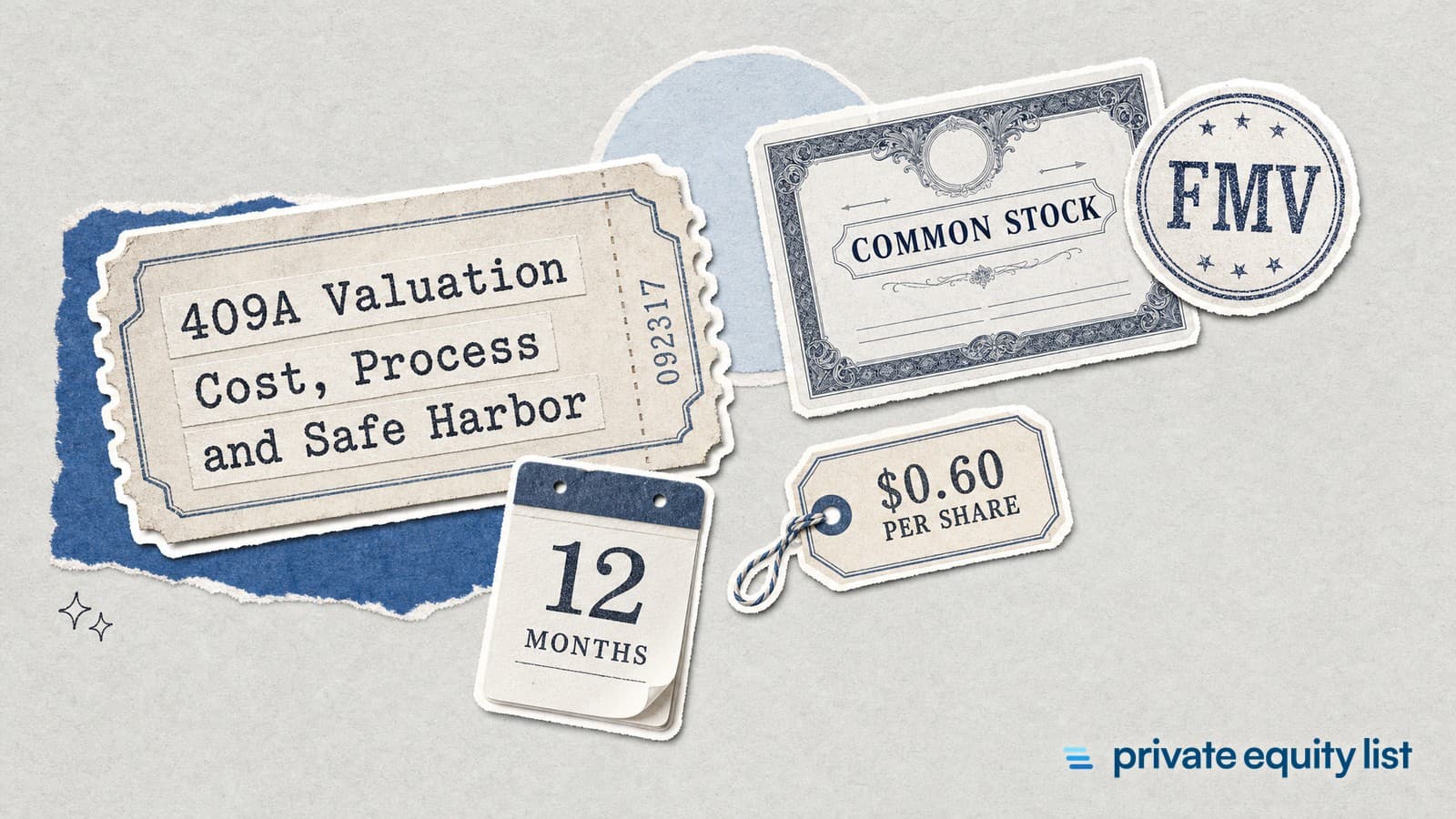
- The short answer: a 409A valuation is an independent appraisal of the fair market value of a private company's common stock. It sets the lowest strike price for employee stock options under US tax rules, lasts up to 12 months and usually costs $1,000–$10,000+.
- When: before the first option grant, then every 12 months and after any material event, such as a priced round or an acquisition offer.
- Safe harbor: an appraisal by a qualified, independent firm is presumed reasonable. The IRS then has to prove it was "grossly unreasonable" (Treas. Reg. §1.409A-1).
- Cost: Eqvista lists $990 for a pre-revenue company and $2,590 at Series A. Cake Equity charges $1,500 as an add-on. Carta and Cake bundle 409As into annual plans.
- Price gap: the 409A price of common stock is usually a fraction of the preferred price investors paid, often 10–25% at seed and 25–50% at Series A.
- Getting it wrong: options struck below fair market value cost the employee income tax on the spread, an extra 20% federal tax and interest, plus 5% more in California.
What is a 409A valuation?
Definition: a 409A valuation is an appraisal of the fair market value (FMV) of one share of a private company's common stock. It is named after Section 409A of the US Internal Revenue Code, which taxes deferred compensation.
Why it exists: a stock option struck below FMV counts as deferred compensation under 409A. A strike price at or above the 409A price keeps options outside the rule (Treas. Reg. §1.409A-1).
What it values: common stock only, the class founders and employees hold. Investors' preferred stock carries a liquidation preference and other rights, so it is worth more per share.
Who does it: usually a valuation firm or an equity platform such as Carta, which says it delivers more than 16,000 409A valuations a year.
What you get: a written report with the FMV per common share, the method used, the effective date and the inputs. The board adopts it and sets option strike prices at or above that number.
Who it is for: any company that grants options or other equity to US employees, advisers or contractors, wherever the company is incorporated.
When you need a 409A valuation
You need a current 409A valuation every time the board grants options.
Before the first grant: the first 409A comes before the first option grant, often right after incorporation or a first SAFE round.
Every 12 months: an independent appraisal keeps its safe harbor for 12 months from its effective date (Carta).
After a material event: a valuation stops being reasonable once it "fails to reflect information available after the date of the calculation" (Treas. Reg. §1.409A-1(b)(5)(iv)(B)(1)).
Before an exit: the start-up safe harbor does not apply if a sale is reasonably expected within 90 days, or an IPO within 180 days.
Not needed: companies that grant no options, and companies that only issue SAFEs or priced rounds to investors, do not need one for those deals. Restricted stock to founders at incorporation is usually bought at a nominal price instead.
Events that usually call for a new 409A:
- A priced round: a seed, Series A or later round resets the preferred price and almost always calls for a new 409A.
- A sale or a term sheet: an acquisition offer, a signed LOI or a term sheet you plan to accept.
- A secondary sale: founders or employees selling common stock to an investor set a market price for common.
- A big change in results: a large contract won or lost, a pivot, or revenue far above or below plan.
- A down round or bridge: a lower price or emergency money changes the outlook in the other direction.
409A safe harbor: three ways to qualify
Under the 409A safe harbor, the IRS presumes a valuation is reasonable. To challenge it, the IRS has to show that the method or the way it was applied was "grossly unreasonable" (Treas. Reg. §1.409A-1(b)(5)(iv)(B)(2)). There are three routes.
| Route | What it requires | Valid for | Who uses it |
|---|---|---|---|
| Independent appraisal | An appraisal that meets the standard of section 401(a)(28)(C), by an independent appraiser | 12 months, or until a material event | Almost every venture-backed startup |
| Illiquid start-up stock | A written report by a person with significant experience, generally at least 5 years in valuation, appraisal or investment banking | Until the facts change; not within 90 days of a sale or 180 days of an IPO | Companies under 10 years old with no traded shares; sometimes done in-house |
| Binding formula | A formula price used for all transfers to the company or to holders of over 10% of voting power | As long as the formula is applied consistently | Rare in startups; some private companies with buy-sell agreements |
In practice: most founders use the independent appraisal route. It costs more than an in-house report and puts the burden of proof on the IRS.
Factors the appraiser must weigh: tangible and intangible assets, the present value of future cash flows, market values of similar companies, and discounts for lack of marketability (Treas. Reg. §1.409A-1).
No safe harbor: a board can still set FMV by another reasonable method, but then the company has to prove it was reasonable if the IRS asks.
409A valuation cost in 2026
A 409A valuation costs from about $1,000 at pre-revenue to more than $10,000 for larger, later-stage companies (Carta). Price depends on stage, the number of share classes and how fast you need the report.
Pre-revenue and angel: Eqvista lists $990 a year pre-revenue and $1,290 after a friends-and-family or angel round (Eqvista).
Seed and Series A: Eqvista lists $1,990 at seed and $2,590 at Series A. Series B and later are quoted one by one.
Market estimate: Eqvista estimates other providers at $2,000 pre-revenue, $3,000 at seed and $5,000+ from Series B, as of September 2026.
Flat add-on: Cake Equity sells a 409A for $1,500 on any annual plan (Cake Equity pricing).
Larger valuation firms: $10,000–$25,000 for a full report from a traditional firm (Eqvista).
Rush fees: Eqvista charges $490+ for 1–5 business days. It estimates rush premiums elsewhere at $1,000–$3,000.
409A valuation providers compared
| Provider | How you pay for a 409A | Turnaround | Worth knowing |
|---|---|---|---|
 Carta | Included in Grow and Scale plans; Grow listed at $3,900 a year plus $130 per stakeholder after 30 (partner pricing, April 2023) | 1–3 weeks | No standalone 409A; current plan prices are quoted by sales |
 Cake Equity | 2 a year included in the Team plan ($2,750 a year); $1,500 each as an add-on | 3 business days | Add-on available on any annual plan |
 Eqvista | $990–$2,590 a year by stage; Series B+ by quote | Standard; expedite from $490 | Lowest published price by stage |
| Pulley | Included in the Growth plan ($3,500 a year) | Not published | Shutting down after 8 December 2026; customers move to Carta (BPM) |
| Independent valuation firms | $10,000–$25,000 per report | 2–4 weeks | Used for complex structures, later stages and pre-IPO work |
Cheapest way in: if you already pay for a cap table tool, check whether the plan includes 409As before buying one separately.
Pulley customers: the cut-off to opt into the arranged Carta migration is 30 November 2026, and data access ends on 31 January 2027 (BPM). Export your 409A reports now.
Audit and IPO: later-stage companies often move to a larger firm, since auditors and the SEC review 409A history before a listing.
How the 409A valuation process works
The 409A valuation process takes one to three weeks for most startups (Carta). Most of the time goes on collecting documents.
- Pick a provider: check that the appraiser is independent of the company and has the experience the safe harbor asks for.
- Send documents: the certificate of incorporation, cap table, the latest financing terms, financial statements, a forecast and a short description of the business.
- Answer a questionnaire: recent events, expected exits, secondary sales and comparable companies.
- The appraiser values the company: it chooses a method, values the whole company, splits that value across share classes and applies a discount for lack of marketability.
- Draft report: you check the facts, the cap table and the forecast. You can question inputs, not ask for a number.
- Board approval: the board adopts the final report and approves grants with strike prices at or above the 409A price.
- Diary the next one: 12 months from the effective date, or the next material event, whichever comes first.
409A valuation methods
An appraiser values the whole company first, then works out what one common share is worth.
| Method | How it works | When it is used |
|---|---|---|
| OPM backsolve (market approach) | Starts from the price investors just paid for preferred stock and solves for the total equity value that implies | The usual method after a priced round |
| Income approach (DCF) | Discounts forecast cash flows to today | Companies with steady revenue and a credible forecast |
| Market approach (comparables) | Applies revenue or EBITDA multiples of similar public companies or deals | Companies with revenue and clear peers |
| Asset approach | Adds up the value of assets less liabilities | Very early companies with no revenue or round |
| PWERM and hybrid | Weights the value under several exits (sale, IPO, staying private) by their probability | Later-stage companies with visible exit paths |
Option pricing model (OPM): treats each share class as a call option on the company's value, so preferred stock with a liquidation preference gets more of the value than common (Carta).
Discount for lack of marketability (DLOM): common stock in a private company cannot be sold easily. Carta puts the discount at 25–35% for a standard holding period.
Same inputs, other tools: the DCF and multiples inputs are the ones our business valuation calculator uses. Current multiples by sector are in EBITDA multiples by industry.
409A valuation vs preferred price
The 409A price of common stock is almost always below the price investors pay for preferred stock in the same company.
Why: preferred stock gets its money back first in a sale, may carry dividends and votes, and comes with protective provisions in the term sheet. Common stock gets what is left and cannot be sold.
Typical gap: common often sits at 10–25% of the preferred price at seed, 25–50% at Series A and 50–75% or more at later stages (Fundamentals). Another estimate puts early-stage common at 20–50% of preferred (Vquity).
The gap closes over time: as an IPO or sale gets closer, preferences matter less and common converges towards the preferred price.
Why founders care: a low 409A price means a low strike price. Employees pay less to exercise and keep more of the gain.
Why too low is risky: a 409A far below what the facts support can lose its safe harbor, and auditors will question it in an IPO.
Worked example (illustrative example, not data):
- Series A: investors pay $2.00 per preferred share.
- 409A after the round: the appraiser backsolves from $2.00, applies a 30% DLOM and lands at $0.60 per common share, 30% of the preferred price.
- Grant: a new engineer gets 40,000 options at a $0.60 strike. Exercising costs $24,000.
- Without a new 409A: if the board had kept last year's $0.30 price, the $12,000 spread would sit outside the safe harbor.
What happens if a 409A valuation is wrong
Most of the penalty falls on the employee who holds the options, so a missed 409A becomes a hiring problem as well as a tax one.
Income tax early: options struck below FMV become deferred compensation. The spread is taxed as income when the options vest, not when they are exercised (26 U.S.C. §409A).
Extra 20%: federal tax rises by 20% of the amount included in income.
Interest: interest runs at the IRS underpayment rate plus 1 percentage point, from the year the compensation was first deferred.
California: the state adds its own 5% (it was 20% before 2013) under Revenue and Taxation Code §17508.2.
Company exposure: the company may face withholding and reporting failures, and must fix grants before they vest.
In the example above: $12,000 of spread brings ordinary income tax, $2,400 of extra federal tax, interest, and $600 more in California (illustrative example, not data).
Fixes: grants can often be repriced to the right strike before they vest. Ask a tax lawyer before you do it.
409A in the UK: EMI valuations with HMRC
UK companies granting Enterprise Management Incentive (EMI) options use a different process with the same goal: an agreed price for share options.
Who agrees it: HMRC's Shares and Assets Valuation team, after the company applies with form VAL231.
How long it lasts: an agreed EMI valuation is valid for 90 days from the date of the agreement (GOV.UK). The COVID-era 120 days ended on 1 December 2022 (HMRC bulletin 44).
What changes: UK companies batch grants inside the 90-day window instead of granting all year on one valuation.
US employees of a UK company: they still need a 409A price for their options. Many UK startups with US staff run both.
How a 409A fits into your fundraise
Order of events: raise the round, close it, then order a new 409A before the next option grants.
Model the dilution: a bigger option pool at the round shifts ownership; test it in the equity dilution calculator and the cap table template.
SAFEs and notes: a SAFE note or a convertible note sets a cap, not a share price. The 409A still values common on its own.
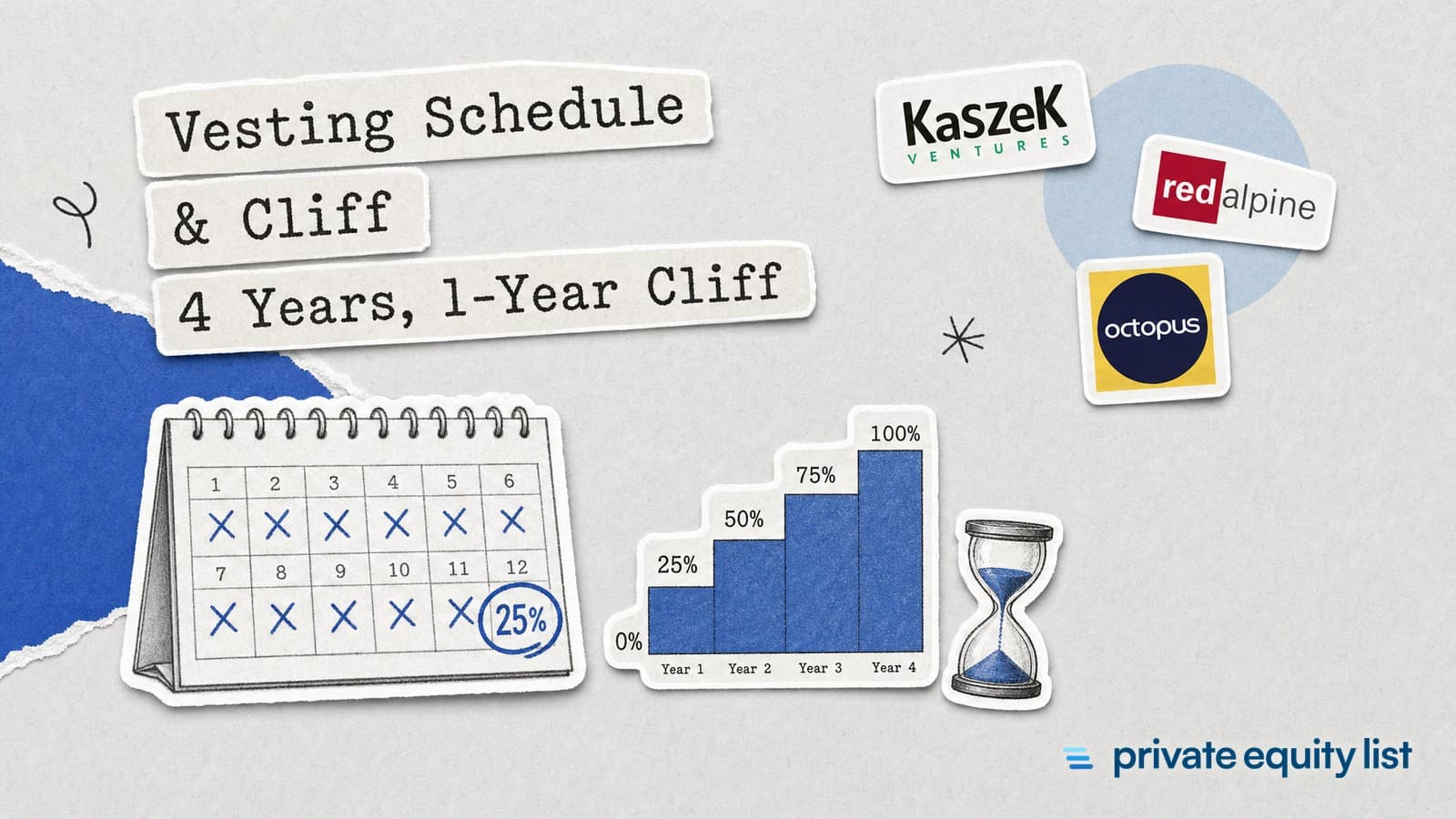
Equity for people: options sit on a vesting schedule; sweat equity for early hires and advisers is priced off the same 409A.
Round sizes by stage: see pre-seed vs seed funding and the full capital raise guide.
Find the investors: filter seed investors and Series A investors by country, sector and cheque size, and check the new VC funds tracker for firms that have just raised.
Look up a term: FMV, DLOM, liquidation preference and other terms are in the private equity and venture capital glossary.
Data and methodology
Rules: safe harbor routes, validity and penalties come from 26 U.S.C. §409A and Treasury Regulation §1.409A-1; the California rate from Revenue and Taxation Code §17508.2; UK rules from GOV.UK and HMRC, as of November 2026.
Prices: 409A prices come from the providers' own pricing pages (Eqvista, Cake Equity, Carta partner pricing) and Carta's guide, checked in November 2026. Plan prices change; confirm with the provider.
Ratios and methods: common-to-preferred ranges come from Fundamentals and Vquity; methods, turnaround and DLOM from Carta. Each figure is linked where it appears.
Examples: the worked example and penalty maths are illustrative and use round numbers.

 Updated weekly
 Investors