Key takeaways
- Vesting schedule: the timetable over which founders and employees earn the shares or options they were granted. Shares that have not vested go back to the company if the holder leaves.
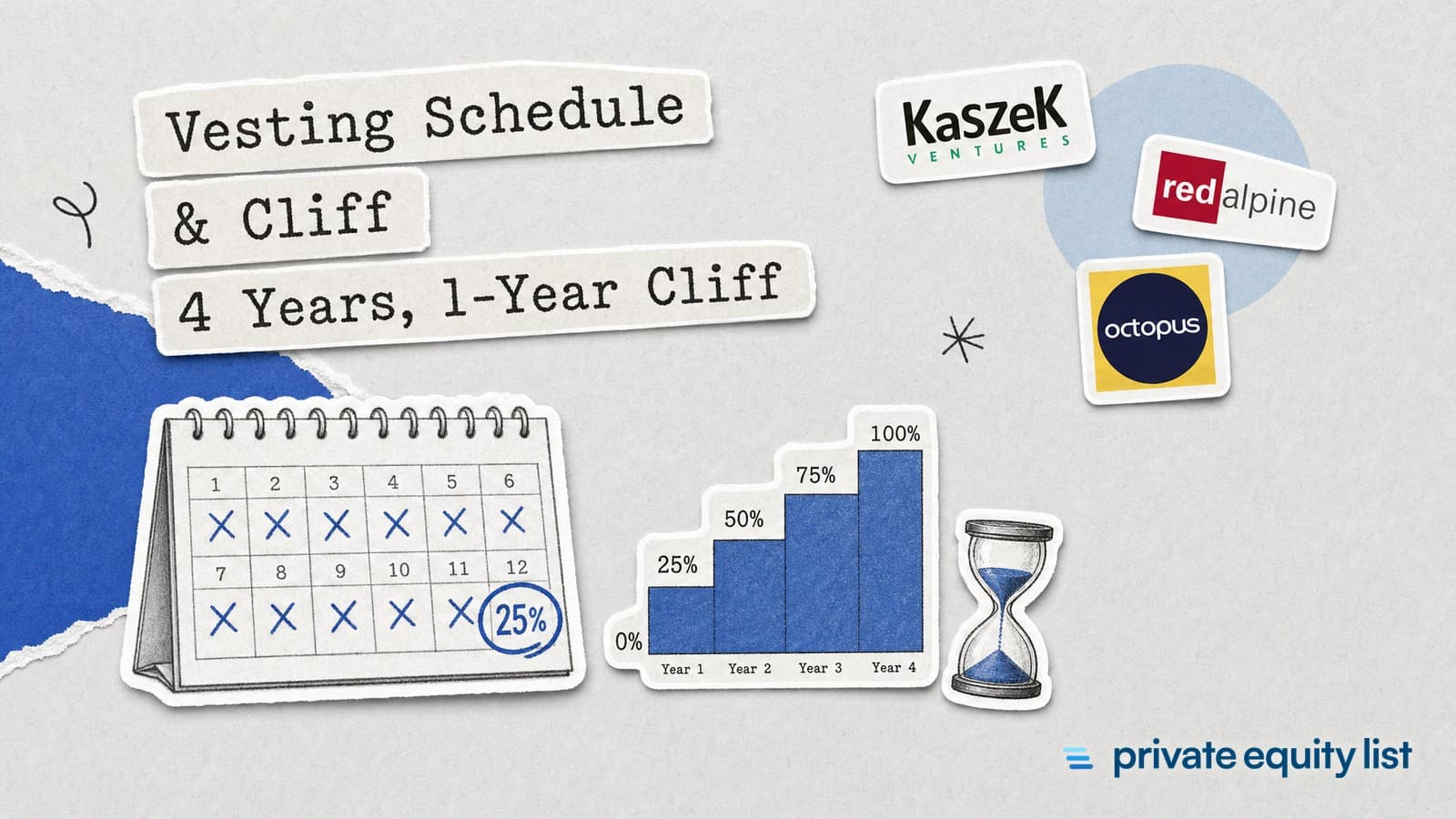
- The startup standard: four years with a one-year cliff. Nothing vests in year one, 25% vests on the first anniversary, then 1/48 of the grant vests each month (Carta).
- Cliff length: at least 95% of cliffs on Carta are set at one year. About 70% of employee grants carry a cliff, against about half of management grants.
- Why investors insist: 25–35% of two-founder teams formed in 2016–2021 had split up within five years (Carta, June 2026).
- Other meaning: in a US 401(k), employer contributions must vest within three years on a cliff or six years on a graded schedule (IRS).
What is a vesting schedule
Vesting schedule: the timeline that decides when a founder, employee or advisor fully owns the equity they were granted.
Vested vs unvested: vested shares (or options) are yours even if you leave. Unvested ones return to the company, usually to the option pool.
Time-based: almost all startup equity vests by time served. Milestone vesting is more common in private equity: about 61% of initial management grants at PE-backed LLCs are tied to a performance metric (Carta).
One grant, one clock: each grant has its own schedule. A second four-year grant made two years after the first vests two years later.
What is a vesting cliff
Vesting cliff: a waiting period before anything vests. At startups it is almost always one year.
What happens at the cliff: the whole first year vests at once. On a four-year grant, that is 25%.
Leave before the cliff: you get nothing from that grant, and the shares go back to the pool.
Why companies use it: a hire who leaves after four months does not stay on the cap table.
Cliff vs graded vesting: graded vesting adds equity in small steps, monthly or quarterly. Startup grants usually combine the two.
Example: four-year vesting with a one-year cliff
Illustrative example, not data. A first employee is granted 48,000 options on 1 January 2026.
| Date | Vests that day | Vested in total | Share of grant |
|---|---|---|---|
| Before 1 January 2027 | 0 | 0 | 0% |
| 1 January 2027 (cliff) | 12,000 | 12,000 | 25% |
| 1 February 2027 | 1,000 | 13,000 | 27% |
| 1 January 2028 | 1,000 | 24,000 | 50% |
| 1 January 2029 | 1,000 | 36,000 | 75% |
| 1 January 2030 | 1,000 | 48,000 | 100% |
| 0% | 0% | 25% | 37.5% | 50% | 75% | +33.3% on Month 36100% |
| Month 6 | Month 11 | Month 12 | Month 18 | Month 24 | Month 36 | Month 48 |
|---|
Source: Illustrative example, not data
Leave at month 18: you keep 18,000 options (37.5%).
Options still need exercising: vested options are a right to buy at the strike price. After you leave, the window to buy them is short at many companies, so check the grant.
Types of vesting schedules
| Type | How it works | Where you see it |
|---|---|---|
| Cliff + graded | Nothing for 12 months, then 25% at once and the rest monthly | Founders and employees at VC-backed startups |
| Graded | Equal steps from day one, for example 20% a year over five years | Some startups, many 401(k) plans |
| Cliff only | 0% until a date, then 100% | 401(k) plans, up to three years |
| Milestone | Vests when a goal is hit: a product launch, a revenue target, an exit | PE-backed management teams, some contractors |
| Hybrid | Needs both time served and a milestone | Executive grants |
| Immediate | Fully owned on the grant date | Rare for startup equity; 49% of Vanguard 401(k) plans |
Advisors: shorter schedules, often two years. The Founder Institute's FAST agreement uses two years with a three-month cliff.
Founder vesting: what investors ask for
Founder vesting: investors in a seed or Series A round usually ask founders to put their shares on a four-year schedule with a one-year cliff.
Credit for time served: founders who have built the company for a year or more ask for part of their shares, often 25%, to count as vested at closing. See item 21 of our term sheet template.
Reverse vesting: founders own their shares from day one, and the company can buy back the unvested part at cost if a founder leaves. In the UK this is the usual name for founder vesting.
83(b) election (US): a founder who receives restricted stock can elect to be taxed on its value at grant. The election must be filed within 30 days (IRS Form 15620).
Equity split first: the split between co-founders and how to value unpaid work are covered in sweat equity; track every grant on a cap table template.
Single-trigger vs double-trigger acceleration
Acceleration: a clause that vests unvested equity early when a set event happens, usually a sale of the company.
Single trigger: all or part of the unvested equity vests on the sale alone.
Double trigger: equity vests only after a sale and the holder being let go without cause. It is the more common form, because buyers want key people to stay after closing (Carta).
Founders' ask: 100% double-trigger acceleration is standard for founders, according to Fenwick & West; many VC firms treat 50% or one year as standard (Holloway Guide to Raising Venture Capital).
Vesting schedules in 401(k) plans
Your own contributions: always 100% vested from day one.
Employer contributions: may vest over time, within federal maximums. A cliff can last up to three years; a graded schedule must reach 100% by year six (IRS).
Full vesting is required: at the plan's normal retirement age and when the plan is terminated.
Does it keep people? Vanguard studied 4.7 million job separations in 1,500 plans from 2010 to 2022. Workers did not quit more often right after a vesting date, and vesting recovered only 2.5% of employer contributions for the average plan (ASPPA).
Seed investors with new funds in 2026
These firms closed or launched early-stage funds in October and November 2026, according to the announcements linked. They lead the seed and Series A rounds where founder vesting is negotiated.
| Investor | HQ | New fund | Size | Announced |
|---|---|---|---|---|
 Kaszek VenturesFirst cheques of $1–20 million into 20–30 Latin American companies, from pre-seed to Series B. | Buenos Aires | Kaszek Ventures VII | $650M | 24 November 2026 |
 RedalpineAround 20 European companies, mainly at seed and Series A. | Zurich | Redalpine Capital VIII | $250M | 10 November 2026 |
 Inovia CapitalEarly-stage fund for AI-native companies; first close towards a $325 million target. | Montreal | Fund VI (first close) | $200M | 20 October 2026 |
 ElevenPre-seed and seed cheques of €300,000–1.5 million across Europe; target €100 million. | Sofia | Fourth fund (first close) | €57M | 25 November 2026 |
 Proximal VenturesPre-seed and seed AI-native companies across the pharmaceutical value chain. | San Francisco | Fund I | $27.5M | 11 November 2026 |
 Octopus VenturesSecond dedicated pre-seed fund, aiming at more than 80 founders in the UK and Europe. | London | First Cheque II (first close) | £20M+ target | 6 November 2026 |
For more early-stage investors, see the seed investors directory, top seed and pre-seed investors and new venture capital funds.
Related terms
Option pool, cap table, dilution and term sheet sit next to vesting schedule and cliff vesting in our private equity glossary.
When you raise: SAFE note, dilution calculator and pre-seed vs seed funding.
Data and methodology
Vesting terms and cliffs: Carta's vesting guide and its June 2026 study of two-founder teams, linked in the text.
401(k) rules and data: IRS vesting rules; Vanguard's 2024 plan data and retention study as reported by ASPPA. The schedule table is illustrative, not legal or tax advice.
Investors: early-stage funds from the Private Equity List fund tracker, checked against the linked announcements, as of November 2026; firms link to their Private Equity List profiles.

 Updated weekly
 Investors