Key takeaways
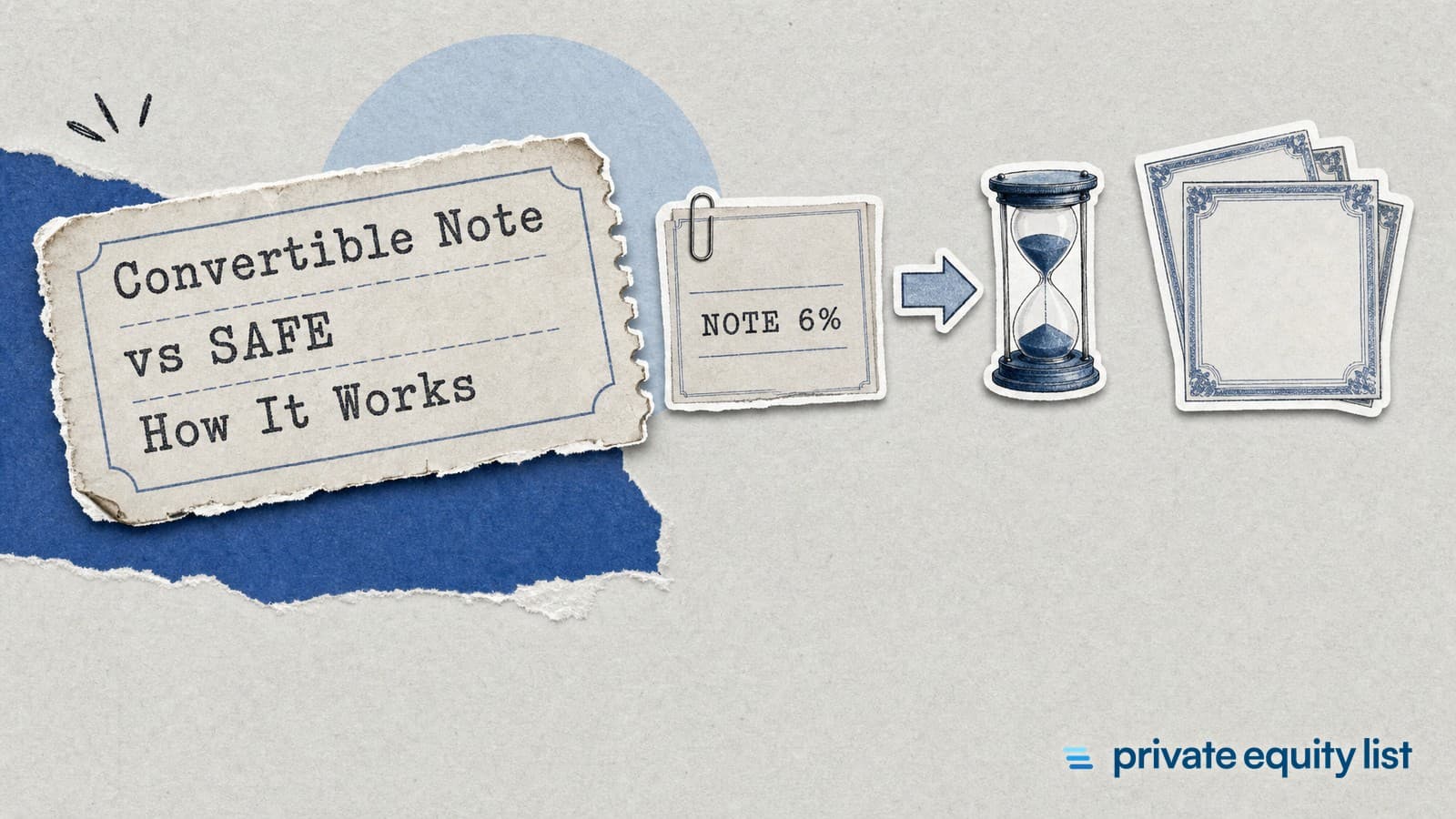
- The short answer: a convertible note is a short-term loan from an investor to a startup that turns into shares at the next priced round. Until then it accrues interest and has a maturity date. A valuation cap or a discount sets the conversion price.
- Interest: the median rate on US pre-seed convertible notes was 7% in Q1 2025, down from 8% in Q2 2024 (Carta). It is not paid in cash; it converts into extra shares.
- Usage: notes were 12% of US pre-seed rounds on Carta in Q2 2024 and a record low of 7% in Q1 2026. SAFEs took 93% of rounds in Q2 2026.
- Caps: most notes measure the cap pre-money; only 19% were post-money in Q2 2024, against 84% of SAFEs.
- Maturity: if no round comes before the deadline, the note can be repaid, extended or converted. Extension is the usual outcome.
- Convertible note vs SAFE: a note is debt with interest and a deadline; a SAFE is neither. Energy, biotech and medical device startups still use notes most.
| Q2 2024 | 12% |
|---|---|
| Q1 2025 | 10% |
| Q1 2026 | 7% |
| Q2 2026 | 7% |
Source: Carta, State of Pre-Seed reports, Q2 2024 to Q2 2026
| SAFEs | 93 | 93.0% |
|---|---|---|
| Convertible notes | 7 | 7.0% |
Source: Carta, State of Pre-Seed Q2 2026
What is a convertible note?
Definition: a convertible note is a loan an investor makes to a startup that converts into equity at a later qualifying event, usually a priced round (Carta).
Also called: convertible debt, a convertible promissory note or, in the UK, a convertible loan note (CLN). All describe the same instrument.
On the books: the company carries the note as a liability on its balance sheet until it converts or is repaid.
Two debt features: an interest rate and a maturity date, which a SAFE note does not have.
What the investor gets: no shares or votes until conversion. At the round, principal plus accrued interest turns into the same preferred shares the new investors buy, at a lower price.
Why founders use one: the price of the company is set later, at the priced round, when there is more traction to negotiate with.
How a convertible note works, step by step
- The loan: an investor lends, say, $500,000 under a note purchase agreement. No valuation is set.
- Interest accrues: a 6% simple rate adds $30,000 a year to the balance. Nothing is paid in cash.
- The trigger: the company closes a qualified financing, a priced round above a minimum size named in the note (Carta).
- The price: the note converts at the lower of the cap price and the discounted round price.
- The shares: principal plus interest, divided by that price, gives the noteholder's new shares.
- No round in time: at maturity, the sides repay, extend or convert on terms set in the note.
Other triggers: most notes also say what happens on a sale of the company before a round. The usual choice is repayment with a premium or conversion at the cap, whichever the holder prefers.
Who decides: in a startup note, conversion at a qualified financing is automatic. Public company convertibles work the other way: the holder usually chooses whether and when to convert (Investor.gov).
Convertible note terms: interest, maturity, cap and discount
Every note sets five numbers. The table shows what each does and what recent data says about it.
| Term | What it does | Typical value | Source |
|---|---|---|---|
| Interest rate | Accrues on the principal and converts with it, adding shares | Median 7% in Q1 2025; 8% at the Q2 2024 peak | Carta |
| Maturity date | The deadline to convert; after it, the holder can ask for repayment | Worked examples use 1 year (Carta) and 2 years (AngelList) | Carta, AngelList |
| Valuation cap | The highest valuation used for conversion, so it sets a minimum stake | Median $7M pre-money cap on note rounds under $250K, Q2 2025 | Carta |
| Discount | Converts below the price new investors pay | 20% in Carta's example; 30% in AngelList's | Carta, AngelList |
| Qualified financing | The minimum priced round that forces conversion | A dollar threshold set in the note | Carta |
Rates follow the market: note rates fell through 2025 as the Federal Reserve cut twice (Carta).
Caps are pre-money: a note's cap is usually measured before the new money, while a post-money SAFE's cap counts every SAFE. Only 19% of notes were post-money in Q2 2024 (Carta).
Caps run lower than on SAFEs: Carta found note caps lower than SAFE caps in 2025, and more volatile; they do not always rise with round size (Carta).
Cap and discount together: the holder gets whichever gives the lower price. A cap matters when the round prices high; a discount matters when it prices low.
Tax side effect: interest that converts adds to the amount turned into stock, which can affect qualified small business stock (QSBS) eligibility in the US (Carta).
Convertible note example: conversion with interest
Illustrative example, not data. Founders and the option pool hold 10,000,000 shares. An angel lends $500,000 on a note with 6% simple interest, a 20% discount and an $8M pre-money cap. Eighteen months later, a seed fund invests $3M at a $12M pre-money valuation.
| Step | Calculation | Result |
|---|---|---|
| Interest | $500,000 × 6% × 1.5 years | $45,000 |
| Amount converting | $500,000 + $45,000 | $545,000 |
| Round price | $12M ÷ 10,000,000 shares | $1.20 |
| Discount price | $1.20 × (1 − 20%) | $0.96 |
| Cap price | $8M ÷ 10,000,000 shares | $0.80, the lower, so it applies |
| Noteholder shares | $545,000 ÷ $0.80 | 681,250 |
| Seed fund shares | $3,000,000 ÷ $1.20 | 2,500,000 |
Ownership after the round: 13,181,250 shares in total. Founders and pool hold 75.9%, the seed fund 19.0% and the noteholder 5.2%.
What interest added: without it, the same $500,000 converts into 625,000 shares, or 4.8%. Eighteen months of interest is worth about 0.4 points of the company.
What the cap did: the angel paid $0.80 a share while the seed fund paid $1.20, a third less.
Post-money valuation: 13,181,250 × $1.20 = about $15.8M.
Convertible note calculator
The calculator below runs the same seed round. Enter principal plus accrued interest as the note amount, here $545,000, since the tool has no interest field. It counts the converted note inside the $12M pre-money and tops the option pool back up to 10% after the round, two common term-sheet conventions, so its percentages differ from the table above. Our equity dilution calculator guide explains option pool top-ups and later rounds.
Convertible note conversion calculator
Post-money valuation: pre-money + new money = $12M + $3M = $15M. Price per share: $12M ÷ 11,064,286 shares = $1.08.
New investors: 2,766,071 new shares, 20.0% of the company after the round.
Founders: they go from 90.0% to 65.1%, a dilution of 27.7%.
SAFEs and notes: they convert at the lower of the cap price (cap ÷ shares before the round) and the round price less the discount.
What happens when a convertible note matures
A note with no qualified round by its maturity date is, on paper, a loan that is due. In practice, few startups can repay it.
| Outcome | What happens | How often |
|---|---|---|
| Extend | Noteholders sign an amendment that moves the maturity date out | The most common outcome (AngelList) |
| Convert at maturity | The note converts at a valuation set in the note, often the cap, into common or preferred shares | Only if the note includes this option |
| Repay | The company pays principal plus interest: $100,000 at 8% for one year is $108,000 (Carta) | Rare; the cash is usually not there |
| Default | Holders can demand payment, which can push a weak company into a sale or shutdown | Rare; it rarely serves either side |
Why maturity matters anyway: the deadline gives noteholders leverage when the company asks for an extension. They can ask for a lower cap or a bigger discount in return.
Interest keeps running: an extended note keeps accruing, so two extra years at 7% add about 14% to the amount that converts.
Founder tip: set a maturity long enough to reach the next round with slack, and write in what happens at maturity, so it is not left to a negotiation under pressure.
Convertible note vs SAFE vs priced round
A SAFE, a note and a UK advance subscription agreement all delay the price. A priced round sets it now.
| Convertible note | SAFE | Priced equity round | UK ASA | |
|---|---|---|---|---|
| Legal form | Debt | Contract for future equity, not debt | Shares issued now | Prepaid share subscription |
| Interest | Yes, median 7% | None | None | None allowed for SEIS |
| Deadline | Maturity date | None | None | Longstop date, up to 6 months for SEIS |
| Valuation | Cap, discount or both; cap usually pre-money | Cap, discount or MFN; 91% post-money | Negotiated pre-money valuation | Discount, cap or a longstop valuation |
| Share of US pre-seed rounds | 7% (Q2 2026) | 93% (Q2 2026) | Standard from the seed or Series A | UK only |
Is a SAFE a type of convertible note? No. Y Combinator built the SAFE in 2013 as an alternative to notes, with no interest and no maturity (Y Combinator). Both convert at the next priced round; only the note is debt.
Money as well as count: SAFEs took 95% of pre-seed dollars in Q2 2026, notes about 5% (Carta). In Q1 2025 notes still took 18% of dollars on 10% of rounds, a sign of a few large note deals.
Under $4M: in 2025, most early rounds under $4M used SAFEs or notes rather than priced equity (Carta).
The full SAFE side: caps, post-money maths and accelerator terms are in our SAFE note guide.
When a convertible note still makes sense
The investor asks for one: some angels and corporate investors want a creditor's position and interest. A note keeps them in the round.
Capital-heavy sectors: energy, biotech and pharma, and medical devices use notes more than any other industries on Carta (Carta).
Bridge rounds: existing investors often fund a few months of runway between priced rounds on a note, because it can close in days. The interest and maturity suit a short loan.
Non-US companies: the SAFE is written for US company law. Outside the US, a local convertible loan is often the simpler document.
When to avoid it: if the next round is far away or uncertain, a maturity date becomes a cliff. A SAFE, or venture debt lenders for later-stage companies with revenue, may fit better.
Convertible loan notes in the UK
Same instrument, different name: UK founders call it a convertible loan note, or CLN. It carries interest, a maturity date and converts at the next round.
No SEIS or EIS relief: a CLN is not eligible for SEIS or EIS tax relief, so it does not suit UK angels who want the relief (SeedLegals).
The ASA instead: an advance subscription agreement takes money now for shares later, with no interest and no refund. HMRC expects its longstop date to be no more than 6 months after signing (HMRC VCM33025).
When a CLN still fits: investors who do not need SEIS or EIS, such as funds, corporates and overseas angels, can use a CLN. It is also common for bridge money ahead of a larger round.
Convertible note vs convertible bond
Startup note: private, small, converts at the next priced round at a cap or discount, and is held to maturity.
Convertible bond: issued by a listed company, often called convertible senior notes. It pays a coupon and converts into listed shares at a fixed conversion price.
Who converts: a startup note converts automatically at a qualified round. A bondholder chooses whether and when to convert (Investor.gov).
This guide: covers startup notes only; convertible bonds work under listed-market rules.
Pros and cons of a convertible note
| For founders | For investors | |
|---|---|---|
| Pros | Price set later; quick, cheap paperwork; can close one investor at a time | Creditor ranking before conversion; interest adds shares; cap protects the upside |
| Cons | Maturity deadline; interest adds dilution; stacked notes hide how much has been sold | No vote or board seat until conversion; repayment rarely happens in practice |
Hidden dilution: three $500,000 notes at a $5M pre-money cap convert into more than 23% of the company before the seed investors arrive (illustrative example, not data).
Creditor ranking: if the company fails before a round, noteholders rank ahead of shareholders for whatever is left.
Stacking caps: later notes often carry higher caps. Model each one in a cap table template before signing the next.
How to raise on a convertible note
- Decide note or SAFE: if the investor does not ask for debt, a post-money SAFE is the market default. Pick a note when the investor, sector or country calls for one.
- Set the terms: a rate near the 7% median, a maturity that covers your runway with room to spare, and a cap or a 20% discount.
- Define the trigger: name a qualified financing size you will realistically reach, and write down what happens at maturity and on a sale.
- Model conversion: run every note through the calculator above, with interest to your expected round date.
- Build the list: filter pre-seed investors, seed investors and angel investors by country, sector and cheque size; our guide on how to find investors covers outreach. The new VC funds tracker shows who has just raised money for first cheques.
- Plan the priced round: the note converts at your seed or Series A round; the term sheet template lists what that round will negotiate. Amounts by stage are in pre-seed vs seed funding and our capital raise guide.
- Check a term: valuation cap, pro rata and other round terms are defined in the private equity and venture capital glossary.
Data and methodology
Market figures: shares of SAFEs and convertible notes, interest rates and caps come from Carta's State of Pre-Seed reports, Q2 2024 to Q2 2026, which cover US startups on Carta's platform. Each figure is linked where it appears.
Terms and rules: standard terms come from Carta, AngelList and Y Combinator; UK rules come from HMRC's Venture Capital Schemes Manual and SeedLegals.
Examples: conversion, maturity and dilution examples are illustrative and use simple interest.

 Updated weekly
 Investors